Planning a trip to Japan in 2026? Knowing what things actually cost is the easiest way to avoid nasty surprises at the ATM. The good news: Japan fits almost any budget. You can backpack it on capsule hotels and convenience-store rice balls, or blow the bank on a luxury ryokan with private onsen — and everything in between. This guide breaks down the real numbers for accommodation, food, transport, sightseeing, and shopping, plus a few things first-timers always get tripped up by, like how much of Japan still runs on cash.
A quick note on dollars: figures below use roughly ¥150 to US$1. The yen moves around a lot, so treat the dollar amounts as ballpark and the yen as the number you’ll really pay.
How Much Does a Trip to Japan Cost?
According to the Japan Tourism Agency, the average foreign visitor spent about ¥227,000 (~$1,500) per person in 2024 — up from ¥212,193 in 2023 — over a trip of roughly 9 nights. Most of that money went to three things:
- Accommodation: ~¥77,000
- Shopping: ~¥66,000
- Food and drinks: ~¥49,000
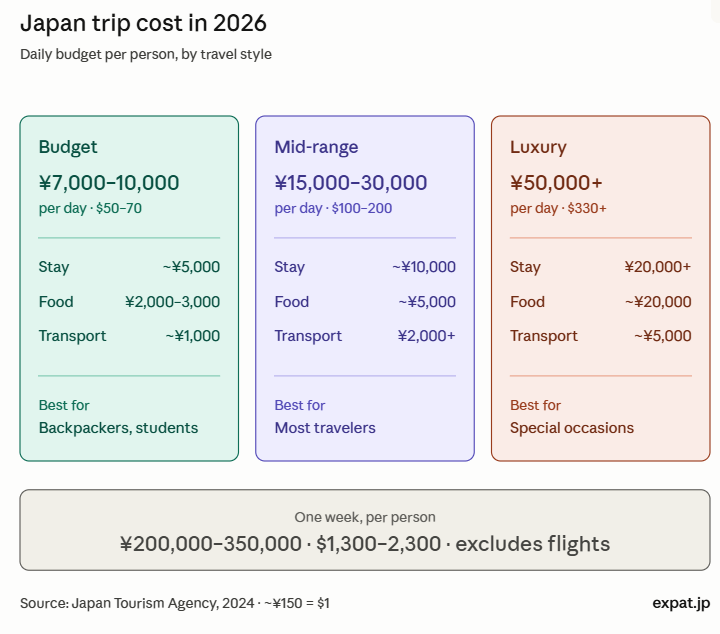
As a rule of thumb, set aside at least ¥20,000 (about $130) per person per day to cover the essentials. Here’s what that breaks down to:
- Accommodation: ¥5,000–¥50,000 ($35–$350) per night, depending on the type of lodging and the city.
- Food and drinks: ¥2,000–¥10,000 ($13–$65) per day for most people, far more if you’re chasing Michelin stars.
- Transportation: ¥1,000–¥10,000 ($7–$65) per day, depending on how far you roam.
- Shopping & sightseeing: from ¥2,000 ($13) up.
A typical one-week trip lands around ¥200,000–¥350,000 ($1,300–$2,300) per person, not counting flights. Want to see where the money goes day by day? Skip to the example one-week budget further down. First, let’s go category by category.
Accommodation Costs in Japan
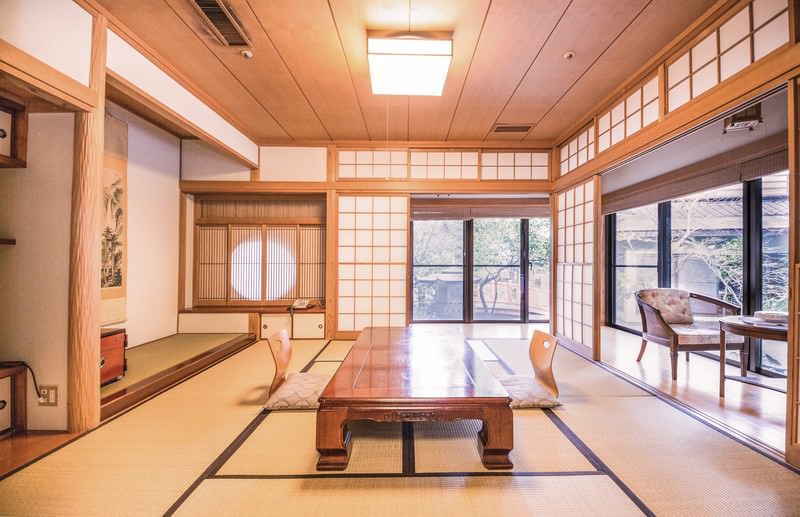
Japan has a place to sleep for every budget, and yes — the rumors are true. Even the cheap options are clean, safe, and weirdly thoughtful about the little details. Here’s what you can expect.
Booking tip: prices for the same room swing a lot between sites, so it pays to compare. I usually start on Agoda, which tends to have competitive rates on Japanese hotels and ryokans.
Hostels
Dorm beds run about ¥1,500–¥6,000 ($10–$40) per night. Hostels suit budget-minded and social travelers, with shared kitchens, lounges, and a built-in chance to meet people.
The one time I stayed in a hostel I booked a women-only room, and it turned out lovely. One of my roommates was an older woman who felt like a life mentor — calm, kind, the kind of presence that puts you at ease. Conversation just happens in a good hostel, and that’s the real draw if you’re traveling solo.
Capsule Hotels
Compact pod-style berths start at ¥3,000–¥6,000 ($20–$40) per night. They’re small but functional — usually a USB charger, a reading light, shared bathrooms and lounges, and a location right by a major station. Great for a short stay.
Honestly? One night was my limit. I’ve only ever done a single night in a capsule and couldn’t face a second. It wasn’t the size so much as the privacy: dozens of people separated from you by a single curtain. For me that was harder to settle into than an open dorm. Fun to try once, but know your tolerance before you book three nights.
Business Hotels
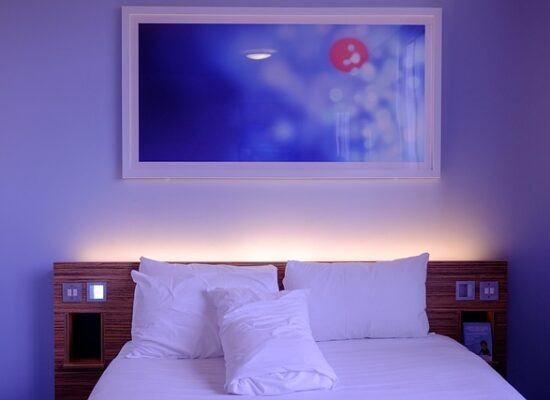
Small but functional private rooms, typically ¥5,000–¥15,000 ($35–$100) per night. Chains like APA Hotel and Toyoko Inn are reliable for clean rooms, free Wi-Fi, and good locations, and many throw in breakfast and coin laundry. For the price, they’re hard to beat — especially your first night off a long flight, when you’ll want a door that locks and a bed that’s yours.
Minshuku (Family Guesthouses)
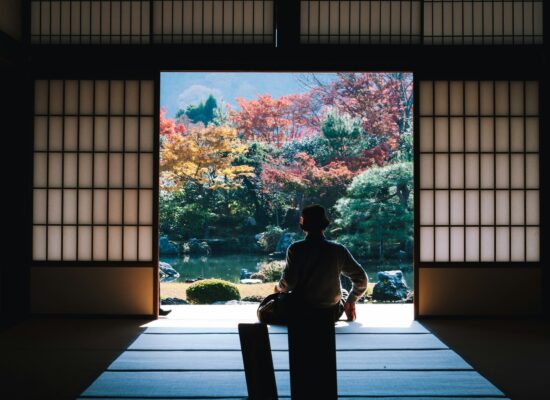
Expect ¥5,000–¥20,000 ($35–$135) per night, often with tatami rooms, futons, and home-cooked meals made from local ingredients. A minshuku is where you get the warm, lived-in side of Japan that no hotel can sell you.
My favorite stay anywhere in Japan was a minshuku on Miyakejima, a small island south of Tokyo. It felt like visiting my grandmother’s house. The bathroom and plumbing were nothing fancy, but everything was spotless, and there was this unfussy, back-in-time feeling — like being a kid again — that let me relax all the way down. If you want the real countryside, this is how you find it.
Luxury Hotels & Ryokans
Luxury stays start around ¥30,000 ($200) per night, and the top end — high-end ryokans or marquee city hotels — can run ¥200,000–¥300,000 ($1,300–$2,000) per night or more, depending on location, season, and room. A good ryokan is its own reason to travel: multi-course kaiseki dinners and a private onsen (hot spring) in the room.
Which Option Is Right for You?
- Budget travelers: Use hostels as your base, sprinkle in a capsule night for the novelty, and book a business hotel for your first night so you can crash in private after the flight. When you need quiet, swap back to a business hotel.
- Social travelers: Hostels make it easy to meet people. A countryside minshuku run by a chatty family can give you the kind of warmth a big-city hotel never will.
- Cultural enthusiasts: Minshuku give you everyday Japanese life; ryokans give you tradition with a bit of polish.
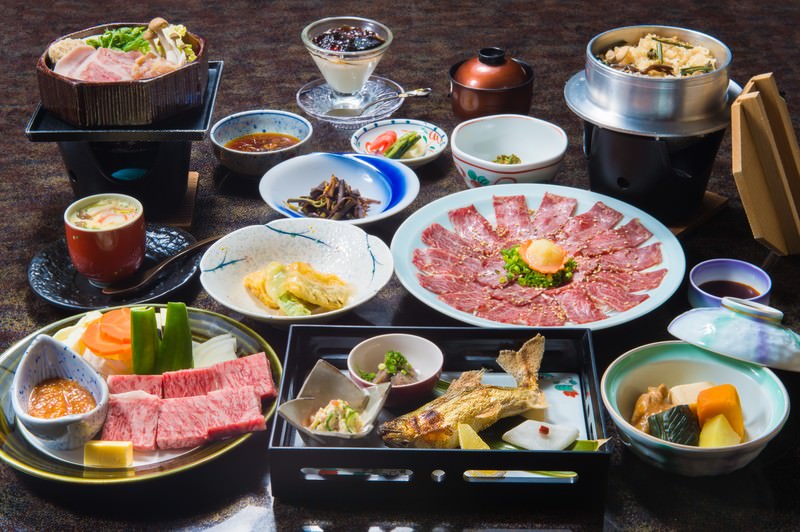
- Luxury seekers: Western-style luxury hotels are nice, but you can find those anywhere in the world. You came all the way to Japan — spend at least a couple of nights in a ryokan. Kaiseki dinner, a hot bath, and service that anticipates what you need before you do. It’s the one you’ll still be talking about a year later.
For more detailed recommendations, see:
- Best Hotels & Ryokans in Tokyo, Kyoto, and Osaka
- Japan on a Budget: Affordable Hotels in Tokyo, Kyoto, and Osaka
Food Costs in Japan
Food is the highlight of any trip to Japan, and you don’t need a big budget to eat well. The range runs from a ¥150 convenience-store rice ball to a months-in-advance Michelin reservation.
Fast Food & Convenience Stores
Chains like Yoshinoya and Sukiya, or burger spots like MOS Burger, serve a filling meal for ¥500–¥1,500 ($3–$10). Don’t sleep on convenience stores either — 7-Eleven, Lawson, and FamilyMart turn out onigiri, sandwiches, and hot snacks that are genuinely good and perfect when you’re on the move.
Take-Home Meals
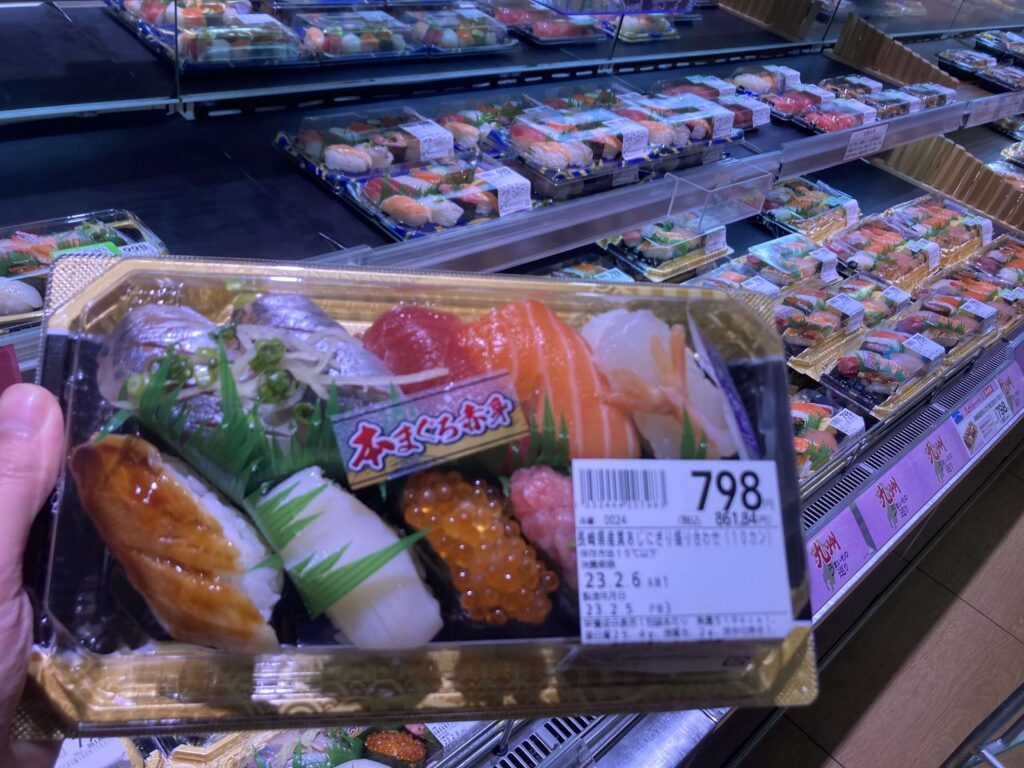
Supermarkets and department store food halls (the basement ones, known as depachika) sell ready-to-eat meals from ¥500–¥3,000 ($3–$20): bento boxes, sushi packs, fried foods. You’ll see office workers lining up for dinner on the way home. It’s the easy way to sample a lot of Japanese dishes without restaurant prices — and after about 8 p.m., a lot of it gets marked down. More on this in Food 101: Take-Home Meals in Japan.
Casual Dining
At izakayas, ramen shops, or family restaurants, plan on ¥1,500–¥4,000 ($10–$27) per meal. These are the everyday spots, and they’re everywhere — train stations, side streets, shopping arcades. Want to know where to go and what to order? See Food 101: Tips for Eating Out and Our Top Picks.
Fine Dining
High-end sushi counters and Michelin restaurants start around ¥10,000 ($65) per person and climb to ¥100,000 ($650) or more. These meals are as much about presentation, atmosphere, and pace as the food, and they can run several hours. Worth knowing: Tokyo has led the world in Michelin stars for 18 years running — the 2025 guide lists 170 starred restaurants in the city.
How Much Should You Budget for Food?
Most travelers spend around ¥10,000 ($65) per day on food — three proper meals plus a snack or two. Mix in a few convenience-store breakfasts and the average drops fast.
Ways to eat well for less:
- Grab a bento at a convenience store or station — and check the depachika after 8 p.m. for discounts.
- Order the set meal (teishoku) at small family restaurants; it’s usually the best value on the menu.
- Balance casual meals with one or two splurges so your budget — and your stomach — survives the week.
Transportation Costs in Japan
Japan’s transport is famously clean, safe, and punctual. What you pay depends on whether you’re hopping around a city or crossing the country.
Local Travel
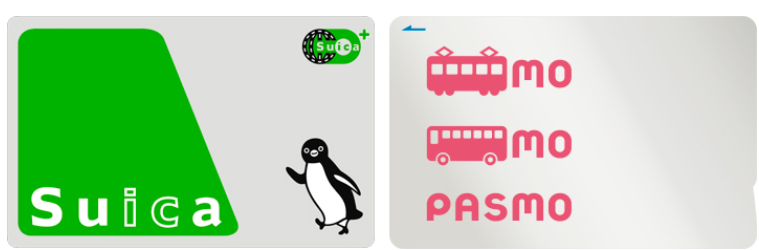
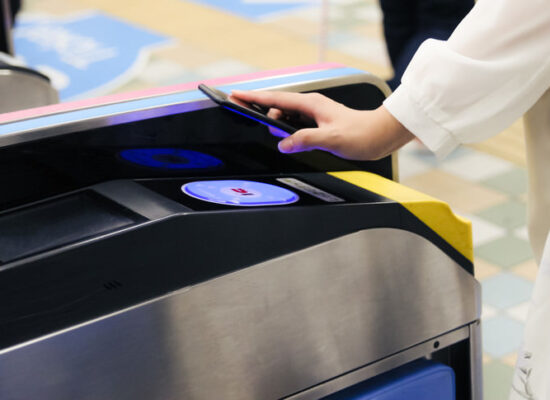
Metro and bus fares usually run ¥200–¥500 ($1.30–$3.30) per ride. Get a prepaid IC card like Suica or Pasmo — you tap and go, and the same card works at vending machines and convenience stores. You can also add Suica to an iPhone’s Apple Wallet and top it up from your phone.
Day Passes
If you’re bouncing between sights, day passes pay off fast. A Tokyo Metro 24-hour ticket is ¥700 ($5); broader passes covering Toei lines, JR, and buses run around ¥1,600 ($11). Worth it the moment you take more than a few rides in a day.
Taxis & Ride-Hailing
Starting fares are ¥500–¥700 ($3.30–$5); a 3 km ride is around ¥1,100 ($7), and 10 km can hit ¥3,500 ($23). Uber and GO exist, but they price about the same as a regular taxi. Cabs here are spotless and the drivers polite — your wallet just won’t thank you if you lean on them.
Long-Distance Travel
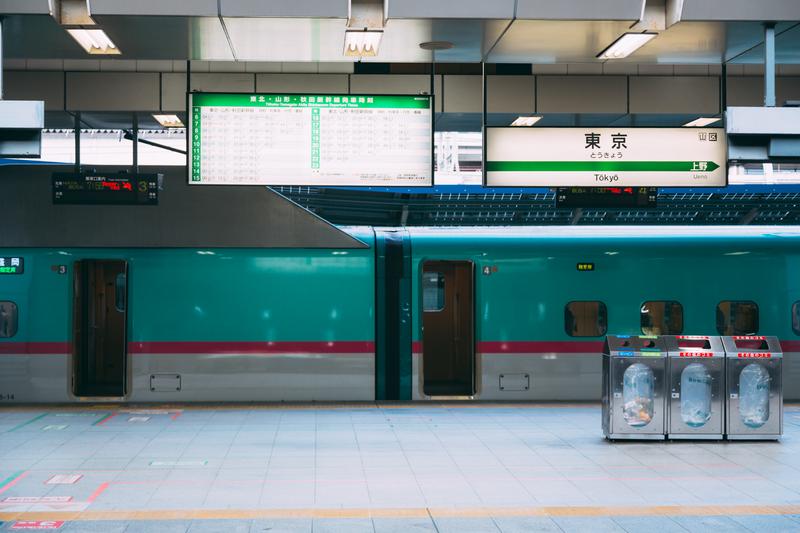
- Shinkansen (bullet trains): A one-way Tokyo–Kyoto ticket is about ¥14,000 ($93).
- Japan Rail Pass: The 7-day ordinary pass is ¥50,000 ($330). After the 2023 price hike it only pays off if you’re covering serious distance — roughly two or more long shinkansen legs — so do the math against individual tickets before you buy. If it works out for your route, you can buy the Japan Rail Pass online and pick it up after you arrive.
- Highway buses: ¥4,000–¥15,000 ($27–$100), and an overnight bus doubles as that night’s accommodation.
- Flights: Budget carriers often beat the train over long distances, like Tokyo–Okinawa or Tokyo–Sapporo.
- Car rentals: From ¥5,000 ($33) per day, though fuel and expressway tolls add up quickly. You’ll need an International Driving Permit.
Ways to Save on Transport
- Use IC cards or day passes for cheap, hassle-free city travel.
- For multi-city trips, check regional passes (JR East, JR West, etc.) — they’re often a better deal than the nationwide Rail Pass now.
- Night buses are the classic budget hack: cheap, and you skip a hotel.
- Forwarding your big suitcase between cities by takkyubin (courier, around ¥2,000) means you can travel light on packed trains.
Need more detail? How to Get Around in Japan Like a Local covers every option with practical tips.
Sightseeing & Activity Costs
From ancient temples to futuristic attractions, Japan has plenty to see. Some of it is free; some charges admission. Here’s the lay of the land.
Temples & Shrines
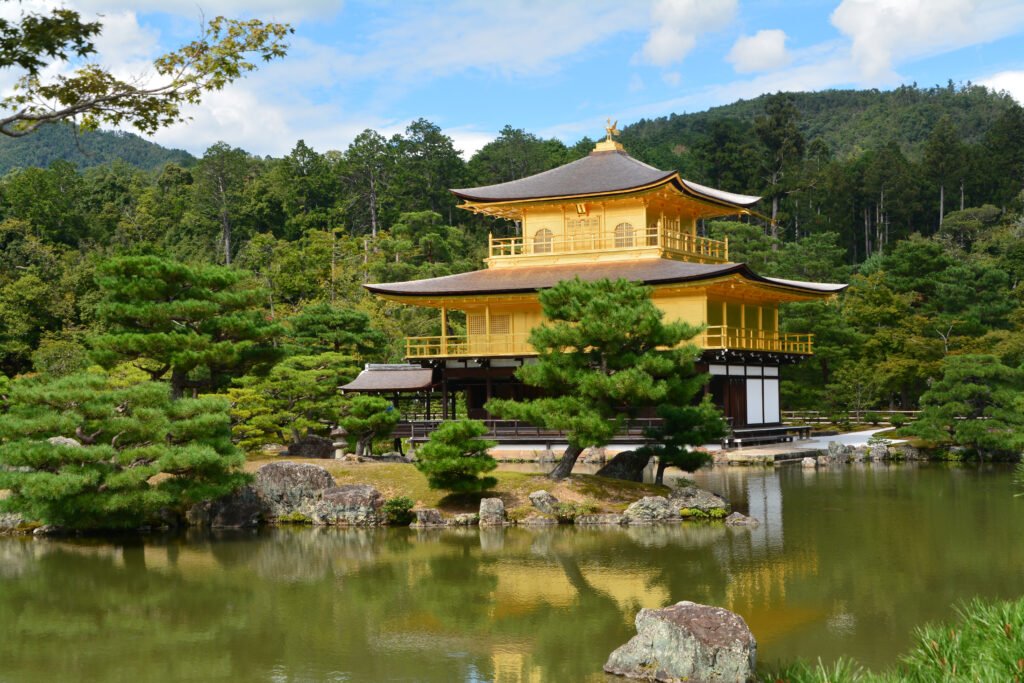
Many are free; popular ones sometimes charge ¥500–¥1,000 ($3–$7). Kyoto’s Kinkaku-ji (the Golden Pavilion), for example, is ¥500. A tip worth remembering: the shrines that stick with you are often the small ones you wander into by accident, not the famous ones packed shoulder-to-shoulder with tour groups. Leave room in the day to get a little lost.
Museums
Entry usually runs ¥500–¥2,500 ($3–$17), with special exhibitions costing more. Two I’d vouch for personally: the digital-art playground teamLab, and the National Museum of Nature and Science in Ueno — the science museum genuinely impressed me, and it’s easy to lose a whole afternoon in there. If you make it down to Tokushima, the full-scale replica galleries of the Ōtsuka Museum of Art are also famous for a reason.
Landmarks
From the free Shibuya Scramble Crossing to Tokyo Tower (¥1,500 Main Deck / ¥3,300 Top Deck Tour) and the Tokyo Skytree (¥2,100 Tembo Deck / around ¥3,500 for both decks), the city’s landmarks range from street-level chaos to sweeping skyline views.
Theme Parks
Tokyo Disneyland and Universal Studios Japan run about ¥8,000–¥11,000 ($55–$75) per person depending on the date (both use date-based pricing now), for a full day of rides, shows, and lines you’ll convince yourself were worth it.
Paying in Japan: Cash, IC Cards & Credit Cards
Here’s the thing that surprises almost every first-timer: for all its vending machines and bullet trains, Japan still runs on cash more than you’d expect. Cards are widely accepted in cities, hotels, department stores, and chain restaurants, but small ramen shops, older izakayas, family-run minshuku, some temples, and rural buses can still be cash-only.
My husband moved here from India, and years in, the cash habit is still the thing he finds most baffling about an otherwise high-tech country — the little counter restaurant with no card reader gets him every time. So a practical setup for a trip:
- Carry some cash. Keep ¥10,000–¥20,000 on you. 7-Eleven ATMs and Japan Post Bank ATMs reliably accept foreign cards.
- Load an IC card. Suica/Pasmo cover trains, buses, vending machines, and most convenience stores — your everyday small change, sorted.
- Bring a credit card for hotels, big purchases, and tax-free shopping. Visa and Mastercard have the widest acceptance.
Staying Connected: eSIM & Pocket Wi-Fi
You’ll want data the moment you land — for maps, train apps, translation, and IC-card top-ups. Two ways to do it, and both run roughly ¥2,000–¥5,000 ($13–$33) for a week:
- eSIM — the easiest option if your phone supports it. You install it before you fly and you’re online the second you switch on at the airport, no counters or pickups. I use Airalo, which has affordable Japan data plans you can set up in a few minutes.
- Pocket Wi-Fi — a small rental router that connects several devices at once, handy if you’re traveling as a group. You can rent a pocket Wi-Fi router with airport pickup, then drop it in a post box on your way out.
Tax-Free Shopping for Tourists
One genuine perk of visiting on a tourist visa: you can shop tax-free and skip Japan’s 10% consumption tax. Spend ¥5,000 or more in a single day at a participating store, show your passport at checkout, and you’ll either pay the pre-tax price or get the tax refunded on the spot.
A few things to know: the goods are technically meant to leave Japan with you, so don’t open consumables before you go; bring your physical passport (a photo won’t do); and look for the Japan Tax-Free Shop logo at electronics chains, department stores, and drugstores. On a shopping-heavy trip this adds up quickly. (Note: this applies to short-term visitors only — foreign residents with a residence card aren’t eligible.)
Daily Cost by Travel Style
Everyone’s budget looks different. Here’s roughly what one day costs depending on how you like to travel.
| Travel style | Accommodation | Food | Transport | Daily total |
|---|---|---|---|---|
| Budget | Hostel / capsule ~¥5,000 | Convenience store & fast food ¥2,000–¥3,000 | Metro pass ~¥1,000 | ¥7,000–¥10,000 ($50–$70) |
| Mid-range | Business hotel / Airbnb ~¥10,000 | Casual dining + a splurge ~¥5,000 | City pass + regional trains ¥2,000+ | ¥15,000–¥30,000 ($100–$200) |
| Luxury | High-end hotel / ryokan ¥20,000+ | Fine dining ~¥20,000 | Shinkansen / private car ~¥5,000 | ¥50,000+ ($330+) |
- Budget: If you’re fine skipping the luxuries, this still buys good food, a comfortable bed, and plenty to see.
- Mid-range: The sweet spot for most travelers — comfort without emptying your account.
- Luxury: Western-style hotels are fine, but since you’re here, spend at least a night or two in a ryokan for the real thing.
Example Budget for a One-Week Trip
Here’s how a mid-range traveler might spend over 7 days, mixing cheap days with a couple of splurges:
- Day 1: Arrive tired — business hotel (¥15,000), casual izakaya dinner (¥2,000), metro (~¥1,000).
- Days 2–3: Explore Tokyo on day passes (¥1,600 each), capsule hotel (¥5,000), ramen and street food (¥3,000/day), Skytree or teamLab (¥3,500).
- Day 4: Shinkansen to Kyoto (¥14,000), budget hotel (¥10,000), Kyoto-style dinner (~¥5,000).
- Day 5: Temples and shrines (¥1,000), souvenirs (¥5,000), casual dinner (~¥2,500).
- Day 6: Splurge on a ryokan with kaiseki dinner and onsen (~¥30,000–¥40,000).
- Day 7: Local transport home (¥2,000) and last-minute shopping (¥10,000).
Total for 7 days: around ¥340,000 ($2,200–$2,300) per person, excluding flights. The trick is obvious once you see it laid out — cheap days to fund the big ones.
How to Save Money on Your Japan Trip
Traveling in Japan doesn’t have to break the bank. A few smart calls stretch your budget without cutting the fun:
- Travel off-season. Winter (outside New Year) and the height of summer mean cheaper hotels and flights. See When Is the Best Time to Visit Japan?
- Book ahead. Passes, flights, and hotels are usually cheaper when you lock them in early. See How to Plan a Trip to Japan: Itinerary Tips.
- Shop tax-free and carry your passport — that’s an instant 10% off on bigger purchases.
- Eat smart. Mix depachika bento and fast food with the occasional sit-down meal; raid the supermarket for after-8 p.m. markdowns.
- Enjoy what’s free. Parks, most shrines, and the famous Shibuya Crossing don’t cost a yen.
- Sort souvenirs online. Save a shopping trip — and the transport to it — with our guide to the Best Souvenirs From Japan.
Save where you can, splurge where it counts — that’s the whole secret to a satisfying Japan trip.
Frequently Asked Questions: Japan Trip Costs
How much money do I need for 7 days in Japan?
Budget around ¥200,000–¥350,000 ($1,300–$2,300) per person for a one-week trip, not including international flights. Backpackers staying in hostels and eating cheaply can do it for closer to ¥100,000, while a luxury trip with ryokan stays and fine dining can run well past ¥500,000. A safe mid-range daily figure is about ¥20,000 ($130) per person.
Is Japan expensive to travel in 2026?
Less than you might think, thanks to the weak yen — for visitors paying in dollars or euros, Japan is noticeably cheaper than it was a decade ago. Accommodation and Western-brand shopping can be pricey in Tokyo, but food and public transport are excellent value. With convenience-store meals and IC-card travel, daily costs stay very reasonable.
Should I use cash or card in Japan?
Both. Credit cards work in cities, hotels, and chains, but plenty of small restaurants, rural spots, and temples are still cash-only. Carry ¥10,000–¥20,000 in cash, keep a Suica or Pasmo IC card topped up for daily small spending, and bring a Visa or Mastercard for larger purchases. Withdraw cash from 7-Eleven or Japan Post ATMs, which accept foreign cards.
Is the Japan Rail Pass worth it?
Since the 2023 price increase to ¥50,000 for 7 days, the nationwide Rail Pass only pays off if you’re covering long distances — roughly a Tokyo–Kyoto–Hiroshima loop or more within the week. For a single round trip or a Tokyo-only stay, individual tickets or a cheaper regional pass (JR East, JR West) usually work out better. Add up your planned routes before buying.
What’s the cheapest way to travel around Japan?
For cities, IC cards and 24-hour subway passes are cheapest. Between cities, overnight highway buses are the budget champion — fares from about ¥4,000, and you save a night’s accommodation. Regional rail passes and advance-purchase discount shinkansen tickets also beat full fares if you book ahead.
Conclusion & Key Takeaways
Japan can be as cheap or as indulgent as you make it. With a little planning, you’ll know exactly where to save and where it’s worth spending.
- Budget around ¥20,000 ($130) per person per day for a balanced trip.
- A one-week stay typically runs ¥200,000–¥350,000 ($1,300–$2,300) per person, excluding flights.
- Carry some cash, load an IC card, and shop tax-free with your passport.
- Use passes and budget stays to leave room for one ryokan night or one unforgettable meal.
Whether you’re eating ramen from a convenience store, sinking into a ryokan onsen, or watching the Tokyo skyline light up, Japan rewards the traveler who spends smart and splurges on purpose.

11 thoughts on “Japan Trip Cost in 2026: A Realistic Budget Breakdown”