Tokyo and Kyoto earn their crowds, but Japan rewards anyone willing to keep going past them. Get on a slower train, ride a rattling local bus into the mountains, and the country opens up: a thousand-year-old pilgrimage trail, a valley crossed on bridges woven from living vines, a frozen sea you can sail straight into. These are seven places that still feel like a discovery — some genuinely remote, a couple famous-but-far-flung — and exactly how to reach each one. For the headline destinations, see our guide to the best places to visit in Japan by region; this is the list for when you want what’s beyond them.
Kumano Kodo (Wakayama)
The Kumano Kodo is a network of ancient pilgrimage routes threading through the forested mountains of the Kii Peninsula. Emperors and commoners alike have walked them for more than a thousand years, drawn to the three grand shrines of the Kumano Sanzan and tied to the mountain-asceticism of Shugendo. It’s one of only two pilgrimage routes in the world designated a UNESCO World Heritage site — the other being Spain’s Camino de Santiago — and if you walk both you can register as a “dual pilgrim.” What stays with you isn’t any single shrine but the rhythm: cedar forests, stone-paved paths slick with moss, tiny tea houses, and the thundering 133-meter Nachi Waterfall at the end.
- Why go: A walkable spiritual journey through some of Japan’s most atmospheric forest.
- Best season: Spring (Apr–May) and autumn (Oct–Nov); avoid the rainy and typhoon months.
- Time needed: 1 day for a sampler; 2–4 days to walk the classic Nakahechi route with overnight stays.
- Getting there: From Kansai International Airport or Osaka, take a train to Kii-Tanabe, then a bus to the trailhead.
- Cost: The trail is free; a guided multi-day tour with lodging runs roughly ¥20,000 and up per day. Official site.
Iya Valley (Tokushima)
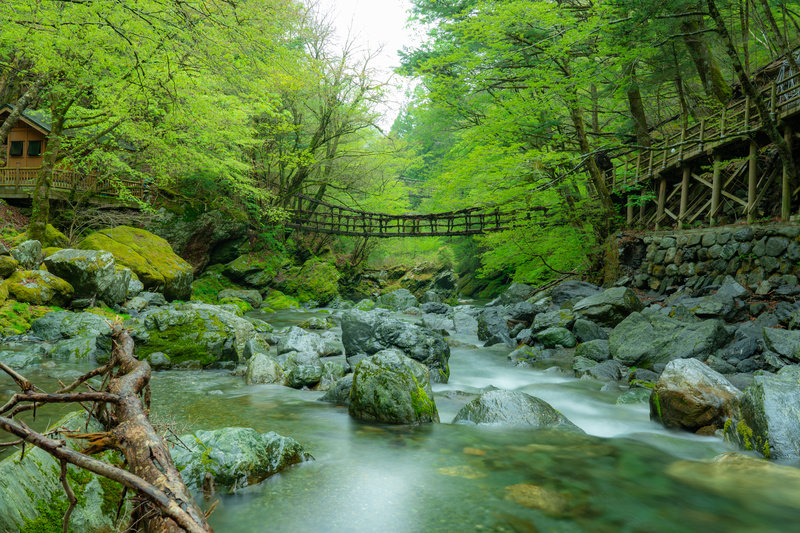
Deep in the mountains of Shikoku — the island most travelers skip entirely — the Iya Valley is the kind of remote that feels almost mythical. Legend says defeated Heike warriors hid here centuries ago, and you can see why nobody found them. The signature sight is the Kazurabashi, a 45-meter suspension bridge woven from mountain vines that sways over a river 14 meters below, the water clearly visible through the gaps in the slats. It’s reinforced with hidden steel cables and rebuilt every three years, so it’s safe — your knees just won’t believe it. Pair it with the Oboke and Koboke gorges, where you can take a sightseeing boat through emerald water.
- Why go: Genuinely off-radar mountain scenery, vine bridges, and gorge boat rides.
- Best season: Autumn for foliage; summer for the gorges. Roads can be tricky in deep winter.
- Time needed: A full day, or an overnight to slow down and soak in a riverside onsen.
- Getting there: Take a train to Oboke Station, then the Shikoku Kotsu bus toward Kazurabashi (about 25–35 min).
- Cost: Vine bridge ¥550 (one-way crossing only — there’s no walking back). Tourist info.
Takachiho Gorge (Miyazaki)
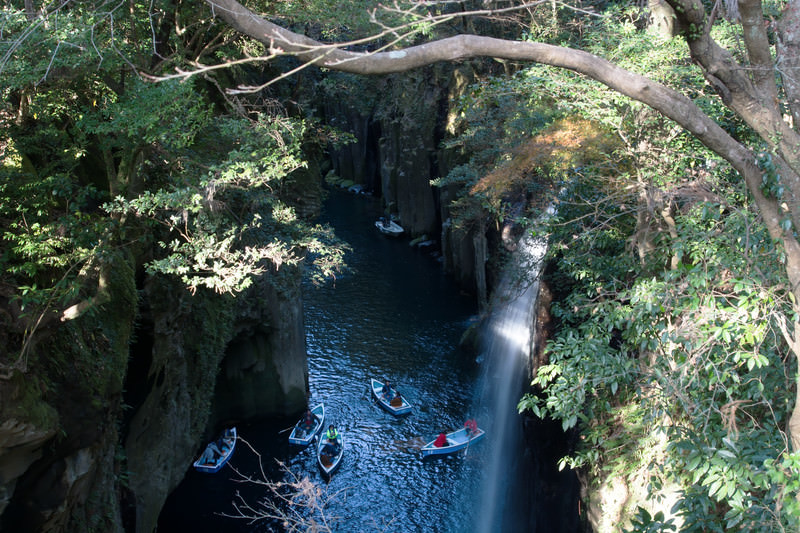
Takachiho, in the highlands of Kyushu, is where Japanese mythology comes from — this is the land the sun goddess Amaterasu is said to have hidden in a cave, plunging the world into darkness. The gorge itself is a narrow ravine of sheer volcanic-rock walls where the slender Manai Falls drops into deep blue water. Rent a rowboat and paddle right up under the falls; it’s the photo everyone comes for, and it’s worth the early start to beat the queue. In the evening, head to Takachiho Shrine for a one-hour condensed performance of yokagura, the all-night sacred dance that retells the cave myth.
- Why go: Mythic scenery, the iconic rowboat-under-a-waterfall, and nightly kagura.
- Best season: Year-round; autumn foliage is spectacular. Boats can sell out on weekends and holidays.
- Time needed: One full day, ideally with an overnight to catch the 8 p.m. kagura.
- Getting there: There’s no train — take the direct bus from Kumamoto Station to Takachiho Bus Center (about 3 hrs, ~¥2,700).
- Cost: Rowboat ¥4,100 weekdays / ¥5,100 weekends (30 min, up to 3 people, reserve online); night kagura ¥1,000. More info.
Tottori Sand Dunes (Tottori)
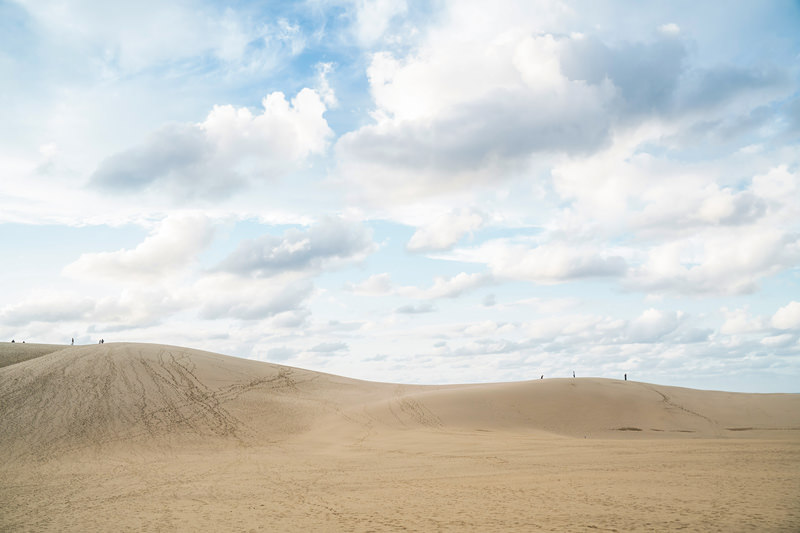
Most people have no idea Japan has a desert. The Tottori Sand Dunes stretch for 16 kilometers along the Sea of Japan, wind-sculpted ridges of sand rising up to 50 meters, and cresting the top to see the ocean on the far side genuinely doesn’t feel like Japan at all. You can ride a camel, try sandboarding down the slopes, or paraglide over them. Right next door is the Sand Museum, the only museum in the world devoted to sand sculpture, with astonishingly detailed works built around a different country’s theme each year. One very practical heads-up: local buses in Tottori don’t take IC cards, so carry cash.
- Why go: Japan’s “desert,” camel rides, sandboarding, and a one-of-a-kind sand-sculpture museum.
- Best season: Spring and autumn (summer sand gets blisteringly hot); sunsets over the sea are stunning.
- Time needed: Half a day, or a full day with the Sand Museum and activities.
- Getting there: Bus from JR Tottori Station to the dunes, about 22 minutes (cash only).
- Cost: Dunes free; camel ride ¥1,600 (one person); Sand Museum around ¥800. Access info.
Iwami Ginzan Silver Mine (Shimane)
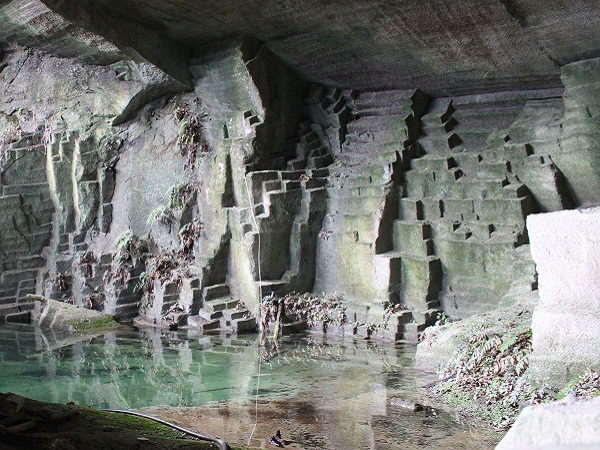
In the 16th and 17th centuries, Iwami Ginzan was one of the most productive silver mines on Earth, and the silver that flowed out of it reshaped Japan’s economy and its trade with the wider world. Designated a UNESCO World Heritage site in 2007, it’s the rare industrial-history site that’s also genuinely lovely to wander: you can walk into the Ryugenji Mabu, one of around a thousand old mine shafts, then stroll the preserved Edo-era merchant town of Omori, all wooden facades and quiet lanes. It’s a thinking person’s day trip, and almost never crowded.
- Why go: A walkable World Heritage mine plus a beautifully preserved old town.
- Best season: Spring through autumn; pleasant for walking and cycling the valley.
- Time needed: Half to a full day.
- Getting there: The nearest hubs are Oda-shi Station and Izumo Airport, then a local bus to Omori.
- Cost: Ryugenji Mabu mine shaft entry around ¥410.
Shirakawa-go (Gifu)
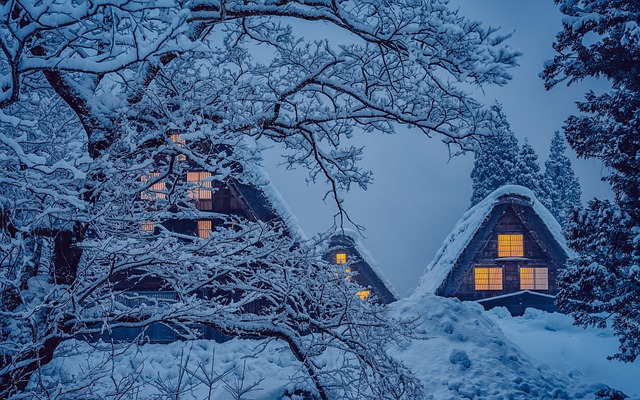
Shirakawa-go is the most famous place on this list, and on a snowy night it earns every bit of the fame. The village is known for its gassho-zukuri farmhouses — steep thatched roofs built like hands pressed in prayer to shed heavy snow — some of them over 250 years old. It’s a UNESCO World Heritage site and a window into a rural Japan that has mostly vanished. Winter, when the houses are buried in snow and lit up on select evenings, is magical; just know those illumination nights now require advance reservations and get genuinely busy. Climb to the Shiroyama Viewpoint for the classic photo over the whole valley.
- Why go: Storybook thatched-roof village; one of Japan’s iconic winter scenes.
- Best season: Winter for snow (illumination nights need reservations); green and gold in other seasons too.
- Time needed: Half a day, or overnight in a farmhouse to see it after the day-trippers leave.
- Getting there: Highway bus from Takayama (~50 min) or Kanazawa (~75 min); about 10 departures daily from each.
- Cost: Free to explore; some farmhouse interiors charge ¥300–600. Official site.
Monbetsu (Hokkaido)
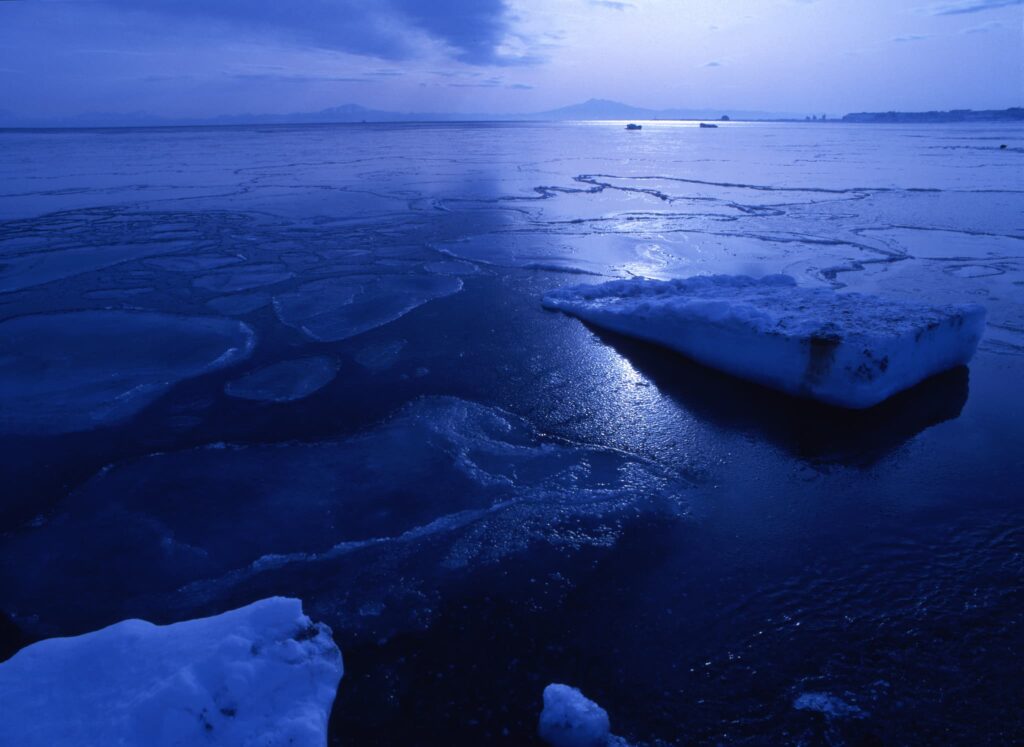
Every winter, the Sea of Okhotsk freezes and vast sheets of drift ice float down to the Hokkaido coast — one of the few places in the world at this latitude where you can witness it. Monbetsu is the spot to see it up close: board the Garinko III IMERU, an icebreaker with a giant drill on its bow, and crunch straight out into the ice floes, often alongside seals and sea eagles. The town is also a seafood haven (the scallops and crab are superb), making it a deeply atmospheric, genuinely cold-weather adventure.
- Why go: Sail an icebreaker into real drift ice; superb Okhotsk seafood.
- Best season: The ice runs roughly mid-January to late March — February is the safest bet for thick floes.
- Time needed: A day; the cruise itself is about 60 minutes.
- Getting there: Fly to Okhotsk-Monbetsu Airport direct from Tokyo, or take a bus from Sapporo (about 5.5 hrs).
- Cost: Garinko III IMERU cruise around ¥3,000–4,000 depending on date.
Fitting These Into a Trip
The catch with hidden gems is that they’re hidden for a reason — most sit a few hours off the main Tokyo–Kyoto–Osaka corridor, so they reward a little planning. A few are seasonal locks: Monbetsu’s drift ice only in winter, Shirakawa-go at its best under snow, Kumano Kodo most comfortable in spring or autumn. Sort out the timing with our season-by-season guide, work out the trains and buses with how to get around Japan, and slot it all together using our trip-planning guide. Even one of these added to an otherwise standard itinerary is usually the day people remember most.
FAQs About Japan’s Hidden Gems
Are these places hard to reach without a car?
Most are doable by train plus a local bus — Tottori, Shirakawa-go, Iya Valley, and Takachiho all have bus connections. A rental car gives you more freedom in the Iya Valley and around Iwami Ginzan, but it isn’t essential. Just budget extra travel time and carry cash for rural buses.
Which hidden gem is best for a first visit to Japan?
Shirakawa-go is the easiest add-on, since it pairs naturally with Takayama and Kanazawa. Kumano Kodo suits anyone wanting a walking and spiritual experience, while Tottori is the most fun, family-friendly day out.
When is the best time to see the drift ice in Monbetsu?
The drift-ice season runs from about mid-January to late March, and February typically offers the thickest, most reliable ice. Icebreaker cruises do sell out in peak weeks, so book ahead.
Do I need to reserve anything in advance?
Yes for a few: Takachiho’s rowboats and night kagura, Shirakawa-go’s winter illumination nights, and Monbetsu’s icebreaker cruises in peak season all benefit from advance booking. The Tottori dunes, Iya vine bridge, and Iwami Ginzan are walk-up.
Are these destinations expensive?
The sights themselves are cheap — many are free or under ¥1,000. Your real cost is transport and accommodation, since these spots are remote. For a fuller budget picture, see our Japan trip cost breakdown.


One thought on “Hidden Gems of Japan: 7 Off-the-Beaten-Path Destinations (2026)”