For a long time, if you wanted to work in Japan but didn’t have a university degree, the honest answer was: you basically couldn’t, at least not legally and not in the open. The white-collar work visa demanded a degree that matched the job, and everything below it was funneled into the Technical Intern Training Program — a scheme with a genuinely troubled reputation. The Specified Skilled Worker (特定技能, tokutei ginō) status, launched in 2019, was Japan’s attempt to build a proper front door for exactly those “non-degree” jobs: hotels, restaurants, farms, factories, construction sites, nursing homes. It has grown fast — past 390,000 residents by 2026 — and the government keeps widening it.
This guide covers how the visa actually works: the sectors it covers, the two types and the very different futures they lead to, how you qualify, who’s eligible, and — the part most guides skip — what the pay and working conditions are really like, with the caveats you should know before you sign anything. It pairs with our broader guide to status of residence in Japan and our overview of working in Japan. As always, immigration rules shift, and this is a map rather than legal advice — confirm specifics with the Immigration Services Agency’s Specified Skilled Worker page or a licensed specialist.
What Is the Specified Skilled Worker Visa?
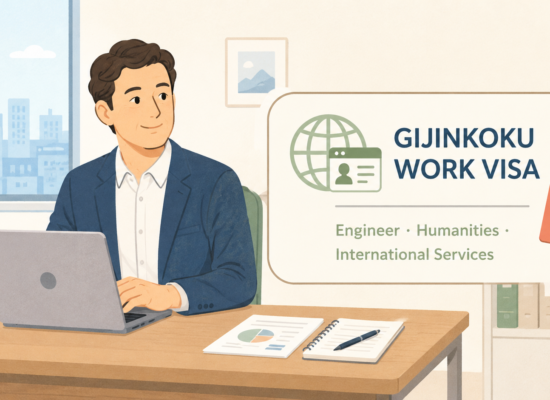
The Specified Skilled Worker status exists to fill Japan’s most acute labor shortages with workers who have real, tested skills — but not necessarily a degree. That’s the key difference from the Engineer/Specialist in Humanities/International Services visa (gijinkoku), which is built for degree-matched office work. If someone tells you restaurant, hotel, farm, or construction work can’t be done on a legitimate long-term visa in Japan, they’re working from information that’s several years out of date.
How serious is Japan about this? In January 2026 the government revised its five-year intake projection sharply upward — the combined target for Specified Skilled Worker and the incoming training program now runs past 1.2 million people. This is not a niche program being quietly wound down. It’s a central plank of how Japan plans to staff its economy over the next decade, which is worth remembering when you’re weighing how much leverage you actually have as an applicant.
The 16 Sectors Covered by the SSW Visa
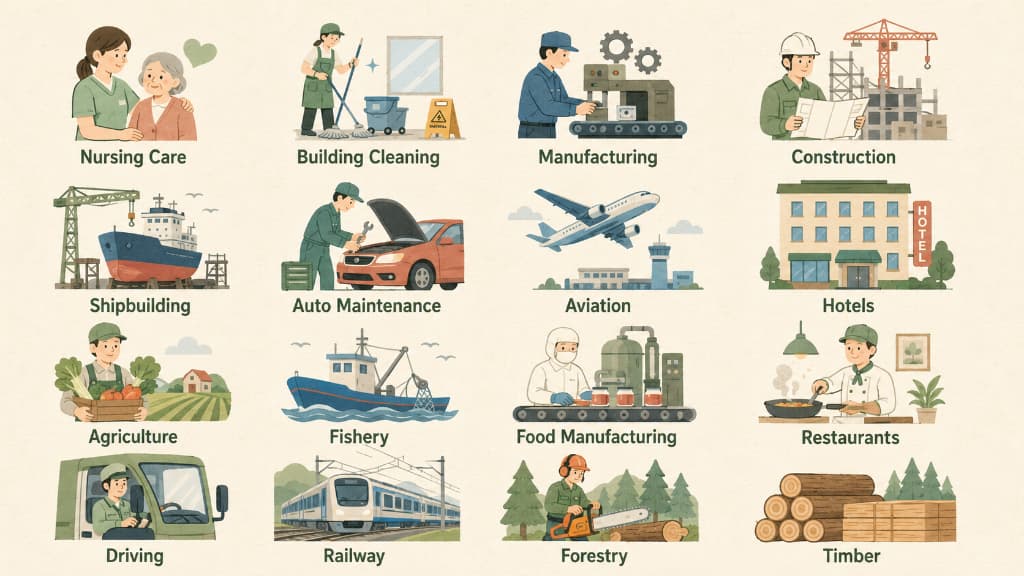
As of 2026, the Specified Skilled Worker status covers 16 industry sectors. These aren’t loose categories — each has its own skills test, its own supervising ministry, and its own rules, so the sector you apply under matters.
- Nursing care (介護)
- Building cleaning (ビルクリーニング)
- Industrial products manufacturing (工業製品製造業)
- Construction (建設)
- Shipbuilding and ship machinery (造船・舶用工業)
- Automobile maintenance (自動車整備)
- Aviation (航空)
- Accommodation / hotels (宿泊)
- Agriculture (農業)
- Fishery (漁業)
- Food and beverage manufacturing (飲食料品製造業)
- Food service / restaurants (外食業)
- Automobile transportation / driving (自動車運送業)
- Railway (鉄道)
- Forestry (林業)
- Timber industry (木材産業)
The last four — driving, railway, forestry, and timber — were added in 2024, which is why older guides list only 12. And the list is still growing: in January 2026 the cabinet approved three more sectors (linen supply, logistics/warehousing, and resource circulation), which will eventually bring the total to 19. Those three aren’t open yet, though — the skills tests still need to be built, so actual hiring is expected around 2027. If your target job falls in one of the new three, check current status before you plan around it.
Type 1 vs. Type 2: The Difference That Shapes Your Future
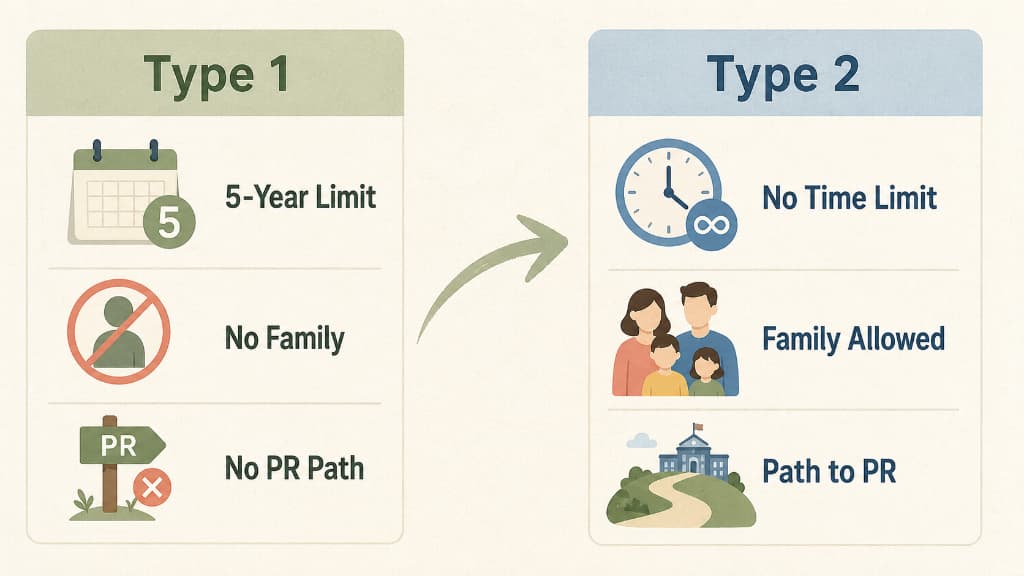
This is the single most important thing to understand about the visa, because the two types lead to completely different lives. Almost everyone starts on Type 1 (特定技能1号). A smaller number progress to Type 2 (特定技能2号), and that jump is what separates “a few years of work in Japan” from “a permanent life here.”
| Type 1 (1号) | Type 2 (2号) | |
|---|---|---|
| Maximum stay | 5 years total (cumulative) | No upper limit — renewable indefinitely |
| Renewal cycle | Up to 1 year at a time | Up to 3 years at a time |
| Family (spouse & children) | Not permitted | Permitted (they get a Dependent visa) |
| Path to permanent residency | No — this time doesn’t count | Yes — can lead to PR |
| Sectors available | All 16 | 11 (nursing care excluded; the 4 newest sectors not yet open) |
| Skill level | Requires a skills test (or Technical Intern route) | Requires a higher, supervisory-level skills test |
Read that “path to permanent residency” row carefully, because it trips people up. Time spent on Type 1 — like time spent as a Technical Intern — does not count toward the 10 years of residence you need for permanent residency. So five years of hard work on Type 1 gets you no closer to PR on paper. The clock only starts once you reach Type 2 (or switch to a status that counts). If your goal is to settle in Japan long-term, reaching Type 2 isn’t a nice-to-have — it’s the whole game.
Nursing care is the one oddity worth flagging: it has no Type 2, because Japan already has a separate, dedicated “Nursing Care” (介護) status of residence that offers a longer-term path. So if you’re in care, your progression route looks different from the other sectors.
How to Qualify: Tests and the Training Route
There are two doors into Type 1, and you only need to walk through one.
Route 1: Pass the tests
You take two exams: a skills test for your specific sector (administered by that sector’s designated body), and a Japanese-language test. For the language, you need either the JFT-Basic (the Japan Foundation Test for Basic Japanese) or JLPT N4 or above. Nursing care adds a small extra care-specific Japanese test on top.
One honest heads-up that comes up again and again from people who’ve done it: the language on the skills test itself is often harder than the N4 bar suggests. N4 might be the formal requirement, but the sector test is written in workplace Japanese, and people who’ve sat both frequently say it felt closer to N3. Don’t treat the language test as the hard part and the skills test as a formality — study the free official practice materials for your sector’s exam specifically.
Route 2: Transfer from the training program
If you’ve completed Technical Intern Training (ii) (技能実習2号) satisfactorily in a matching field, you can move to Specified Skilled Worker Type 1 without taking the skills or language tests. This is the pathway a large share of current SSW workers actually took. As we’ll cover below, that training program is being replaced from 2027, but the principle of a test-exempt bridge from training into SSW is being carried into the new system.
Who Can Apply? Nationality and Country Rules
Here’s a point that generates a lot of confusion online. The Specified Skilled Worker status has no blanket nationality restriction — there’s no official list of “only these passports allowed.” People from Western countries have sat and passed the exams inside Japan and obtained the status. So if you read a forum comment saying it’s closed to your nationality, that’s usually a misunderstanding.
What actually exists is a set of bilateral agreements (二国間協力覚書, MOC) that Japan has signed with — as of 2025 — around 19 countries, including Vietnam, Indonesia, the Philippines, Myanmar, Nepal, Sri Lanka, Bangladesh, Thailand, Cambodia, Mongolia, and India. These agreements set up the sending-side machinery: local skills testing, approved sending organizations, and departure procedures in each country. If you’re applying from one of these countries, there’s an established path with local testing. If your country isn’t on the list, you can generally still qualify — most commonly by taking the tests while already in Japan on another status — but the overseas infrastructure won’t be there for you.
Two nationalities are a hard stop: Iran and Turkey cannot currently be accepted under the Specified Skilled Worker program at all. The ISA’s country-by-country page is the authoritative source if you’re unsure where your nationality stands.
Switching to SSW From a Student or Dependent Visa
A lot of people don’t arrive on this visa — they switch to it from something else. Two common cases: a language or vocational student who can’t afford (or doesn’t want) further schooling and wants to stay and work, and someone on a Dependent visa — say, the spouse of a graduate student — who’s capped at 28 hours a week of part-time work and wants a full-time, better-paid job.
Both are doable as a change of status of residence, but go in with a realistic timeline. You have to pass the skills and language tests before you can file the change application, and those tests run only a handful of times a year with results landing weeks later. Once you and your employer submit everything to immigration, the status change itself has taken applicants around 2.5 months in practice. So from “I’ve decided to do this” to “I’m legally working full-time,” you’re realistically looking at several months — plan your finances around that gap, because you can’t jump the gun and start the full-time role before approval comes through.
Getting the sector right matters, too. A tire shop, for instance, might fall under automobile maintenance or industrial products manufacturing depending on the exact work — and choosing wrong means the wrong test. This is one place where an employer-arranged support organization or an immigration specialist genuinely earns their fee.
Can You Change Jobs on an SSW Visa?
Yes — and this is a genuine improvement over the old training program, where changing employers was essentially forbidden. But “yes” comes with real friction, and it’s worth understanding before you count on it.
You can move to a new employer, but generally only within the same work category (or a category whose skills test overlaps with yours). More importantly, a job change isn’t like handing in your notice and starting somewhere new on Monday. Your status is tied to your employer, so changing jobs means applying for a fresh status of residence — and until that’s approved, which can take one to three months, you cannot legally work at the new place. Not even part-time to bridge the gap. That’s a serious financial squeeze for someone on an SSW wage, and it’s the reason many workers who technically can change jobs don’t. The freedom exists on paper; the cash-flow reality makes it heavier than it sounds.
Registered Support Organizations: Your Safety Net
Every Type 1 worker is entitled to a defined package of support, which the employer must provide either in-house or (far more commonly) by outsourcing to a registered support organization (登録支援機関). This isn’t a favor — it’s a legal obligation, and it’s one of the features that’s supposed to make SSW more humane than what came before.
The required support includes help finding housing and setting up utilities and a bank account, a pre-start orientation on life in Japan, access to Japanese-language learning, a contact point for consultations and complaints in a language you understand, and regular check-in meetings. A 2025 rule change tightened the reporting employers must file on the support actually delivered. If you’re being offered an SSW job and nobody can tell you who your support organization is or how you’d reach them with a problem, treat that as a red flag, not a detail.
What You’ll Actually Earn — and What to Watch For
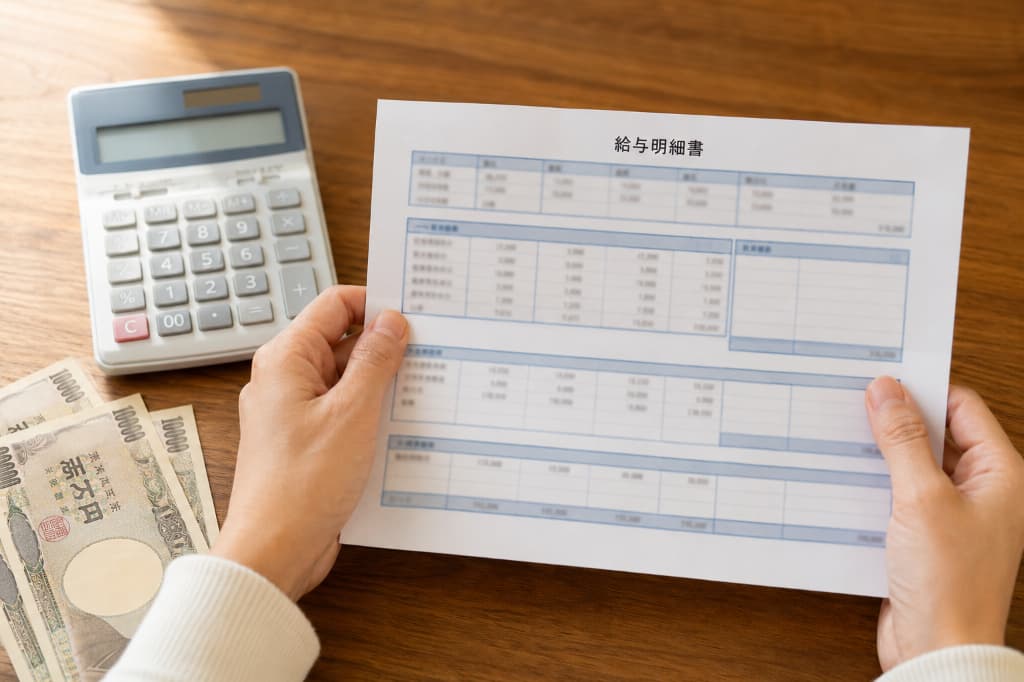
This is the section other guides tend to gloss over, and it’s the one you most need. Let’s do the numbers first, then the honest warnings.
The pay, in real figures
Government data for 2025 put the average monthly salary for Specified Skilled Workers at about ¥221,400 — up 4.8% on the previous year. For comparison, the average for Technical Interns was around ¥182,000, so SSW does pay meaningfully better than the training program it partly replaces. Sectors where Japanese tradespeople are well paid — construction, shipbuilding, some manufacturing — can run higher, and workers in the finishing trades on construction sites report ¥300,000–¥400,000 a month once they’re established and qualified. Construction actually has a built-in wage protection: an employer’s hiring plan won’t be approved unless the pay is benchmarked against comparable Japanese workers, and there are floors tied to the regional minimum wage.
So the earning potential is real, especially measured against wages back home. But “you can earn money” and “you can easily save money” are different claims. Japan’s cost of living, a weaker yen, and shared employer-arranged housing that’s convenient but not free all eat into the number. Go in with a budget, not a fantasy.
The warnings worth taking seriously
You’ll see the SSW visa called a “slave visa” in online expat forums. That’s an overstatement of a real problem, and it’s worth separating the two. The reputation is inherited from the Technical Intern Training Program, which the U.S. State Department’s Trafficking in Persons report has repeatedly criticized — across multiple years — for ongoing forced-labor conditions and weak prosecution of abusers. Specified Skilled Worker was designed to be better, with the right to change jobs and mandated support. But some of the same actors and pressures carry over, so a few things are worth knowing cold:
- Your employer must never hold your passport or residence card. Japanese government guidance is explicit that employers should not retain these, and a 2024 court ruling found that refusing to return a worker’s documents on request is illegal. You are legally required to carry your own residence card. If an employer or agency wants to “keep it safe” for you, that is not normal and not okay.
- Beware of large upfront fees and debt to sending agencies. Under the old training program, workers paid sending organizations an average of over ¥520,000 in fees and costs before departure — and that debt, and the pressure to repay it, has been identified by the government itself as a leading cause of workers absconding. Be extremely wary of any arrangement that has you arriving in Japan already deep in debt to a broker.
- Read the contract before you sign, specifically. Check the stated salary, overtime, bonus (some employers pay SSW workers little or none), holidays, and exactly what post-arrival support you get. Talk to people from your country already doing the job at that company if you possibly can.
- Know your rights. Foreign workers are covered by Japanese labor law — minimum wage, overtime rules, health and pension enrollment — the same as anyone else. Your support organization and local labor bureaus exist partly for when something goes wrong.
None of this is meant to scare you off. Plenty of SSW workers are doing fine, sending money home, and building toward Type 2. The point is that the difference between a good experience and a bad one often comes down to the employer and the agency — and those are things you can partly screen for before you commit.
The 2027 Shift: From Technical Intern to “Employment for Skill Development”
The old Technical Intern Training Program is being abolished and replaced. From April 1, 2027, a new system called Ikusei Shūrō (育成就労, roughly “employment for skill development”) takes over, with a three-year transition during which both systems coexist until around 2030.
The change matters even if you’re aiming straight for SSW, because the new program is explicitly designed as the feeder into Specified Skilled Worker. Where the old training program dressed itself up as “international skills transfer,” Ikusei Shūrō openly states its purpose: developing workers to Type-1 SSW level and securing labor. It runs about three years, requires a basic Japanese level (around N5) before or shortly after starting, and — crucially — allows workers to change employers under certain conditions, directly addressing one of the old program’s worst features. It also aims to shift more of the pre-arrival cost burden onto employers rather than loading it onto the worker as debt. Complete it, pass the relevant test, and you move up into SSW Type 1, then potentially Type 2.
Frequently Asked Questions: The Specified Skilled Worker Visa
How long can I stay in Japan on a Specified Skilled Worker visa?
Type 1 allows a cumulative maximum of 5 years, renewed in increments of up to a year. Type 2 has no upper limit and can be renewed indefinitely, in increments of up to three years. Reaching Type 2 is also what opens the door to permanent residency, since Type 1 time doesn’t count toward the residence requirement.
Can I bring my family on an SSW visa?
Not on Type 1 — family accompaniment isn’t permitted. Type 2 does allow you to bring a spouse and children, who receive a Dependent status of residence. This is one of the biggest practical reasons workers push to advance from Type 1 to Type 2.
What Japanese level do I need for the SSW visa?
The formal bar is JLPT N4 or a pass on the JFT-Basic test (nursing care adds a small extra care-Japanese test). Be aware, though, that the sector skills test is itself written in workplace Japanese that many people find harder than N4 — closer to N3 in feel — so study the specific practice materials for your sector’s exam rather than relying on general N4 study alone.
Can I change jobs on a Specified Skilled Worker visa?
Yes, generally within the same work category — a real improvement over the old training program. But changing employers requires applying for a new status of residence, and you cannot legally work at the new job (not even part-time) until it’s approved, which can take one to three months. That income gap is why many workers who could switch decide the timing isn’t worth it.
Is the SSW visa a path to permanent residency in Japan?
Only indirectly. Time on Type 1 does not count toward the 10 years of residence needed for permanent residency — same as Technical Intern time. You need to progress to Type 2 (whose years do count) or switch to another qualifying status. For the full requirements, see our guide to status of residence and permanent residency in Japan.
Key Takeaways
- The Specified Skilled Worker visa is a legitimate, growing route into 16 (soon 19) sectors of non-degree work — hotels, restaurants, care, construction, farming, and more.
- Type 1 caps out at 5 years with no family and no PR credit; Type 2 is unlimited, allows family, and counts toward permanent residency. Advancing to Type 2 is the real long-term goal.
- You qualify by passing a sector skills test plus a Japanese test (JFT-Basic or JLPT N4), or by transferring from the training program without tests.
- Switching from a student or dependent visa is possible but slow — budget for several months and an income gap before you can work full-time.
- Average pay is around ¥221,000/month and rising, higher in skilled trades — but screen the employer and agency hard, never let anyone hold your passport, and avoid arriving in debt to a broker.
- The training program feeding into SSW is being replaced by Ikusei Shūrō from April 2027, with easier job changes and less worker-borne cost.
For the wider picture of visas, renewals, and permanent residency, start with our hub guide to status of residence in Japan. And for salaries, the job market, and how the white-collar work visa compares, see working in Japan.

2 thoughts on “The Specified Skilled Worker (Tokutei Ginō) Visa in Japan: A Complete Guide (2026)”