Becoming a Japanese citizen is a bigger decision than getting permanent residency, and as of 2026 it also got harder. On April 1, 2026, the Ministry of Justice quietly tightened how it screens naturalization (帰化, kika) applications, and immigration offices are now working through a wave of people who rushed to apply before the change. If you’re thinking about trading your current passport for a Japanese one, this guide walks through what naturalization actually requires, what shifted in 2026, how the process really unfolds from your first phone call to your name appearing in the Official Gazette, and the practical traps (unpaid pension, a single unlucky job change) that sink otherwise-strong cases.
This is a companion to our hub guide on status of residence in Japan, which covers permanent residency in depth, and it pairs with our guides to social insurance and pension (which matters more than people expect here) and working in Japan. Naturalization is a legal process with real discretion baked in, so treat this as an orientation rather than legal advice. The authoritative sources are the Ministry of Justice’s Nationality Law page and your local Legal Affairs Bureau (法務局).
Naturalization vs. Permanent Residency: Which Are You Actually After?
People use these two almost interchangeably, and they shouldn’t. The difference is fundamental, and it decides whether naturalization is even the right goal for you.
Permanent residency (永住権) lets you stay in Japan indefinitely with no work restrictions, but you keep your original citizenship and passport. You still hold a residence card, you still can’t vote, and in theory the status can be lost (long absences, serious crimes, and under 2026 rules even unpaid taxes or pension can put it at risk). Naturalization makes you a Japanese national outright. You get a Japanese passport, the right to vote, and you stop being a foreigner in the eyes of the law. The catch is the one many people don’t want to hear: Japan does not permit dual nationality in principle, so you generally have to give up your original citizenship. That’s a genuine emotional and practical weight, and it’s the first thing to sit with before you start.
| Permanent Residency (永住権) | Naturalization (帰化) | |
|---|---|---|
| Nationality | Keep your own | Become a Japanese national |
| Original citizenship | Kept | Generally must be renounced (no dual nationality) |
| Passport | Your home country’s | Japanese passport |
| Residence card | Still required | No longer needed; you’re not a foreigner |
| Voting rights | No | Yes |
| Can it be lost? | Yes (long absence, serious crime, and under 2026 rules unpaid tax/pension) | No, it’s citizenship for life |
| Decided by | Immigration Services Agency | Ministry of Justice (via the Legal Affairs Bureau) |
One useful myth to kill early: you do not need permanent residency first. Naturalization is a separate track, and plenty of people naturalize without ever holding PR. In some ways the requirements overlap, but they’re judged under different laws by different offices. PR is handled by the Immigration Services Agency; naturalization is handled by the Ministry of Justice through the Legal Affairs Bureau.
The Six Requirements for Naturalization
Standard naturalization (普通帰化) is governed by Article 5 of the Nationality Law, which sets out six conditions. Meeting them all doesn’t guarantee approval, because the Minister of Justice has wide discretion, but failing any one of them usually ends the application.
- Residence (住所要件): at least five continuous years living in Japan on a valid status, and in practice with a stable job for a good chunk of that. Note the 2026 change below, which raises this bar considerably in practice.
- Age and capacity (能力要件): you must be 18 or older and a legal adult under your home country’s law.
- Good conduct (素行要件): a clean record, taxes paid, pension and health insurance paid. This is where more applications quietly die than people realize, so it gets its own section below.
- Livelihood (生計要件): you can support yourself. This is judged by household, so a spouse’s or family’s income counts. You don’t personally need a high salary.
- Renouncing your nationality (重国籍防止要件): you have no other nationality, or you’re willing to lose it on becoming Japanese.
- No threat to Japan (憲法遵守要件): you haven’t plotted against the Japanese government or constitution, and you’re not tied to groups that advocate doing so.
There’s a seventh, unwritten requirement that the statute doesn’t list but the process absolutely checks: Japanese language ability. The working standard is roughly the level of a Japanese elementary-school third-grader, meaning everyday conversation plus basic reading and writing. That sounds modest, and it is, but it trips people up in a specific way we’ll get to when we cover the interview.
What Changed on April 1, 2026
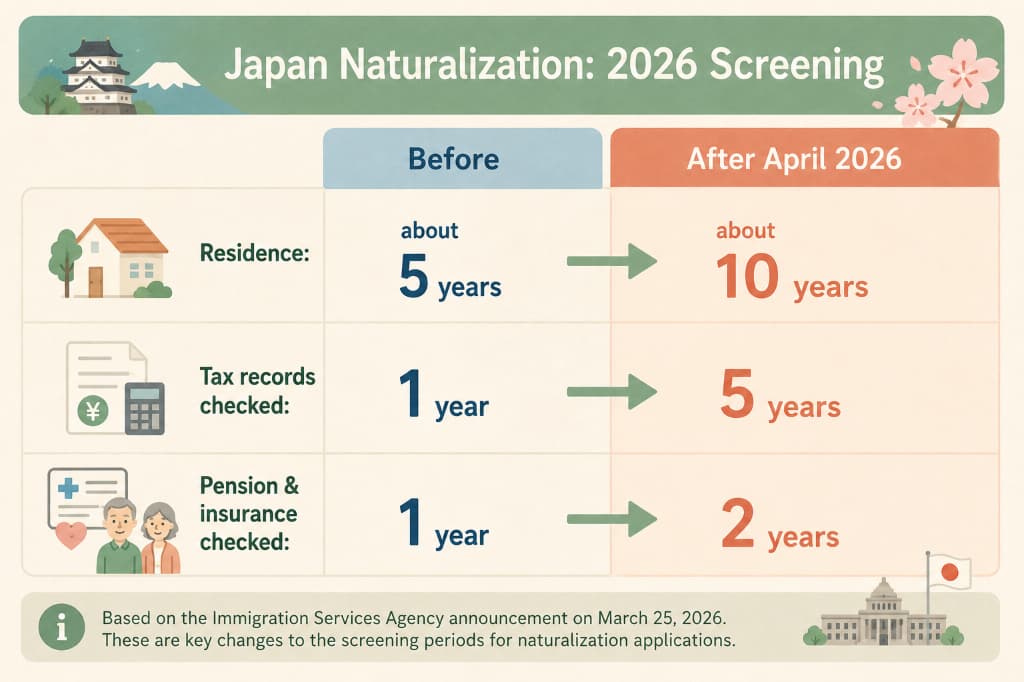
This is the news driving the current rush, and it’s widely misunderstood, so let’s be precise. The Nationality Law itself was not rewritten. The five-year residence line is still in the text. What changed is the Ministry of Justice’s screening practice, and in day-to-day terms the effect is significant. From April 1, 2026, the review effectively looks for:
- Around ten years of residence in practice, rather than the old five as a comfortable baseline.
- Five years of tax records (residence tax and income tax), up from roughly one year previously.
- Two years of pension and health-insurance payments on the record, up from about one.
The sharpest detail: this applies to cases not yet approved by the end of March 2026, even if you filed earlier. Filing before the deadline didn’t lock in the old standard; if your permission hadn’t come through, you’re judged under the new one. Predictably, the announcement triggered a surge of applications from people trying to get in, which has itself slowed everything down. Applicants and case officers alike are reporting that offices are swamped and that approvals since April have gotten noticeably slower. If you’re starting now, plan for a long, patient road, and make sure your tax and pension history is genuinely spotless before you go anywhere near the Legal Affairs Bureau.
The Conduct Trap: Taxes, Pension, and a Clean Record
The good-conduct requirement (素行要件) is the one that catches people who assumed they were fine. It bundles together your criminal record, your tax payments, and your social-insurance payments, and the 2026 change put a much longer lens on the last two.
The pension trap is the cruelest, because it surprises people who did everything else right. National Pension (年金) enrollment is legally mandatory, but for years it was never checked when you renewed a visa or even applied for permanent residency, so a lot of long-term residents simply never paid it and never knew it was a problem. Naturalization checks it directly, and people have been rejected purely for a gap in pension payments, even after arranging to pay the arrears in installments. If you have unpaid pension, the move is to start paying (including back-payments where you can) and build a clean two-year record before applying, not to explain it away afterward. Our guide to social insurance and pension in Japan covers how to get current.
Taxes work the same way, now over five years: residence tax and income tax paid, and paid on time. Minor traffic offenses are usually survivable in small numbers, but a stack of parking tickets or anything involving driving under the influence is a real problem, and the office will pull your driving record. A criminal record is the most serious factor of all; for how convictions and even arrests interact with your status, see our guide on how criminal proceedings affect visas in Japan.
Simplified Naturalization for Spouses and Others
Not everyone faces the full five-year (now practically longer) residence bar. The Nationality Law provides eased conditions (簡易帰化) for people with a close tie to Japan. The most common case is being married to a Japanese national: you can qualify with either three continuous years of residence in Japan while married, or three years of marriage plus one continuous year of residence. Others who get eased terms include children of current or former Japanese nationals, people born in Japan under certain conditions, and former Japanese nationals themselves.
Two things worth flagging. First, “simplified” refers to the residence requirement, not the paperwork or the scrutiny; a spouse case still involves the full document pile and a real interview. Second, it’s genuinely unclear how the 2026 tightening will land on these eased routes in practice, so if you’re on a spouse track, this is exactly the situation where a consultation at the Legal Affairs Bureau before you invest months is worth its weight.
The Process, Step by Step
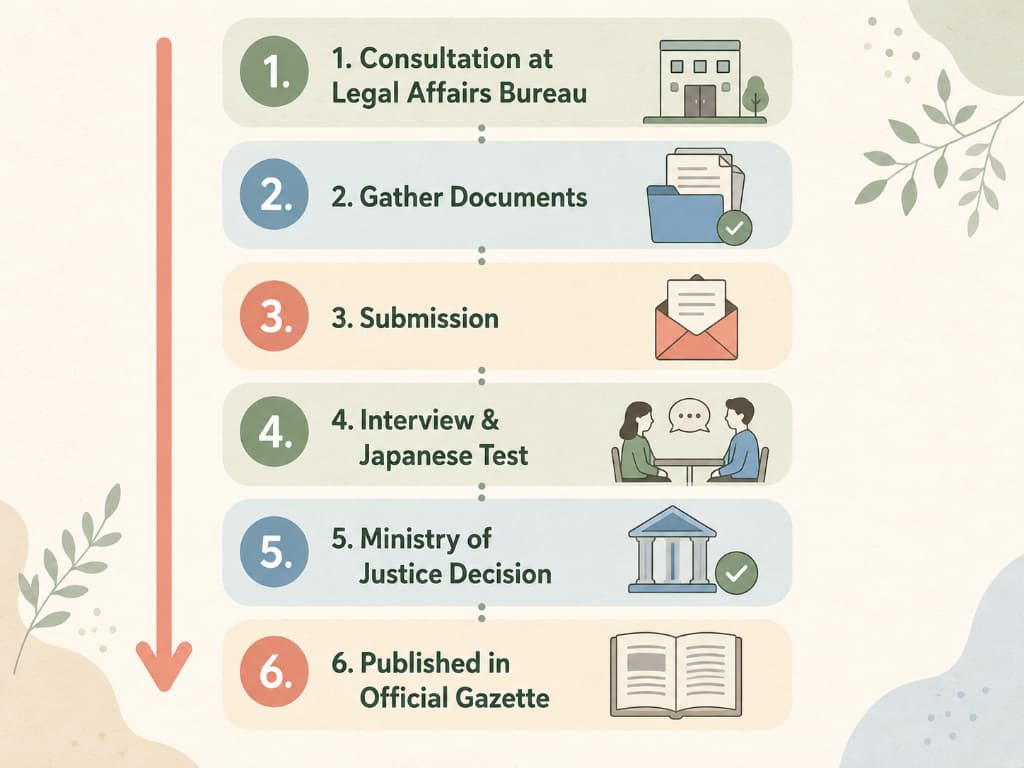
Nearly everyone who has been through this gives the same first piece of advice: phone your local Legal Affairs Bureau (法務局) and book a consultation before you do anything else. The information scattered around the internet is inconsistent because the required documents genuinely differ by nationality, job, family situation, and how long you’ve been here. Only the Bureau can hand you the checklist tailored to your case, and that checklist is the real map.
- 1. Consultation (相談): an officer assesses your eligibility face to face and gives you a document checklist and booklets. Call early. In Tokyo’s 23 wards, the first consultation actually doubles as your submission slot, and it can be booked as much as half a year out.
- 2. Gathering documents: the heavy part. Expect tax certificates, proof of pension and insurance payments, employment and income records, a family registry from your home country (often with a certified translation you do yourself), and more. Some home-country documents take months to obtain.
- 3. Submission (受理): you hand everything in, in person, which typically takes one and a half to two hours of checking at the counter. You’ll also write a reason-for-applying statement (動機書 / 理由書) in your own Japanese handwriting.
- 4. Interview: usually three to six months after submission. One interview, covered in detail below.
- 5. Ministry of Justice decision: your file goes to the Ministry for the final call. They may request more documents, but there will be no second interview.
- 6. Result: approval is published in the Official Gazette (官報). Many people say they don’t truly relax until they see their name printed there. After that come the final registration steps to formalize your new citizenship.
The Interview and the Japanese Test
The interview is one meeting, in Japanese, usually 30 minutes to an hour, with your case officer (担当者). People describe it as a mix of strict and fair. The officer goes through your file more or less line by line: your history in Japan from the day you arrived, your education, your work record, and your family, asking you to explain what each entry is and when it happened. A recent job change tends to draw extra questions, so be ready to explain your previous role, not just your current one. Applicants are often struck by how much the officer already seems to know about their home country and culture; the background research is real.

The Japanese test is the part that catches people off guard. It isn’t always given. Holders of JLPT N1 are typically waved through, and many N2 holders too, but the officer can decide on the spot to test you, and people around the N3 level usually do sit it. When it happens, it’s done by hand: reading aloud, converting between hiragana and katakana, a comprehension passage, and writing a short paragraph yourself, often with a tight 20 minutes on the clock. The genuine difficulty for most modern applicants is handwriting kanji, because everyone types now. You don’t need every character in kanji, and a couple of spelling slips in the essay generally won’t sink you if the rest is solid, but if you’ve been relying on autocomplete for years, practice writing by hand before you go.
There’s a quiet irony here that long-term residents enjoy pointing out: you can naturalize at roughly N3, yet many employers won’t hire you for an office job below N2, and from 2026 some work visas even demand it (see our guide to the gijinkoku work visa). The bar to become Japanese is, on paper, lower than the bar to get hired.
How Long It Takes
Set your expectations wide. From first consultation to submission is often ten months to a year on its own, mostly document-gathering. From submission to a result usually runs another year to a year and a half, and the 2026 backlog is pushing some cases toward two years or beyond. A total of eighteen months to well over two years is normal, and very little of it is in your control once the file is in.
That open-ended waiting is worth taking seriously. When my husband went through permanent residency, the review alone ran about a year and a half, and partway through, immigration asked him to re-submit several documents because the originals had expired while his file simply sat in the queue. Naturalization runs on the same kind of unhurried clock. The lesson we took from it applies here too: don’t wait until you technically qualify to start pulling documents together, because the timeline you can influence is your own preparation, not theirs.
Do It Yourself, or Hire a 行政書士?
Most people handle naturalization themselves, and it’s genuinely doable if you’re organized and reasonably comfortable in Japanese. Helpfully, the application itself carries no government fee, so doing it solo costs you time and postage rather than money. The Legal Affairs Bureau gives you the checklist, answers questions at consultations, and is the real source of truth. Doing it solo also means you learn your own file inside out, which helps at the interview.
A licensed immigration lawyer (行政書士, gyōsei shoshi) earns their fee in specific situations: a complex case (you run your own business, you have gaps in tax or pension history, your family situation is unusual), limited Japanese, or simply no time and energy for a mountain of forms. They help most with the reason-for-applying statement and with anticipating problems particular to your circumstances, and an experienced one often knows how the 2026 standards are actually being applied because they’re in and out of the Bureau constantly. Fees for a naturalization case typically run ¥150,000 to ¥250,000 or more, higher than a routine visa application because the document load is so much heavier. Two honest caveats: you’ll usually still have to arrange translations of your home-country documents yourself, and no professional can attend the interview for you. Weigh the cost against how genuinely tangled your case is.
Frequently Asked Questions: Japanese Naturalization
Do I have to give up my original citizenship to naturalize in Japan?
In principle, yes. Japan does not allow dual nationality for adults who naturalize, so you’re generally required to renounce your original citizenship. How that plays out depends partly on your home country’s own rules, since some make renunciation difficult or don’t fully recognize it. This is the single biggest personal consideration, separate from whether you meet the legal requirements.
Do I need permanent residency before I can naturalize?
No. Naturalization and permanent residency are separate tracks under different laws, and you can naturalize without ever holding PR. They share some requirements, like a clean tax and pension record, but they’re decided by different offices (the Ministry of Justice for naturalization, the Immigration Services Agency for PR).
What Japanese level do I need for naturalization?
Roughly the level of a Japanese elementary-school third-grader: everyday conversation plus basic reading and writing. It’s not in the statute, but the process checks it, sometimes with a short handwritten test at the interview. N1 holders are usually exempt from the test and many N2 holders too, while people around N3 often take it. The hardest part for most applicants is writing kanji by hand.
Did the rules really get stricter in 2026?
Yes, in practice. The Nationality Law wasn’t amended, but from April 1, 2026 the Ministry of Justice’s screening effectively looks for around ten years of residence, five years of tax records, and two years of pension and health-insurance payments. It applies to applications not yet approved by the end of March 2026, and the resulting surge of applications has slowed processing further.
How long does naturalization take from start to finish?
Typically eighteen months to over two years. Gathering documents and reaching submission often takes ten months to a year, and the decision after submission usually takes another year to eighteen months, with 2026 backlogs stretching some cases longer. Start collecting documents early, because the post-submission wait is entirely out of your hands.
Key Takeaways
- Naturalization makes you a Japanese citizen and generally requires giving up your original passport; permanent residency lets you stay for good while keeping it. You don’t need PR before naturalizing.
- Standard naturalization rests on six legal conditions plus an unwritten Japanese-ability check at about elementary-school third-grade level.
- From April 1, 2026, screening tightened in practice to around ten years of residence, five years of tax records, and two years of pension and insurance payments, and it applies to cases not yet approved by end of March 2026.
- The conduct requirement sinks more cases than people expect. Unpaid pension is the classic trap, since it was rarely checked for visas or PR but is checked directly here.
- Start by phoning your local Legal Affairs Bureau for a consultation and a case-specific checklist. In Tokyo’s 23 wards that slot can be six months out, so call early.
- Expect one interview in Japanese, a possible handwritten test, a decision published in the Official Gazette, and a total wait of eighteen months to over two years.
For the wider immigration picture, including permanent residency and how the two compare, start with our hub guide to status of residence in Japan. To get your pension and insurance record in order before you apply, see our guide to social insurance in Japan.



One thought on “How to Become a Japanese Citizen: Naturalization (Kika) Explained for 2026”