Planning a trip to Japan is exciting right up until you open a map and realize how much there is. Where do you start, how many days do you need, and what has to be booked months ahead versus sorted on arrival? This guide walks you through it step by step, in the order you’d actually plan: when to go, how long to stay, which route to take, and what to lock in before you fly. For the deeper money questions, I’ll point you to our dedicated guides as we go, so this page stays focused on the part people find hardest, which is building the itinerary itself.
Step 1: Pick When to Go
Timing shapes everything else, from crowds to prices to what you can actually do.
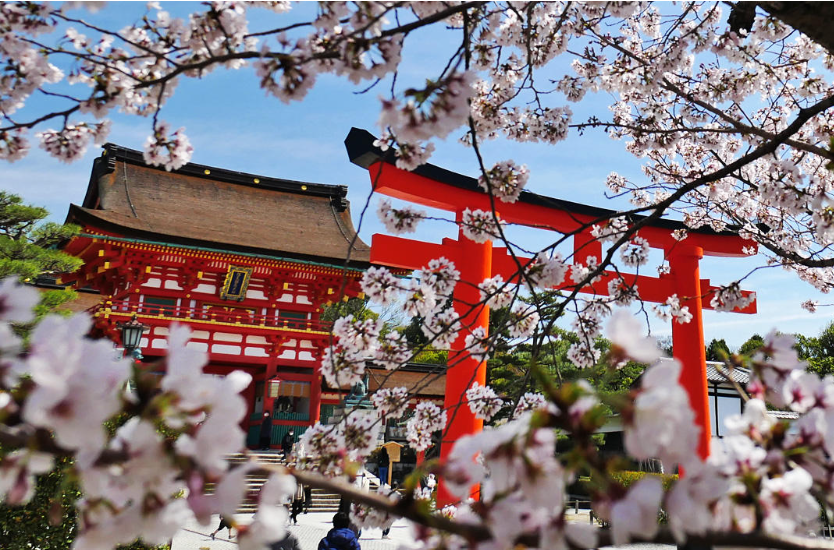
- Spring (late March to May) and autumn (October to November) are the sweet spots: mild weather, cherry blossoms or fiery foliage, and Kyoto and Tokyo at their most photogenic. They’re also the busiest and priciest, so book early.
- Winter (December to February) is for snow. Hokkaido and the Japan Alps get world-class skiing, and a snowy outdoor onsen is one of the country’s great pleasures.
- Summer (June to August) is hot, sticky, and June brings the rainy season. Worth it for festivals, Mount Fuji climbing season, or escaping north to Hokkaido, but a tough first impression otherwise.
For a month-by-month breakdown of weather, events, and what each season is best for, see When Is the Best Time to Visit Japan?
Step 2: Decide How Long to Stay and Map Your Route
How many days do you need? Enough to slow down. First-timers almost always try to cram in too much and spend the trip on trains. Here’s what each trip length realistically gets you, with a sample route to build from.
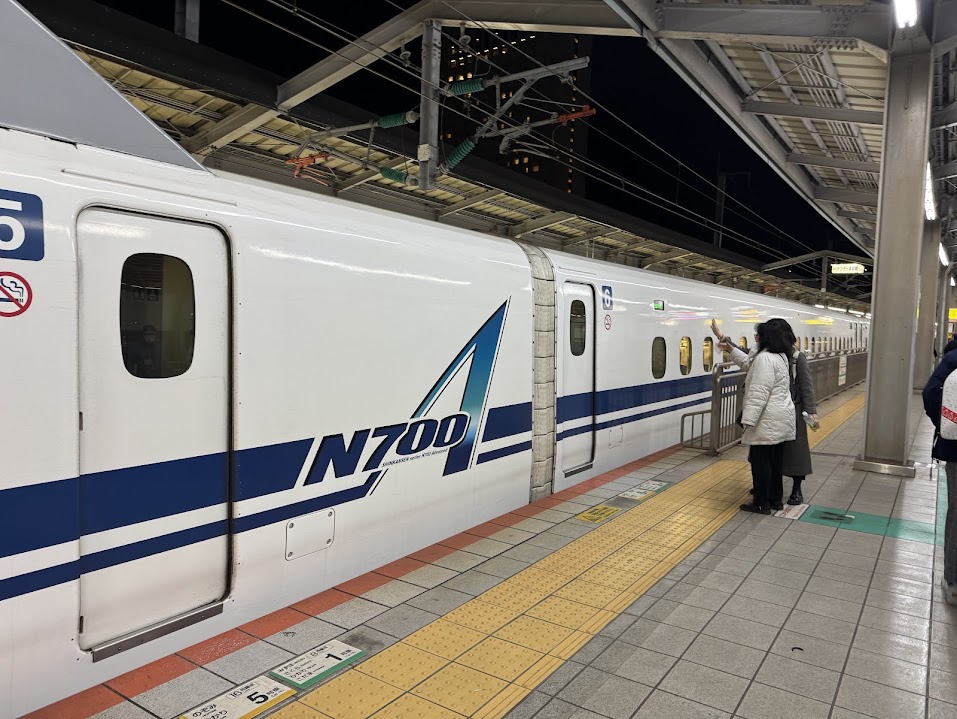
One planning habit that saves a lot of grief: base yourself in a few hub cities and take day trips out, rather than changing hotels every single night. Packing, checking out, and hauling bags across the country eats more time than people expect. Three or four nights in Tokyo, three in Kyoto (with Nara and Osaka as day trips), and a couple further west is far more relaxing than seven one-night stops. Build your route as a string of bases, and treat the shinkansen as the thread connecting them.
7 Days: The Golden Route
The classic first-timer loop is Tokyo to Kyoto to Osaka, with a day trip or two. It’s popular for a reason: it covers the modern-and-traditional contrast people come for, and the transport is easy. A workable day-by-day:
- Day 1: Arrive in Tokyo, drop your bags, and take it easy. Jet lag plus a first walk through Shinjuku or Shibuya at night is plenty.
- Day 2: Old Tokyo, with Senso-ji in Asakusa, Ueno, and the electric chaos of Akihabara.
- Day 3: Shibuya Crossing, Harajuku, and Meiji Shrine, then your pick of teamLab, an izakaya night, or a baseball game.
- Day 4: Day trip to Hakone for hot springs and Mount Fuji views, or Nikko or Kamakura for temples and a breather from the city.
- Day 5: Shinkansen to Kyoto (about 2 hours, roughly ¥14,000). Fushimi Inari’s torii gates in the late afternoon, then dinner in Gion.
- Day 6: Kyoto proper, with Kinkaku-ji and the Arashiyama bamboo grove, or a half-day in Nara to meet the bowing deer at Todai-ji.
- Day 7: Osaka, with Osaka Castle and a final night eating your way through Dotonbori. Fly home from Kansai Airport.
14 Days: Head West Along the Pacific Belt
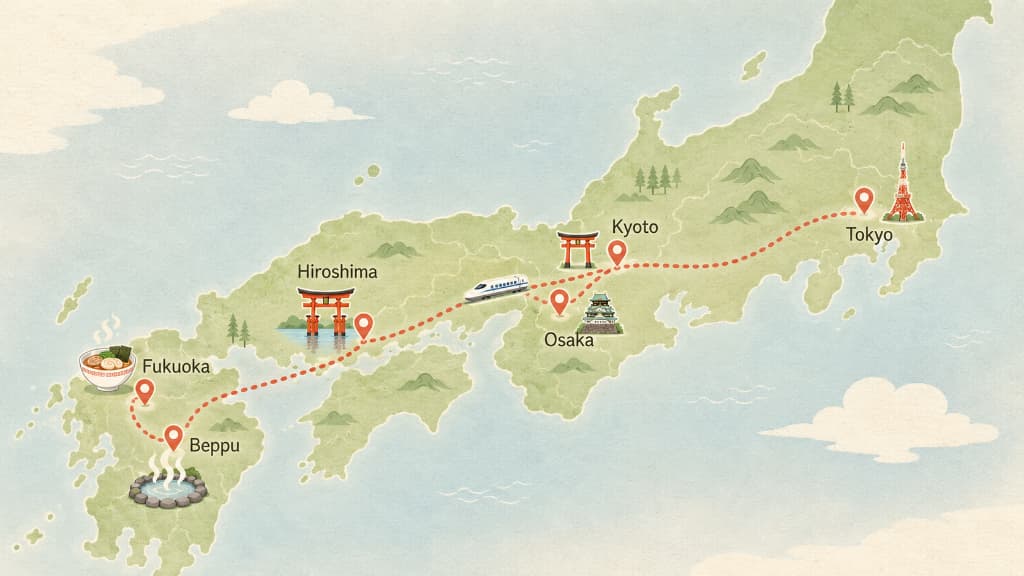
With two weeks, this is the route I push people toward, and it’s the one most first-timers never consider: keep going west past Osaka, down the Pacific Belt to Hiroshima, Fukuoka, and into Kyushu. People hear “regional Japan” and picture sleepy backwaters, but these are big, lively cities with real character, plenty of green and breathing room, some of the best food in the country, and a noticeably warmer, more relaxed feel than the Tokyo crush. It’s the urban-and-countryside balance that makes Japan worth more than a week. For the full day-by-day version of this and two other routes, see our 2-week Japan itineraries
.- Days 1–4 — Tokyo and a Hakone or Kamakura day trip.
- Days 5–7 — Kyoto, Nara, and Osaka, the heart of the Golden Route.
- Days 8–9 — Hiroshima and Miyajima. The Peace Memorial Park is moving and worth a slow half-day. Then it’s oysters and savory Hiroshima-style okonomiyaki, and the ferry to Miyajima for the floating torii gate at sunset, with deer wandering the lanes.
- Days 10–11 — Fukuoka. The gateway to Kyushu and, quietly, one of the most livable cities in Japan: compact, green, on the water, and serious about food. Slurp Hakata ramen at an open-air yatai stall by the river, try motsunabe and spicy mentaiko, and take the short hop to the shrine town of Dazaifu.
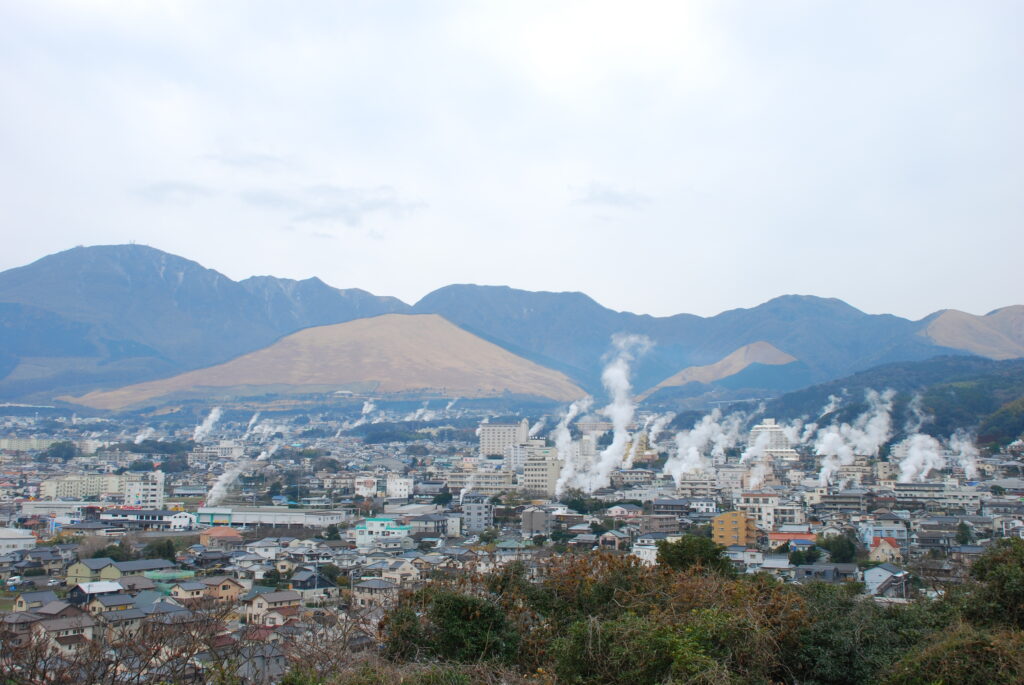
- Days 12–14 — Beppu and Yufuin (Kyushu). End on hot springs. Beppu pumps out more hot-spring water than anywhere on earth except Yellowstone (over 130,000 tons a day, the largest output in Japan). Tour the colorful “hells” (jigoku), soak in a sand bath, then slow down in nearby Yufuin before flying home from Fukuoka.
21 Days: Add the Far Ends
Three weeks lets you reach the parts of Japan that feel like different countries. Build on the two-week route and add one of these:
- Hokkaido (3–5 days): skiing and the Sapporo Snow Festival in winter, or cool air and Furano’s lavender fields in summer.
- The Japan Alps (2–3 days): Kanazawa’s Kenroku-en garden and the old streets of Takayama and Shirakawa-go.
- Deeper Kyushu (3–4 days): Nagasaki’s history, Kumamoto’s castle, and more of the island’s volcanic onsen towns.
Want more ideas by area before you commit? See Best Places to Visit in Japan by Region.
Step 3: Book Flights and Choose Your Tokyo Airport
Airlines release their cheapest long-haul fares roughly 6 to 12 months out, and prices climb fast for cherry blossom season, Golden Week (late April to early May), and New Year. If your dates are fixed around those peaks, book early; if they’re flexible, flying mid-week or just outside peak weeks can save a lot.
Flying into Tokyo, you’ll choose between two airports, and it’s worth a moment’s thought:
- Haneda (HND) is closer, about 30 minutes from central Tokyo, so it’s the kinder choice after a long flight. The Tokyo Monorail in from Haneda has lovely bay views if you want a gentle first look at the city.
- Narita (NRT) has more international routes and is often cheaper, but it’s around 90 minutes out by train or bus. Fine, just factor in the extra travel time on arrival day.
If your route ends in the west, look at flying out of Kansai (KIX) or Fukuoka (FUK) instead of backtracking to Tokyo. An open-jaw ticket (in one city, out another) often costs about the same and saves you a long return leg.
Step 4: Sort the Essentials Before You Go
Register on Visit Japan Web
Visit Japan Web lets you fill in your immigration and customs details before you fly and get a single QR code to scan on arrival. It’s optional (paper forms are still handed out on the plane), but it genuinely speeds things up. As of 2026, Narita, Haneda, and Kansai have new “Joint Kiosk” machines that handle immigration and customs in one go, so having your QR code ready means a quicker walk out of the airport. Set it up a few days before departure.
Decide Whether You Actually Need a JR Pass
This is the big one, and the advice has flipped. Since the 2023 price hikes, the Japan Rail Pass is no longer the automatic buy it used to be. As of 2026 it costs ¥50,000 (7-day), ¥80,000 (14-day), and ¥100,000 (21-day), and overseas agents raise those to ¥53,000 / ¥84,000 / ¥105,000 from October 1, 2026.
- Just the Golden Route (Tokyo–Kyoto–Osaka)? Skip the pass. Individual shinkansen tickets come to roughly ¥30,000, so you’ll save ¥20,000 or more buying point to point.
- Going the distance (Hiroshima, Fukuoka, Kyushu, or Hokkaido) with three or more long bullet-train legs in a week? Then the pass can pay off. Add up your specific routes with an online fare calculator before deciding.
- Either way, regional passes (like the JR Kansai-Hiroshima or all-Kyushu passes) are often the smarter buy than the nationwide one.
Get Connected: eSIM or Pocket Wi-Fi
You’ll want data the moment you land, for maps, train apps, and translation. An Airalo eSIM is the simplest option if your phone supports it (install before you fly, switch on at the gate). Traveling as a group or carrying an older phone? A pocket Wi-Fi you collect at the airport covers several devices at once.
Two Small Things That Make a Big Difference
- Tax-free shopping: short-term visitors can buy tax-free at participating stores by showing a passport. Keep it on you when you shop.
- Luggage forwarding (takkyubin): for around ¥2,000 a bag, send your big suitcase ahead to your next hotel and travel light on packed trains. It feels like a luxury and costs almost nothing. Once you’ve done it, you’ll never drag a suitcase up station stairs again.
Step 5: What to Book in Advance, and When
Some things sell out months ahead; others you can leave to the last minute. A rough timeline:
- 6 months before: peak-season flights and popular hotels and ryokan, plus any bucket-list restaurant. High-end spots like Sukiyabashi Jiro in Tokyo or Kikunoi in Kyoto take reservations months out.
- 1–2 months before: the rest of your accommodation, especially ryokan with private onsen and anything in small towns like Takayama, Shirakawa-go, or Beppu, where rooms are limited.
- 1 month before: shinkansen seat reservations open exactly 30 days ahead. Reserve busy routes like Tokyo to Kyoto, particularly around holidays.
- A few weeks before: tickets for sumo tournaments, theme parks like Universal Studios Japan, tea-ceremony workshops, and seasonal festivals.
Plan the Rest: Budget, Stay & Money
Once your route and dates are set, three decisions remain. We’ve covered each in depth so this page doesn’t have to:
- How much it all costs: a realistic, line-by-line budget is in Japan Trip Cost in 2026.
- Where to stay: compare the cheapest options in Japan on a Budget: Affordable Hotels in Tokyo, Kyoto & Osaka, or splurge with our Best Hotels & Ryokans guide.
- Paying for things: cash, IC cards, QR apps, and getting the best exchange rate (a Wise card is my pick) are all explained in Money in Japan.
Frequently Asked Questions
How many days do I need in Japan?
Seven days is enough for a first taste of Tokyo, Kyoto, and Osaka. Ten to fourteen lets you head west to Hiroshima and Kyushu without rushing, which is the sweet spot for most first trips. Three weeks opens up Hokkaido or the Japan Alps.
Is the JR Pass worth it in 2026?
Not for a standard Tokyo–Kyoto–Osaka trip, where individual tickets are around ¥20,000 cheaper than the ¥50,000 pass. It only pays off if you’re making three or more long shinkansen journeys in a week, such as continuing to Hiroshima and Fukuoka. Check your exact route with a fare calculator, and look at regional passes too.
Do I need to register on Visit Japan Web?
It’s optional but recommended. Registering in advance gives you a QR code that speeds you through immigration and customs, especially at the new Joint Kiosks at Narita, Haneda, and Kansai. If you skip it, paper forms are still available on the plane.
When is the cheapest time to fly to Japan?
Outside the peaks: avoid cherry blossom season, Golden Week, Obon (mid-August), and New Year. Late January to February and June tend to have the lowest fares, and booking 6 to 12 months ahead helps regardless of season.
Should I carry cash or rely on cards?
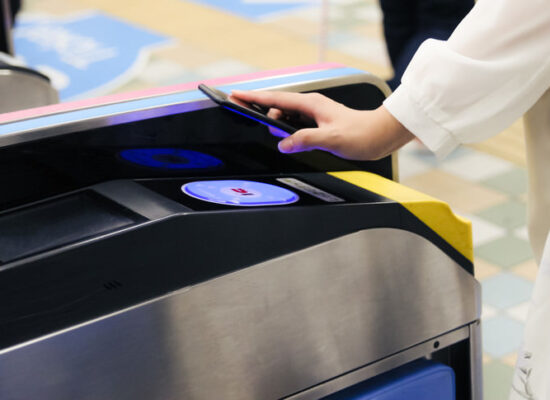
Both. Cards and QR apps work in cities, but small restaurants, shrines, and rural shops are still cash-only, and an IC card (Suica or Pasmo) is the easiest way to ride trains and buy from convenience stores. See Money in Japan for the full rundown.
First-Timer Mistakes to Avoid
A few patterns come up again and again with people planning their first trip:
- Cramming in too many cities. Five cities in seven days means you’ll see a lot of train windows. Pick fewer places and let yourself linger.
- Buying the JR Pass on autopilot. For a Tokyo–Kyoto–Osaka loop it’s now a money-loser. Do the math for your route first.
- Over-scheduling day one. Jet lag is real. Keep your arrival day loose and save the big plans for day two.
- Skipping the west. Most first-timers stop at Osaka. Hiroshima, Fukuoka, and Kyushu are where the trip opens up, with smaller crowds and warmer hospitality.
- Assuming everywhere takes cards. Carry some cash, especially outside the big cities.
Final Thoughts
The trips people remember aren’t the ones that ticked off the most cities, they’re the ones with room to wander. Pick your season, give yourself enough days, and don’t be afraid to head west past the usual route, where the cities are big and friendly and the onsen are waiting. Sort your flights, Visit Japan Web, and connectivity before you go, and the rest falls into place. Then all that’s left is to show up hungry.

4 thoughts on “How to Plan a Trip to Japan: Itinerary Tips for First-Timers (2026)”