There’s a thread that resurfaces on the Japan forums every few months, almost word for word: “These earthquakes are driving me crazy. I can’t sleep.” The replies are always a mix of tough love (“you’ll get used to it”) and something more useful—go do some prep. I want to sit on the useful side of that, because the honest truth is this: you probably won’t stop noticing the shaking, but preparation is the one thing that reliably turns the anxiety down. It gives your nervous system something to point at other than dread.
I’m Japanese, and I grew up with this. I was here for March 11, 2011—the big one. And I’ve watched my husband, who moved here from India, go from white-knuckling his first real quake to calmly checking his phone during a jolt that would once have sent him under the table. This guide is the version I wish someone had handed him: what to actually do when it shakes, what to keep in the closet, and how to stop a bad day from becoming a crisis. It’s about earthquakes first, because that’s what keeps people up at night, but the same habits carry you through typhoons and floods too.
One reassurance before we start: Japan builds for this. Anything constructed under the current seismic code—tightened in 1981 (shin-taishin) and reinforced since—is engineered to hold up in a major quake. Most of what you feel is the ground waving hello, not a building in danger. Your job isn’t to panic; it’s to be the person who already knows what to do.
Start by knowing your own risk
Preparedness is specific. The right move in a quake-only inland neighborhood is different from a coastal block exposed to tsunami or a low-lying area that floods. So before you buy a single bottle of water, look up your address.
- Check the hazard map. Japan’s national Hazard Map Portal (ハザードマップポータルサイト) from the land ministry lets you overlay flood, landslide, storm-surge, and tsunami risk on your exact street. Every municipality also publishes its own map. Do this the week you move in—it’s part of choosing a home, which is why I mention it in our guide to renting an apartment in Japan.
- Know your building. Post-1981 construction is the reassuring line; newer is better still. If you’re in an older building, that’s not a reason to move, but it is a reason to secure your furniture and know your nearest evacuation site.
- Anchor the heavy stuff. More people are hurt by falling furniture and shattered glass than by buildings themselves. Use L-brackets or tension rods (tsuppari-bo) on bookshelves and wardrobes, put film on glass, and don’t place anything tall where it can fall across your bed or your exit.
The moment it hits: what to actually do
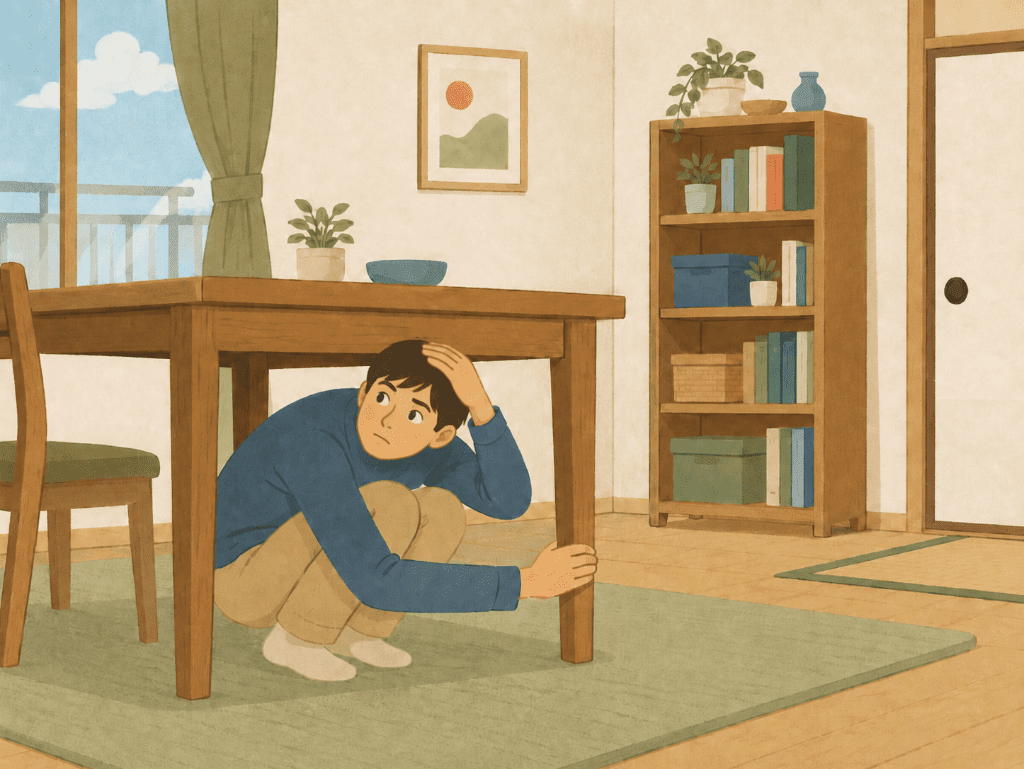
Often you’ll get a few seconds’ warning: phones across the room shriek the Earthquake Early Warning (緊急地震速報) in unison—an alarm you’ll never mistake for anything else. That’s your cue to protect yourself now, before the strong shaking arrives.
The internationally taught rule is Drop, Cover, Hold On: get low, get under a sturdy table, and hold on until the shaking stops. When I felt 3/11 hit, I did something a little more Japanese-apartment-specific: I moved to the bathroom. In many homes it’s the smallest room with the most wall support and no furniture to fall on you, and you’re close to a water source. I got away from the bookshelf—the thing most likely to bury me—and once the first wave passed, I checked that the gas was off. (Modern gas meters cut the supply automatically at around shindo 5, so don’t ever run toward the kitchen mid-quake to do it yourself.) That’s the whole sequence, and it’s worth rehearsing in your head so your body knows it: protect yourself, then—only once it’s calm—deal with gas, doors, and shoes.
- During: Stay away from windows, mirrors, and tall furniture. Don’t bolt outside—falling glass and signage make the street dangerous. If you’re in bed, stay and cover your head with a pillow.
- Right after: Open a door or window to secure an exit (frames can warp and jam). Put on shoes or slippers—broken glass is everywhere. Check the gas meter and smell for leaks; if you smell gas, don’t touch switches.
- Near the coast: If shaking is strong or long, don’t wait for a warning—move to high ground immediately. Tsunami outrun sirens.
The alerts on your phone (and the apps every expat needs)
Your phone is your early-warning system, but only if it’s set up in a language you can read at 3 a.m. Two free apps are built specifically for non-Japanese speakers:
- Safety tips — supervised by Japan’s Tourism Agency, it pushes earthquake early warnings, tsunami warnings, and weather alerts in 15 languages, and includes an evacuation flowchart and handy phrases for asking locals for help. Install this one first.
- NHK World-Japan — the public broadcaster’s international service delivers push alerts and disaster news in 19 languages, with live English-subtitled emergency coverage when something major happens. It’s the closest thing to watching NHK’s authoritative reporting without the Japanese.
You’ll also automatically receive J-Alert messages (the government’s national warning system) and Earthquake Early Warnings through the standard cell-broadcast system—no app required, as long as you don’t disable emergency alerts in your settings. Make sure your phone can actually reach you: keep it charged, keep a battery bank, and if you’re still sorting out your line, our guide to getting a mobile phone and SIM in Japan covers the basics.
Build your stockpile (備蓄)
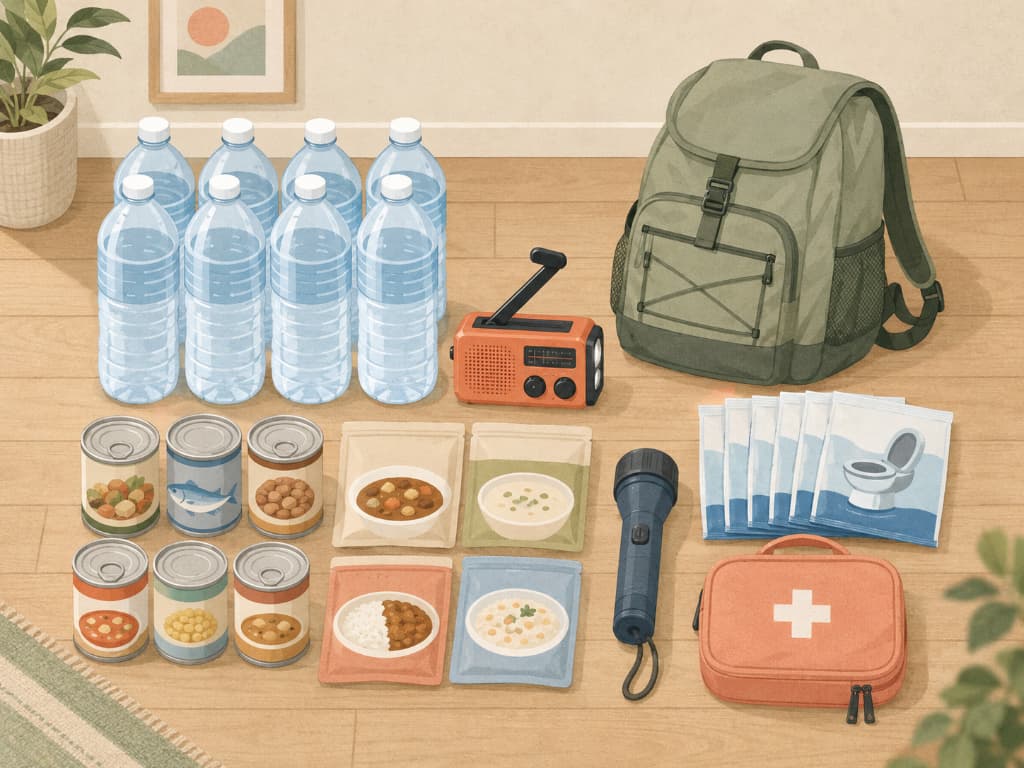
Here’s the mindset shift that makes this easy: you’re not building a bunker, you’re keeping a slightly deeper pantry. Japan’s agriculture ministry recommends a minimum of three days’ supplies, ideally a week, per person—and in dense cities where relief takes longer, plenty of people keep two weeks. The reasoning is staged: enough for day one when nothing’s open, three days until aid arrives, and a week for when supply chains are slow to recover.
- Water: about 3 liters per person per day (drinking plus cooking). For one person for a week that’s roughly 20 liters. In my own home that looks like ten 2-liter bottles of long-life water, rotated before they expire.
- Food you already eat. The trick is rolling stock (ローリングストック): buy a bit extra of your normal shelf-stable food—retort curry, canned goods, instant rice, pasta—and replace it as you use it, so nothing expires and nothing tastes like “emergency.” Keep a cassette gas stove (kasetto konro) and spare canisters to actually cook it.
- A portable toilet is the item people forget. If the water or sewage line breaks, your toilet stops working long before your snacks run out. I keep a pack of simple emergency toilets (簡易トイレ)—coagulant bags that fit over your existing bowl—plus wet wipes. It is not glamorous and it is the thing you will be most grateful for.
- Power and light. A hand-crank radio-charger (手回し充電器) earns its keep here—it charges your phone, gives you a flashlight, and pulls in NHK radio when the network is down and the power is out, all without needing batteries. Add a couple of power banks and a headlamp.
- The rest of the kit: a first-aid kit and any prescription meds, cash in small bills (ATMs and card readers fail), copies of your residence card and passport, a whistle, gloves, a helmet or padded hood, and warm layers or an emergency blanket.
Split it in two: a grab-bag (非常持ち出し袋) by the door with the essentials you’d carry if you had to evacuate in sixty seconds, and a larger home stockpile in a closet for sheltering in place. If you’d rather not assemble it piece by piece, a pre-packed emergency go-bag set is a fine starting point you can customize.
Make a family plan before you need one
In a big quake, mobile networks jam within minutes—not because the towers are down but because everyone calls at once. Voice calls are the first thing to fail, so don’t rely on ringing each other. Decide these things now, while it’s boring:
- The disaster message board. Japan runs Disaster Emergency Message Dial 171: dial 171, then follow the prompts to record or play back a message tied to a phone number. Its web version, web171, does the same online and is checkable from anywhere, including overseas family. Agree in advance on one phone number that everyone will use as the “mailbox,” and actually try it—NTT opens the service for practice on the 1st and 15th of each month and around disaster-awareness days.
- A meeting point and an out-of-area contact. Pick a place to reunite if you’re separated and can’t get home, and choose a friend or relative in another region (or another country) as a relay—it’s often easier to reach someone far away than someone across town.
- Message apps as backup. Data-based apps like LINE often work when calls don’t. But treat them as a bonus, not the plan.
Know where you’re going: hinanbasho vs hinanjo
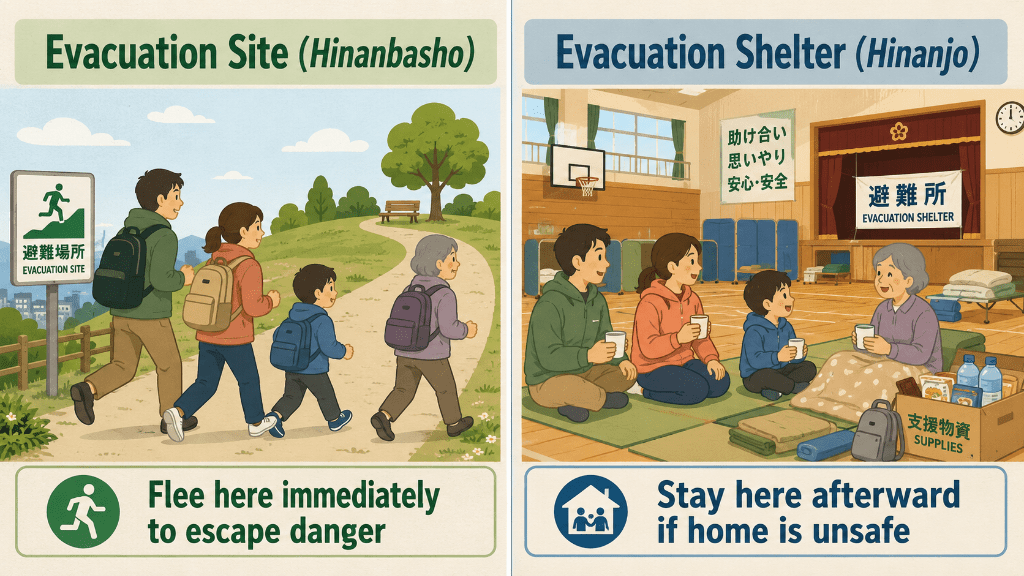
This is the distinction that trips up newcomers, and it genuinely matters. Japanese law separates two kinds of site, and they are not the same place:
- Evacuation site — shitei kinkyū hinan-basho (指定緊急避難場所): where you flee immediately to escape a danger in progress—a park or open ground away from fire, high ground away from tsunami. It’s designated by hazard type, so the right one for a flood may differ from the right one for an earthquake.
- Evacuation shelter — shitei hinan-jo (指定避難所): where you stay afterward if your home is unsafe—typically a school gym or community hall with supplies and information.
Look up both for your address today (they’re on your municipal hazard map and on the Geospatial Information Authority’s site), and walk the route to the nearest one once. Knowing you have somewhere to go is half of what calms the nerves.
Typhoons and floods: read the 5-level warning system
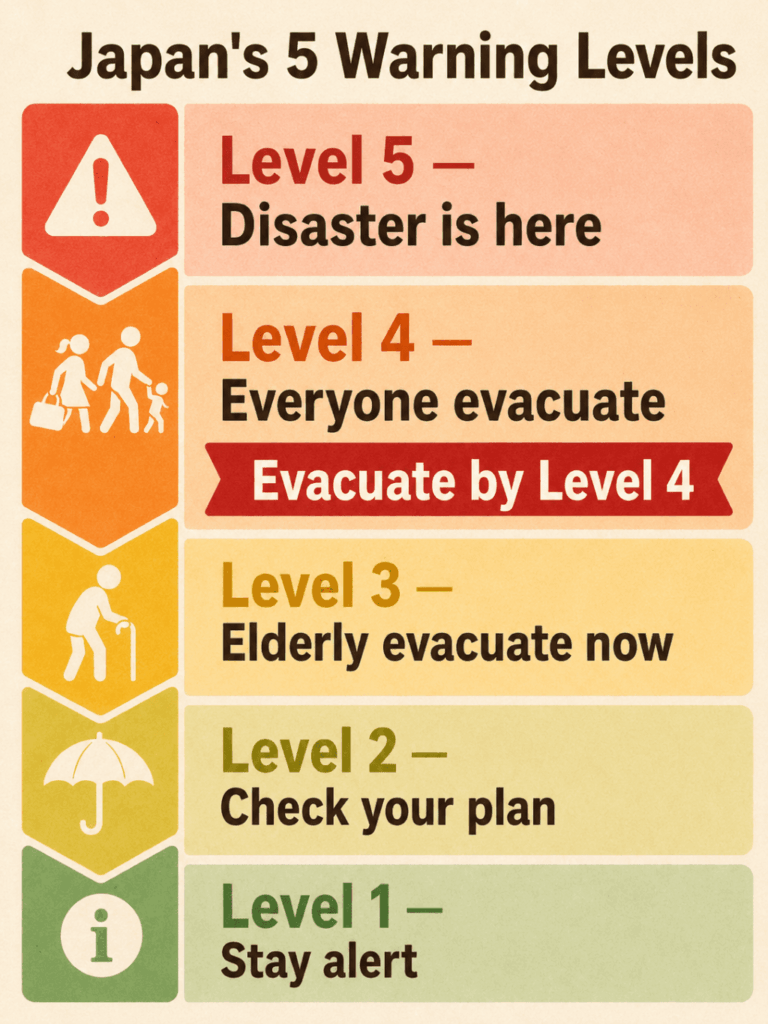
Earthquakes strike without notice; typhoons and heavy rain give you days. Japan’s rainy and typhoon seasons (roughly June through October) come with a 5-level alert scale that tells you exactly when to move. Learn where the line is:
- Level 3 — Evacuation of the elderly, etc. (高齢者等避難): older residents, people with disabilities, families with small children, and anyone who needs more time should leave now. Everyone else gets ready.
- Level 4 — Evacuation order (避難指示): everyone in a dangerous area leaves. Since the 2021 reform this single order replaced the old two-tier “advisory + order” that used to confuse people. The rule is simple: be out by Level 4.
- Level 5 — Emergency safety measures (緊急安全確保): disaster is already happening and safe evacuation may no longer be possible. This is not a “start now” signal—it’s the level you never want to still be home for.
For a typhoon itself: bring in or tie down anything on the balcony, tape or shutter large windows, fill water containers and charge everything before landfall, and once the storm is on you, simply stay inside and away from the glass. (Note that Japan is updating its weather-warning wording from 2026—the 5-level framework and “evacuate by Level 4” principle stay the same.)
One phrase you’ll hear: the Nankai Trough advisory
In August 2024, for the first time ever, Japan issued a Nankai Trough Earthquake Extra Information (南海トラフ地震臨時情報)—specifically the “Giant Earthquake Watch” (Kyodai Jishin Chūi) level—after a quake off Kyushu. It made headlines and confused a lot of foreign residents, so it’s worth knowing what it is.
The Nankai Trough is a massive offshore fault along Japan’s Pacific side, and the JMA now issues an advisory when the odds of a major quake there are assessed as temporarily higher than normal. It comes in tiers (“Investigating,” “Giant Earthquake Warning,” “Giant Earthquake Watch,” “Investigation Ended”). It is not a prediction that a quake is coming—it’s a nudge to double-check your prep, know your evacuation route, and stay reachable for about a week. If you ever hear it, you don’t evacuate; you just do the things in this guide a little more deliberately. The government refined its response guidelines in 2025 to make that expectation clearer.
Frequently Asked Questions
How much water and food should I really store?
Aim for a minimum of three days per person and ideally a week; many people in big cities keep two weeks. For water that’s about 3 liters per person per day—roughly ten 2-liter bottles per person for a week. Use rolling stock so it never expires.
What’s the single most-forgotten item?
A portable toilet. Water and sewage lines can break in a big quake, and a working toilet disappears long before your food does. A pack of coagulant toilet bags and wet wipes is cheap and makes a genuine difference.
I don’t speak Japanese. How will I know what’s happening?
Install the Safety tips app (15 languages) and NHK World-Japan (19 languages) before anything happens. Between them you’ll get earthquake, tsunami, and weather alerts plus live disaster news you can actually read. Keep your phone’s emergency cell-broadcast alerts switched on, too.
Should I run outside when an earthquake starts?
No. Falling glass and signage make the street one of the most dangerous places. Drop, cover under a sturdy table, and hold on until the shaking stops—then secure an exit and put on shoes. The exception is the coast: if shaking is strong or long, head to high ground right away because of tsunami.
Do I need to shut off the gas myself?
Modern Japanese gas meters cut the supply automatically at around shindo 5, so never rush to the kitchen mid-quake. Once the shaking stops, check the meter, and if you smell gas, ventilate and avoid switches. You can restore supply yourself by following the reset instructions on the meter.
What is the Nankai Trough advisory—do I evacuate?
No. It’s an advisory that the chance of a major offshore quake is temporarily elevated, not a prediction or an evacuation order. Treat it as a reminder to check your kit, confirm your evacuation site, and stay reachable for about a week. Carry on with normal life, just a little more prepared.
The Bottom Line
You won’t stop the ground from moving, and after a while you’ll stop expecting to. What changes is your relationship to it. Check your hazard map, secure your furniture, keep a week of water and a portable toilet in the closet, put two apps on your phone, and agree on how your family will find each other. None of it takes a weekend, and all of it converts that 3 a.m. dread into something quieter: I’ve handled this in my head already. That’s what my husband found, and it’s the most Japanese thing he’s learned here—not fearlessness, just being ready. When you do need to call for help in the moment, keep our guide to emergency numbers in Japan handy, and if anyone’s hurt, our overview of Japan’s health insurance and how to see a doctor will help you move fast.