When my husband first moved to Japan, the thing that threw him most wasn’t the language or the trains — it was the cash. He couldn’t believe that a country this high-tech still expected him to carry banknotes around for everyday things. He made his peace with it (“money customs are different everywhere, so this is just how Japan works”), but he’s not wrong: Japan is a strange hybrid. You can tap your phone to ride the train and pay at any convenience store, then walk into a tiny restaurant that only takes coins and bills.
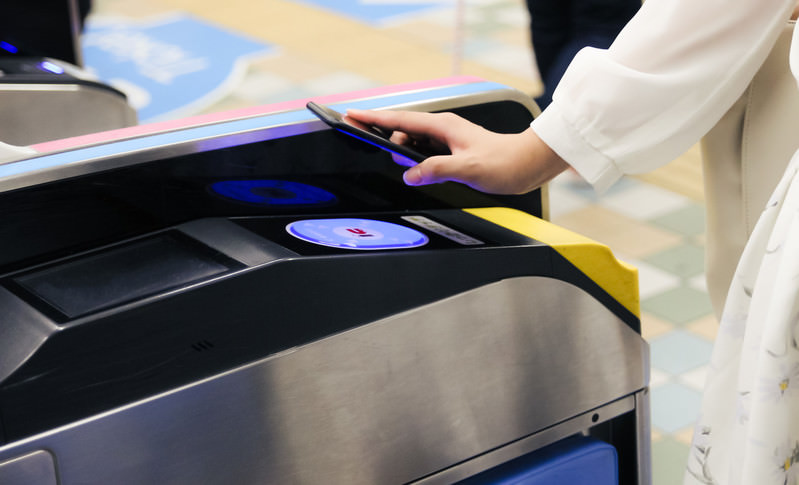
If you’re settling in Japan, this guide covers what actually matters for daily life: how cash and cashless really work here, the bank account and IC card you’ll want, paying rent and bills, getting cash, and sending money home. I’ll flag the tourist-only stuff briefly at the end, but the focus here is on living here.
The Japanese Yen: Notes, Coins, and the New 2024 Banknotes
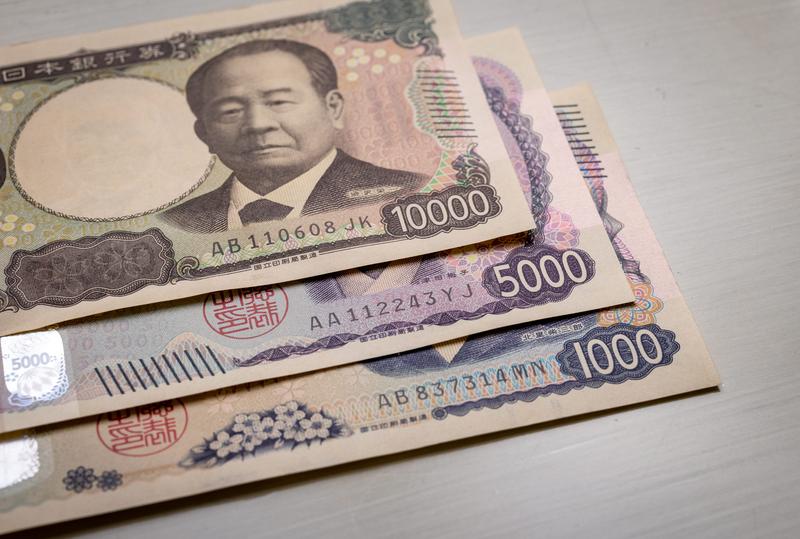
The Japanese yen (¥) is the local currency, and you’ll handle physical money more than you might expect. It’s worth knowing the lineup:
- Coins: ¥1, ¥5, ¥10, ¥50, ¥100, and ¥500. The ¥500 coin is one of the highest-value coins in the world, so your wallet gets heavy fast.
- Banknotes: ¥1,000, ¥5,000, and ¥10,000 in daily use. A ¥2,000 note exists but is rare enough that cashiers sometimes do a double-take.
One thing that surprises returning residents: Japan rolled out redesigned banknotes on July 3, 2024 — its first redesign in 20 years. The ¥10,000 note now features Shibusawa Eiichi (the “father of Japanese capitalism”), the ¥5,000 Tsuda Umeko (a pioneer of women’s education), and the ¥1,000 Kitasato Shibasaburo (a bacteriologist), with 3D holograms that are genuinely hard to fake. Your old notes are still perfectly valid and stay legal tender indefinitely, so there’s nothing to exchange. The only quirk: some older vending machines and ticket machines were slow to accept the new notes, so don’t be shocked if a machine spits one back.
Cash vs. Cashless: Where Japan Actually Stands
The old line that “Japan is a cash-only society” is out of date. Cashless payments blew past the government’s 40% target and have kept climbing — by the latest official count, well over half of consumer spending is now cashless, with credit cards doing most of the heavy lifting and QR-code apps growing fast. In any city, you can get through most days without touching a coin.
And yet. The reason my husband still carries a few thousand yen is that the gaps are unpredictable. Cash is still king — or at least still necessary — in places like these:
- Small, family-run restaurants and old-school izakaya, especially outside the big chains.
- Shrines and temples — entrance fees, omamori charms, and offerings are usually cash.
- Some clinics and smaller medical offices.
- Rural areas, local festivals, and street stalls.
- Splitting the bill with friends — people still settle up in cash surprisingly often.
My rule of thumb after years here: keep around ¥10,000–20,000 in your wallet as a buffer, and you’ll rarely get caught out. One thing you can stop worrying about entirely — tipping. It isn’t customary in Japan, and trying to leave a tip usually just confuses or flusters the staff. Good service is the baseline, not something you pay extra for.
Consumption Tax: What You Actually Pay at the Register
Living here, you’ll meet Japan’s consumption tax on almost every purchase, so it’s worth understanding. The standard rate is 10%, but there’s a reduced 8% rate for groceries and non-alcoholic drinks — basically food you take home. The catch that trips people up: it depends on where you eat. Buy a bento or coffee to go and it’s 8%; eat the same thing in the shop or cafe and it’s 10%, because dining in counts as a service. Convenience stores will sometimes ask “eat in or take out?” for exactly this reason.
Since 2021, shops are required to show tax-included prices (総額表示), so the big number on the shelf is usually what you’ll pay — no nasty surprise at the till like in some countries. Tax-free shopping, by the way, is a tourist-only perk: as a resident with a residence card, you pay consumption tax like everyone else.
Everyday Cashless: IC Cards, Mobile Suica, and QR Apps
This is where daily life in Japan gets genuinely convenient. Once you set up the right tools, you’ll tap and scan your way through most of the week.
IC Cards and Mobile Suica/PASMO
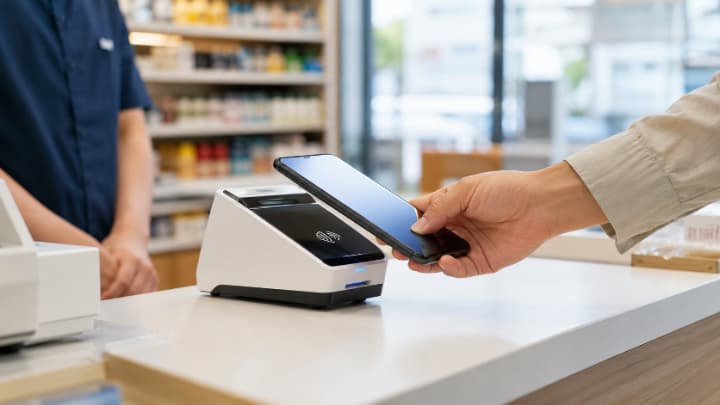
IC cards like Suica, PASMO, and ICOCA started as transit passes but now work as tap-to-pay at convenience stores, vending machines, cafes, and countless shops. After a long pause (a chip shortage halted sales in 2023), unnamed Suica and PASMO cards returned to regular sale in March 2025, so physical cards are an option again.
But honestly, if you live here, skip the plastic and go straight to Mobile Suica or Mobile PASMO on your phone (Apple Pay on iPhone, Google Pay on Android). I use Mobile Suica every day and it’s the single best money tool I have here — when the balance runs low, I just top it up instantly from a credit card, no machine, no queue. It also means one less card in your wallet and no scrambling for a charging machine before the gates. Note that IC card balances cap at ¥20,000, which is plenty for daily use.
QR Code Apps (PayPay and Friends)
QR-code payment apps exploded over the last few years, and PayPay is the runaway leader, accepted everywhere from big chains to tiny noodle shops. Rakuten Pay, d払い (d Barai), and LINE Pay are common too. Once you’re set up with a Japanese bank account or card, topping these up is easy.
The real draw for residents is the points ecosystem. Each app links to a wider world of loyalty points — PayPay points, Rakuten points, d-points, V-points — that you earn on everyday spending and then redeem like cash. Pick one ecosystem and stick with it and the points genuinely add up over a year; juggling all of them just gets confusing. Many people choose their main credit card and QR app specifically to funnel points into one balance.
One feature worth setting up early: sending money to friends. Remember how Japanese people still split bills in cash? PayPay (and LINE Pay) let you send money to a contact instantly, which has quietly become the polite modern way to handle warikan (splitting the bill) without anyone fishing for exact change. After dinner, someone pays and everyone PayPays them back at the table.
Credit and Contactless Cards
Visa, Mastercard, and JCB are widely accepted at mid-range and larger establishments, convenience stores, and supermarkets, and contactless (tap) is increasingly standard. Once you have residency, getting a Japanese-issued credit card unlocks the smoothest setup — auto-charging your Mobile Suica, linking to QR apps, and earning domestic points.
Approval can take patience early on, since a thin credit history in Japan and a short expected stay both count against you. Newcomers often have better luck with cards known for being foreigner-friendly — the Rakuten Card and Epos Card come up again and again — and a stable job and address help a lot. If you’re turned down at first, don’t take it personally; a debit card tied to your bank account works almost everywhere a credit card does, and you can reapply once you’ve built a bit of history here.
Setting Up Your Money as a Resident
The cashless conveniences above mostly depend on one foundation: a Japanese bank account.
Opening a Bank Account
You’ll need a local bank account for your salary, rent, utilities, and to link cards and apps. Employers almost always pay into a Japanese account, and most landlords expect rent by auto-debit or bank transfer. It’s the first piece of admin to sort out — we cover the how-to in detail in our guide to opening a bank account in Japan.
How You Get Paid (and What’s Deducted)
Most employees are paid monthly by bank transfer, often around the 25th, and many companies still add bonuses (賞与) in summer and winter. The number that surprises newcomers is the gap between gross pay and what actually lands in your account. Your payslip (給与明細) shows the deductions: income tax, residence tax (住民税 — note this kicks in from your second year, so your take-home can quietly drop after year one), health insurance, pension, and employment insurance. Take-home pay (手取り) typically runs roughly 75–85% of gross.
Most company employees never file a tax return — your employer handles it through a year-end adjustment (年末調整). You’d only file your own return if you freelance, have side income, or claim certain deductions.
Money and taxes are close cousins here—for the full picture of what comes out of your income, see our guide to income and residence tax in Japan.
Paying Rent, Utilities, and Bills
Day-to-day bills work in a few ways, and you’ll likely use all of them:
- Auto-debit (口座振替): the standard for rent, electricity, gas, water, and phone — money is pulled from your account automatically each month.
- Convenience store payments: utility and tax slips (払込票) can be paid in cash at any konbini register — a genuinely useful safety net when you haven’t set up auto-debit yet.
- App and card payments: more bills now accept PayPay or credit cards, sometimes with a barcode you scan straight off the slip.
Local and national taxes (residence tax, national health insurance, etc.) often arrive as those same payment slips, so don’t toss official-looking mail — it’s frequently a bill with a deadline.
Getting Cash: ATMs That Work for Foreigners
Since you’ll still need cash sometimes, know which ATMs play nicely with foreign-issued cards. The two reliable workhorses are Seven Bank ATMs (in 7-Eleven stores) and Japan Post Bank ATMs — both accept international cards, offer English menus, and are open long hours, with 7-Eleven’s often running 24/7. Lawson and E-net (FamilyMart) ATMs usually work too.
A couple of things to watch: some bank-branch ATMs keep limited hours or charge a fee outside business times, and your home bank may add its own foreign-withdrawal fee. For routine spending it’s far cheaper to pay by card or app and only pull cash when you actually need it.
Sending Money Home: International Transfers
For a lot of expats, moving money out of Japan matters as much as spending it here — supporting family, paying a mortgage back home, or just moving savings. Japanese banks can do international wire transfers, but the fees and exchange margins are steep.
This is where a service like Wise (formerly TransferWise) earns its place. It converts at the real mid-market exchange rate with a transparent, usually much lower fee than a bank, and the multi-currency account lets you hold and move yen, dollars, euros, and more. For regular remittances home, the savings add up quickly. You load funds and send from the app, and recipients get a local deposit on the other end.
A Note on the Weak Yen
You can’t talk about money in Japan right now without mentioning the weak yen. The currency has sat at historically low levels against the US dollar and other majors for the past few years, and it shapes the math in ways worth thinking about. If you earn in a foreign currency and spend in Japan — remote workers, pensioners, anyone funded from abroad — your money goes further than it has in decades. The flip side stings if you’re moving yen out: converting a yen salary back to a stronger home currency, or sending remittances home, buys less than it used to.
There’s no controlling the exchange rate, but two habits help: don’t convert large sums in a panic on a single bad day, and use a real-rate service like Wise rather than a bank so the spread isn’t quietly working against you on top of an already weak rate.
Just Visiting? Quick Notes for Tourists
If you’re here on a short trip rather than settling in, the essentials are simpler:
- IC cards for tourists: short-term visitors can get a Welcome Suica (valid 28 days, no deposit, no refund) at the airport, but the Welcome Suica Mobile app or Mobile Suica/PASMO via Apple Pay or Google Pay is even easier and lasts far longer.
- Getting yen: withdraw from a 7-Eleven or Japan Post ATM rather than exchanging cash at the airport, where rates are poorer. A Wise card withdraws at the real rate.
- Tax-free shopping: tourists can shop tax-free over ¥5,000 — and the system shifts to a refund-at-the-airport model from November 2026. We cover it in our souvenir guide.
For more on getting around as a first-timer, see our guide to the common challenges tourists face in Japan.
Quick Tips for Managing Money in Japan
- Carry a cash buffer. Around ¥10,000–20,000 covers the cash-only gaps without making your wallet a brick.
- Put Suica on your phone. Mobile Suica or PASMO with auto top-up from a card is the everyday workhorse.
- Sort the bank account early. Salary, rent, and auto-debit bills all hinge on it.
- Use Wise for money home. Banks’ international transfer fees are far higher than they need to be.
- Don’t tip. Really. It’s not a thing here.
Frequently Asked Questions
Is Japan still a cash-based society?
Not anymore. Cashless payments have passed the government’s 40% target and now make up well over half of consumer spending, led by credit cards and QR apps. But cash is still needed at small restaurants, shrines, some clinics, and in rural areas, so carry a small reserve.
Do I need a Japanese bank account to live in Japan?
Effectively yes. Employers pay salary into a Japanese account, landlords expect rent by auto-debit or transfer, and utilities and cards all link to it. Opening one is usually the first admin task for new residents — see our guide to opening a bank account in Japan.
Can I use Mobile Suica or PASMO on my phone in Japan?
Yes. Mobile Suica and Mobile PASMO work through Apple Pay on iPhone and Google Pay on Android. You can tap to ride transit and pay in shops, and top up instantly from a linked credit card — no charging machine needed. For residents it’s the most convenient everyday payment method.
Are old yen banknotes still valid after the 2024 redesign?
Yes. Japan issued redesigned 10,000, 5,000, and 1,000 yen notes on July 3, 2024, but the older notes remain legal tender indefinitely — there’s nothing to exchange. A few older vending and ticket machines were slow to accept the new notes, so occasionally a machine may reject one.
What’s the cheapest way to send money from Japan to my home country?
Specialist services like Wise usually beat Japanese banks, converting at the real mid-market exchange rate with a transparent, lower fee. For regular remittances home, the savings over a bank wire add up fast, and a multi-currency account lets you hold and move several currencies.
Do you tip in Japan?
No. Tipping isn’t customary in Japan and can actually confuse staff. Good service is standard and already included, so there’s no need to leave extra at restaurants, taxis, or hotels.




4 thoughts on “Money in Japan: A Practical Guide for Residents and Newcomers”