If you moved to Japan for an office job (engineering, IT, marketing, finance, design, translation), there’s a good chance you’re here on the visa almost nobody can pronounce: Engineer/Specialist in Humanities/International Services, which everyone mercifully shortens to gijinkoku (技人国). It’s the main white-collar work status, and it’s quietly enormous. At the end of 2024 there were 418,706 people living in Japan on it, the third-largest residence status after permanent residents and technical interns, growing by more than 56,000 a year. If you have a degree and a professional job here, this is probably your visa.

This guide covers how gijinkoku actually works: the jobs it does and doesn’t allow, the degree-to-work matching rule that trips people up, how changing employers really goes, why your company’s “category” quietly shapes your paperwork, and the new Japanese-language requirement that starts April 15, 2026, including who it hits and who’s exempt. It’s a companion to our hub guide on status of residence in Japan, our overview of working in Japan, and its sister status for non-degree work, the Specified Skilled Worker visa. Immigration rules shift, so treat this as a map rather than legal advice. Confirm specifics with the Immigration Services Agency’s gijinkoku page or a licensed specialist (行政書士).
What Is the Gijinkoku Visa?
Gijinkoku is Japan’s status of residence for skilled, degree-level office work. The clunky name is really three job families bundled into one visa:
- Engineer (技術): the science-and-tech side. Software and IT engineers, mechanical and electrical engineers, system architects, and researchers with an applied bent.
- Specialist in Humanities (人文知識): the liberal-arts and business side. Marketing, sales, planning, accounting, HR, consulting, and legal and economic work.
- International Services (国際業務): work that leans on a foreign culture or sensibility. Translation and interpretation, in-house language teaching, overseas trade, and certain design and PR roles.
The through-line is that all of it is knowledge work. The one thing gijinkoku firmly does not cover is what immigration calls “simple labor” (単純労働): factory line work, waiting tables, cashier shifts, cleaning, construction. Those jobs are real and legal in Japan, but they run on a different track (that’s what the Specified Skilled Worker visa is for). This distinction is the single biggest source of gijinkoku refusals, and we’ll come back to it.
One genuinely useful feature: unlike the Specified Skilled Worker route, years spent on gijinkoku count toward the ten years of residence you need for permanent residency. So if your long game is to settle in Japan, this visa keeps you moving toward that goal rather than parking you on a road that leads nowhere. For how that math works, see our guide to status of residence and permanent residency.
The Degree-to-Job Match: The Rule That Trips People Up
This is where applications live or die. Gijinkoku isn’t granted just because a job is “office work.” Immigration wants to see a genuine line connecting what you studied (or your professional track record) to what you’ll actually do at the company. The rules differ slightly across the three job families:
- Engineer & Humanities: you generally need a university degree (a Japanese 専門学校 diploma, 専門士, also counts) in a field related to the job. Without a degree, roughly 10 years of relevant work experience can substitute.
- International Services: the bar is usually 3 years of relevant experience. That requirement is waived for translation, interpreting, and language work in your native language, where a degree is enough on its own.
The mismatch trap is real and specific. An economics graduate hired to do accounting is a clean fit; the same graduate hired to wait tables at the company’s restaurant is a refusal, because the job is simple labor no matter how good the degree is. A design graduate hired as a designer is fine; a design graduate hired “as a designer” whose actual daily work is standing at a hotel reception may not be. Immigration reads the real job, not the job title on the contract.
There’s one quirk foreigners often find surprising, especially if they come from a system where your major locks your career. Japan is relaxed about the engineering side in one direction: companies routinely hire humanities and liberal-arts graduates into software-engineer (SE) roles and train them on the job, and immigration accepts it. My husband, who came from India expecting rigid degree-to-role matching, still finds it odd that a literature major can be handed an SE title here. It cuts both ways. It’s easier to break into tech without a computer-science degree, but pay and titles don’t map neatly onto specialization.
The New Japanese-Language Requirement (From April 15, 2026)
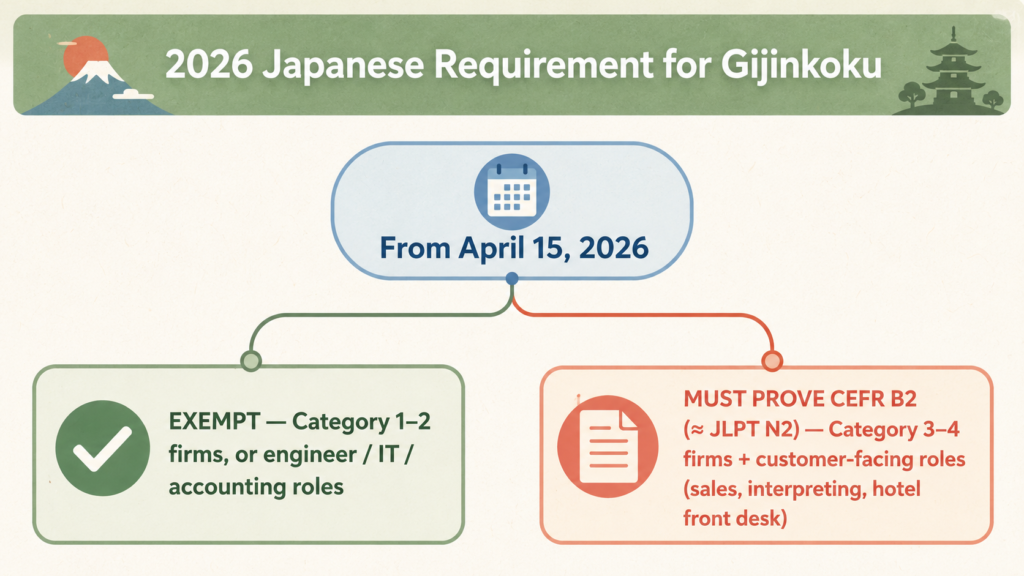
This is the change everyone in the 2026 hiring cycle is asking about, and it’s widely misreported as “gijinkoku now needs N2.” That’s not quite right, and the details decide whether it touches you at all. From April 15, 2026, some (not all) gijinkoku applicants have to prove Japanese ability at CEFR B2 (roughly JLPT N2). The requirement only bites when both of these are true:
- (a) Your employer is a Category 3 or 4 company (smaller or newer firms with a limited tax-filing history, covered in the next section), and
- (b) Your role is a language-centered, customer-facing job: sales, interpreting and translation, hotel front desk, customer service, or managing and communicating with Japanese staff and clients.
If either of those isn’t true, the new rule doesn’t apply to you. Here’s the plain-English version of who’s in and who’s out:
| Your situation | Japanese proof needed from Apr 15, 2026? |
|---|---|
| Software engineer / IT / accounting, any company size | No. Non-customer-facing roles are exempt |
| Sales or hotel front desk at a listed / large firm (Category 1–2) | No. Big employers are exempt |
| Sales, interpreter, or front-desk role at a small/new firm (Category 3–4) | Yes. Must show CEFR B2 (≈ JLPT N2) |
| Renewing the same customer-facing job you already hold | Generally no. Continuing the same work is exempt |
What counts as proof? Any one of: JLPT N2 or above, a BJT Business Japanese Test score of 400+, comparable results on J.TEST or NAT-TEST, or graduating from a Japanese vocational school (専門学校, “専門士”). One catch worth underlining: finishing a Japanese language school alone does not count. It has to be a vocational qualification or a test score. And here’s a nuance the government’s own materials gloss over: the CEFR B2 band actually sits closer to JLPT N1 than N2 on the JLPT’s own comparison chart, so “N2 is safe” is the practical advice, not a cast-iron guarantee for borderline cases. If you’re a career-changer already in Japan renewing within the same role, you generally won’t be asked to re-prove anything. The authoritative source is the ISA’s gijinkoku page; test details are on the official JLPT site.
Company Categories 1–4: Why Your Employer Quietly Matters
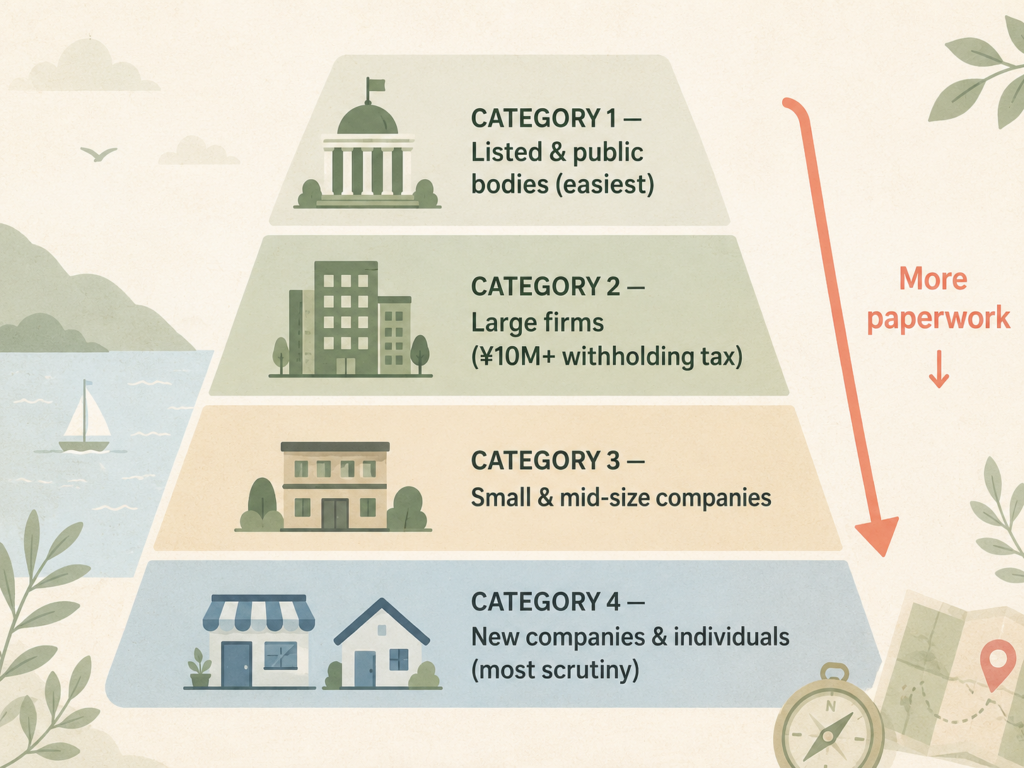
Immigration sorts employers into four categories based on size and tax-filing history, and the category shapes how much paperwork you file, how fast your case moves, and, as we just saw, whether the new language rule applies. You don’t choose your category; your employer’s finances do. But it’s worth knowing which bucket your company sits in, because it tells you what to expect.
| Category | Who it is | What it means for you |
|---|---|---|
| 1 | Listed companies, insurance mutuals, national/local government bodies, independent administrative agencies, large public-interest corporations | Lightest paperwork, fastest screening |
| 2 | Organizations whose prior-year withholding tax (源泉徴収) totaled ¥10 million or more, i.e. large, established firms | Light paperwork, quick screening |
| 3 | Filed last year’s statutory tax report but below the Category 2 threshold. Most small and mid-size companies | More documents; subject to the 2026 language rule for customer-facing roles |
| 4 | None of the above: new companies and individuals with no prior tax-filing record | Heaviest documentation; longest, closest scrutiny |
The practical takeaway: a job offer from a Category 1 listed company is the smoothest possible visa path, while a startup or a brand-new business (Category 4) means more forms and a harder look from immigration. That won’t sink an otherwise solid application; it just adds friction. If you’re weighing two offers and your visa is on a knife’s edge, the employer’s category is a factor most people never think to ask about.
What You’ll Earn, and the Pay Rule
Pay isn’t only a personal concern on gijinkoku; it’s an eligibility rule. Immigration requires your salary to be at least equal to what a Japanese national would earn for the same work at the same company, benchmarked against normal industry pay. If a Japanese colleague doing your job earns more, or if the offer sits below the going rate for the field, the application can be refused on pay alone. Only base salary plus bonus counts toward this test; commuting, housing, and family allowances don’t.
In practice, monthly compensation below roughly ¥180,000–¥200,000 raises the risk of refusal, so treat that as a floor rather than a target. What you’ll actually take home varies enormously by field: an entry-level administrative role may sit near that floor, while bilingual IT, finance, and engineering roles run far higher. For a fuller picture of salaries and how the job market pays, see our guide to working in Japan.
Changing Jobs on a Gijinkoku Visa
This is where gijinkoku is far friendlier than the Specified Skilled Worker visa. On SSW, changing employers means applying for a fresh status and not working until it’s approved, which can mean weeks of unpaid limbo. On gijinkoku, if your new job stays within the visa’s scope (still knowledge work, still degree-matched), you can generally start the new role right away. You don’t need immigration’s blessing before your first day.
What you do have to do is file a “notification regarding the contracting organization” (契約機関に関する届出) within 14 days of leaving the old employer, and again when you sign with the new one. You can do this online, by mail to the Tokyo Regional Immigration office, or in person. Skip it and you risk a fine of up to ¥200,000, plus a black mark that surfaces at your next renewal. It’s a five-minute form; just do it. Details are on the ISA’s notification page.
There’s a smart, optional extra step that seasoned expats swear by: the Certificate of Authorized Employment (就労資格証明書). It’s not mandatory, but it’s immigration formally confirming in advance that your new job genuinely fits your gijinkoku status. Why bother? Because the alternative is finding out at renewal, maybe a year later, that immigration considers your new role a mismatch, after you’ve already built your life around it. Getting the certificate when you switch jobs turns a nasty future surprise into a known quantity now. It’s especially worth it if your new role sits anywhere near the “is this really knowledge work?” line.
One more thing people forget: the three-month rule. If you stop doing the activity your visa is for (say you quit and don’t line up new gijinkoku work) for three months or more without a justifiable reason, your status of residence can be revoked. Being between jobs briefly is fine; drifting for a season without working or job-hunting is not.
The Catch: Finding a Job That Actually Fits
The “knowledge work only” rule has a sharp edge that hits hardest when you’re between jobs. Because gijinkoku can’t cover simple labor, you can’t just pick up convenience-store or restaurant shifts to tide yourself over while you hunt. Those aren’t permitted on this status. If a job offer falls through after you’ve moved (it happens, especially in English teaching), your legal options are narrower than a local’s, and that squeeze is real.
The reassuring flip side: you’re not locked to your current employer or even your exact field. Any gijinkoku-eligible professional role is fair game, and moving into a job that needs a different status just means a change-of-status application, which any serious employer will sponsor. So “my visa says Engineer” doesn’t trap you in engineering; it opens the whole white-collar field to you.
The quieter gatekeeper is Japanese ability, and it matters even outside the 2026 rule. Immigration might not require N2 for your role, but employers often effectively do. Below N3, expats consistently find it hard to land non-teaching white-collar jobs at Japanese companies. The workarounds people actually use: aim at foreign-capital (外資系) firms and international-facing marketing, IT, and customer-success roles where the Japanese bar is lower, and work with a bilingual recruiter (転職エージェント) rather than going it alone. Budget three to six months for a genuine search, and apply broadly, because every stage from document screening to final interview screens people out, and a thin pipeline wears you down fast.
One honest warning, especially around English teaching: read the contract for what it really is. Some “full-time” offers that sound salaried, complete with the promise of social insurance, turn out to be minimum-wage, pay-by-lesson “freelance” (業務委託) arrangements with none of an employee’s protections. Before you uproot your life for a job, confirm whether you’ll be an actual employee enrolled in social insurance and covered by labor law, or an independent contractor dressed up as one.
Gijinkoku vs. the Other Work Visas
Gijinkoku is the broad middle of Japan’s work-visa system, and it helps to see where it sits:
- Below it, for non-degree work: the Specified Skilled Worker (特定技能) status covers hotels, restaurants, care, farming, and construction, exactly the “simple labor” gijinkoku can’t touch.
- Above it, for top earners: the Highly Skilled Professional (高度専門職) status uses a points system (based on salary, degree, age, and Japanese ability) and hands out perks like a fast track to permanent residency. Many gijinkoku holders graduate into it as their careers and salaries grow.
- Alongside it: Business Manager (経営管理) for those starting or running a company, and Intra-company Transferee (企業内転勤) for staff posted to a Japanese branch of their existing employer.
For most professionals arriving to take an office job, gijinkoku is the default, and the others are either steps down (SSW), steps up (Highly Skilled), or special cases. The full landscape is laid out in our status of residence hub.
How to Apply, and How Long It Takes
If you’re coming from overseas, your employer typically files for a Certificate of Eligibility (COE, 在留資格認定証明書) at a Japanese immigration office on your behalf; once it’s issued, you take it to a Japanese embassy or consulate to get the actual visa stamped, then enter Japan. If you’re already here (switching from student status, or from another work status), you file a change of status of residence instead.
Processing time swings on more than the paperwork. A COE for a Category 1–2 employer can come through in a few weeks; a Category 3–4 case, or one filed during the spring rush (roughly December to March), can take one to three months. If you’re already in Japan applying for a change of status or a renewal, there’s a variable people rarely mention: which immigration office handles your case. Applicants routinely report that quieter regional branches clear cases in about two weeks, while the big Tokyo office at Shinagawa tends to be slower for identical paperwork, and several noted faster-than-expected turnarounds through 2026. Don’t assume the maximum period, either: gijinkoku is granted in one-, three-, or five-year spans, and a first grant or a post-job-change renewal often comes back as one or three years rather than the full five.
The documents that carry the most weight are the ones that prove the degree-to-job link: your diploma and transcripts, a detailed description of the actual duties, and the employment contract with salary and role spelled out. Thin or vague job descriptions are what get cases sent back for “additional documents,” which is where the real delay lives. You can file all of this yourself, and plenty of people at Category 1–2 employers do. For a Category 3–4 case, a first-time application, or anything with a borderline job match, hiring an immigration lawyer (行政書士) is common: expect roughly ¥100,000–¥150,000 for a new application or a change of status, and ¥30,000–¥60,000 for a straightforward renewal, on top of a small immigration handling fee (¥6,000 for a change or renewal).
Frequently Asked Questions: The Gijinkoku Visa
Do I really need JLPT N2 for a gijinkoku visa now?
Only in a specific case. From April 15, 2026, you need to prove Japanese at CEFR B2 (about JLPT N2) only if your employer is a Category 3 or 4 company and your job is language-centered and customer-facing, such as sales, interpreting, or hotel reception. Software engineers, IT, and accounting roles are exempt, and so is anyone working for a large or listed (Category 1–2) employer. If you’re renewing the same customer-facing job you already hold, you generally won’t be asked to prove it either.
Can I change jobs freely on a gijinkoku visa?
Largely, yes, as long as the new job stays within the visa’s scope (knowledge work that matches your background). You can usually start the new role right away, unlike the Specified Skilled Worker visa, but you must file a “contracting organization” notification within 14 days, and it’s smart to get a Certificate of Authorized Employment (就労資格証明書) to confirm the new role fits before your next renewal.
Can I do part-time or side work on gijinkoku?
Not automatically. Your gijinkoku status is tied to your main employer’s knowledge-work role. To take on side work outside that scope (especially anything resembling simple labor), you need “permission to engage in activity other than that permitted” (資格外活動許可) from immigration. Side work that’s still clearly within your professional field is a grayer area; when in doubt, ask immigration or a 行政書士 rather than assuming.
Does time on a gijinkoku visa count toward permanent residency?
Yes. Unlike Specified Skilled Worker Type 1 or Technical Intern time, years on gijinkoku count toward the residence requirement for permanent residency (generally ten years, with a shorter path via the Highly Skilled Professional points system). It’s one of the reasons gijinkoku is a solid base for settling in Japan long-term.
Can I bring my family on a gijinkoku visa?
Yes. Gijinkoku holders can bring a spouse and children on a Dependent (家族滞在) status. Dependents can work part-time up to 28 hours a week with permission to engage in activity outside their status. This is a major practical advantage over the Specified Skilled Worker Type 1 visa, which doesn’t allow family accompaniment at all.
Key Takeaways
- Gijinkoku (技人国) is Japan’s main white-collar work visa, with over 418,000 residents and rising, covering engineering, IT, business, and international/language roles, but never “simple labor.”
- Applications succeed or fail on the degree-to-job match: immigration checks that your studies or experience genuinely line up with the real work, not the job title.
- From April 15, 2026, a CEFR B2 (≈ JLPT N2) Japanese requirement applies only to customer-facing roles at smaller (Category 3–4) firms; engineers, back-office staff, and anyone at a large employer are exempt.
- Your pay must legally match a Japanese colleague’s for the same work; below about ¥180,000–¥200,000 a month refusals get likely, though actual salaries vary widely by field.
- Your employer’s category (1–4) affects paperwork and speed: Category 1 listed firms are the smoothest, Category 4 new businesses the most scrutinized.
- Changing jobs is easy compared with SSW (you can usually start right away), but file the 14-day notification, mind the three-month rule, and consider a Certificate of Authorized Employment to de-risk your next renewal.
- When job-hunting, remember you can’t take stopgap combini or restaurant work, but you’re free to switch professional fields. Below N3 Japanese, foreign-capital firms and a bilingual recruiter are your best route in.
- Gijinkoku years count toward permanent residency, and you can bring family, making it one of the better foundations for a long-term life in Japan.
For the bigger picture (renewals, changing status, and the road to permanent residency), start with our hub guide to status of residence in Japan. For salaries and the job market, see working in Japan, and for the non-degree route, our guide to the Specified Skilled Worker visa.



2 thoughts on “The Gijinkoku Visa (Engineer/Humanities/International Services): The Complete Expat Guide (2026)”