Walk into Sanjusangen-do and you stop talking. A thousand and one gilded statues of Kannon, the goddess of mercy, stand in silent ranks down a hall longer than a football field — row after row of them, each face slightly different, all catching the low light at once. It’s one of Kyoto’s most quietly overwhelming sights, and it sits in the Higashiyama district surrounded by other temples, a shrine, and a great national museum, which makes it the perfect anchor for a half-day on foot. Here’s what you’re looking at, and how to build a walk around it.
A Brief History
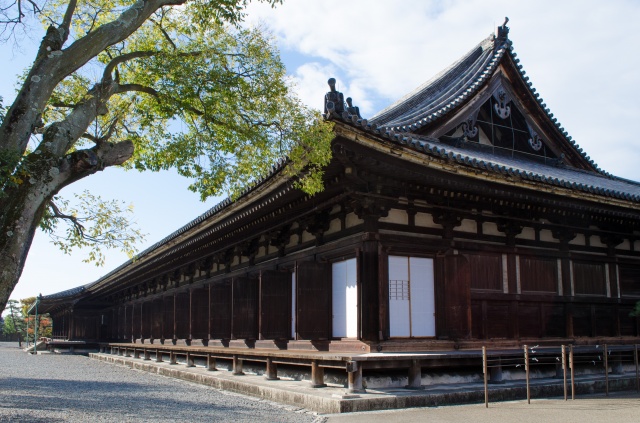
Sanjusangen-do — officially Rengeo-in — was founded in 1164 on the order of Emperor Go-Shirakawa. The name (三十三間堂) means “hall of thirty-three bays,” after the 33 spaces between the pillars running down the main hall. That number isn’t decorative: 33 is how many forms Kannon is said to take to save people in the world. The original burned down in 1249 and was rebuilt in 1266, and that rebuilt hall is the one still standing today — more than 750 years on, and a designated national treasure.
What Makes It Famous
Two things, really. The first is the army of statues. The hall holds 1,001 figures of Kannon arranged in ten tiered rows, with a large seated Kannon at the center carved by Tankei, a master sculptor of the Kamakura period, standing about 3.35 meters tall. Flanking it are a thousand life-size standing Kannon, each with a fan of arms — the “thousand-armed” form, said to reach every corner of existence. They’re carved from Japanese cypress and gilded, and the old belief is that if you look long enough you’ll find a face resembling someone you’ve lost. Tucked among them are 28 guardian deities, some wonderfully fierce, that are national treasures in their own right.
The second is the building itself. At roughly 120 meters, it’s the longest wooden structure in Japan, built long and low specifically to house that wall of statues. Standing at one end and looking down the dim, endless hall is the moment most people remember.
The Tōshiya Archery Contest
If you’re in Kyoto in mid-January, time your visit for the Tōshiya. In the Edo period, archers would compete to fire as many arrows as possible down the full length of the veranda — the all-time record runs into the thousands in a single day and night, an almost unbelievable feat of endurance. Today it survives as a national archery competition held around Coming-of-Age Day, when hundreds of 20-year-olds, many of the women in gorgeous furisode kimono, line up to shoot. It’s free to watch and genuinely photogenic, which makes January a rewarding (if cold) time to come.
Visiting Sanjusangen-do
One thing to know before you go: photography is not allowed inside the main hall. The statues are sacred objects, not exhibits, and the no-photos rule is taken seriously — you can shoot the garden and the exterior, but the interior you’ll have to keep in your memory. Allow 30–45 minutes inside, and come early in the day if you can, as tour groups fill the hall by late morning. Pair the timing with our season-by-season guide to visiting Japan.
- Admission: ¥600 adults, ¥400 junior/senior high, ¥300 elementary.
- Hours: Apr 1–Nov 15, 8:30–17:00; Nov 16–Mar 31, 9:00–16:00 (last entry 30 min before closing).
- Photography: Prohibited inside the hall; fine outside.
- Getting there: From Kyoto Station, city bus 100, 206, or 208 to the “Hakubutsukan Sanjusangendo-mae” stop (about 10 min); or a 10-minute walk from Shichijo Station on the Keihan Line.
- Official site: sanjusangendo.jp.
For getting around the city more broadly, see our guide to transport in Japan, and for where to stay nearby, our roundup of the best hotels and ryokans in Kyoto.
A Walking Tour of the Neighborhood
Sanjusangen-do is the headline, but the surrounding blocks pack in a startling amount of history. This loop links five more sites, all within a few minutes of each other — an easy half-day. It also sits within the wider Higashiyama sightseeing area; see how it fits with the rest of the city in our guide to the best places to visit in Japan by region.
1. Hōkō-ji and the Bell That Started a War
Start at Hōkō-ji, a short walk away. Toyotomi Hideyoshi built a colossal Great Buddha hall here in the 1590s, larger than the one in Nara; it’s long gone, but the temple’s enormous bronze bell survives — and it’s one of the most consequential objects in Japanese history. Cast in 1614 by Hideyoshi’s son Hideyori, the bell carries an inscription reading kokka ankō (“peace for the nation”) that splits the characters of Tokugawa Ieyasu’s name. Ieyasu chose to read it as a veiled curse, used it as a pretext, and laid siege to Osaka Castle — wiping out the Toyotomi clan within a year. You can still see the fateful characters circled on the bell today.
A 2-minute walk to Toyokuni Shrine.
2. Toyokuni Shrine
Next door stands Toyokuni Shrine, dedicated to that same Hideyoshi, who is enshrined here as a deity. Its Karamon — a lavishly carved gate moved from Fushimi Castle — is a national treasure, and the rows of stone lanterns were offered by Hideyoshi’s old retainers. It’s a quiet, atmospheric spot that ties the whole Toyotomi story together.
About an 8-minute walk to the Kyoto National Museum.
3. Kyoto National Museum
Across the street is the Kyoto National Museum, opened in 1897. The original red-brick hall (an Important Cultural Property) sits opposite the sleek Heisei Chishinkan Wing by architect Yoshio Taniguchi, and the collection runs deep in Buddhist sculpture, scrolls, and ceramics, with rotating special exhibitions. The shop is good for souvenirs — think Tale of Genji totes and kimono-pattern stationery.
- Admission: Collection galleries around ¥700; special exhibitions priced separately (often ¥1,800).
- Hours: 9:30–17:00 (later on exhibition Fridays), closed Mondays — check ahead, as the museum sometimes closes between exhibitions.
- Official site: kyohaku.go.jp.
A 6-minute walk back to Sanjusangen-do.
4. Sanjusangen-do
Here’s the centerpiece of the walk — step inside for the thousand and one Kannon and the long hall (full visiting details above). It’s worth saving real time for, so don’t rush the rest of the loop on its account.
A 3-minute walk to Yōgen-in.
5. Yōgen-in and the Blood Ceilings
Just east is Yōgen-in, a small temple with a dark secret overhead. Its ceilings were built from floorboards salvaged from Fushimi Castle, where, in 1600, hundreds of Tokugawa loyalists took their own lives rather than surrender during a siege. Look up and you can still make out bloodstains — even the outline of handprints and a face — in the old wood. The temple also guards painted sliding doors by the great artist Tawaraya Sōtatsu, making it a strange, memorable stop.
A 2-minute walk to Hōjū-ji.
6. Hōjū-ji
Finish at Hōjū-ji, home to the Migawari Fudō Myō-ō, the “substitute” Fudō said to take a worshipper’s misfortune onto itself. The temple has a connection to the 47 Rōnin: Ōishi Kuranosuke, who led the famous vendetta, is said to have prayed to this Fudō before the raid. It’s a fittingly quiet, slightly haunted note to end a walk steeped in Kyoto’s turbulent past.
Practical Tips for the Walk
- Time needed: Half a day for the full loop, more if you linger in the museum.
- Getting there: The whole cluster is a 10-minute bus ride or short taxi from Kyoto Station, so it’s easy to do first thing before heading deeper into Higashiyama.
- Food nearby: Options thin out right around the temples, so plan a meal back toward Kyoto Station or Gion; our guide to Japanese food experiences has ideas.
- Dress for it: You remove your shoes inside Sanjusangen-do and the hall is unheated, so warm socks help in winter.
FAQs
Can you take photos inside Sanjusangen-do?
No. Photography is prohibited inside the main hall to respect the sacred statues. You can freely photograph the building’s exterior and the garden, but the 1,001 Kannon you’ll have to enjoy in person.
How long do you need at Sanjusangen-do?
About 30–45 minutes for the hall itself. Add the neighboring temples, shrine, and museum and you have a comfortable half-day walking tour.
How much is admission and when is it open?
Entry is ¥600 for adults. It’s open 8:30–17:00 from April to mid-November and 9:00–16:00 in winter, with last entry 30 minutes before closing.
How do I get there from Kyoto Station?
Take city bus 100, 206, or 208 about 10 minutes to the “Hakubutsukan Sanjusangendo-mae” stop, or walk 10 minutes from Shichijo Station on the Keihan Line.
When is the Tōshiya archery contest?
Mid-January, around Coming-of-Age Day. It’s free to watch and a wonderful sight, with many young women competing in furisode kimono.
Worth the Trip
Plenty of visitors rush between Kiyomizu-dera and Fushimi Inari and never make it here, which is exactly why it stays calmer than Kyoto’s headline temples. Between the silent hall of a thousand Kannon, a bell that toppled a dynasty, and a ceiling stained with the end of a siege, this little corner of Higashiyama packs in more history than neighborhoods ten times its size. Give it a morning.