If you plan to live in Japan, opening a bank account is one of the first tasks you’ll face. It may sound simple, but the process can surprise many foreigners. Banks often ask for documents and procedures that don’t exist in other countries—the famous hanko (personal seal), proof you’ve registered your address, a local phone number—though, as you’ll see, a signature now works in place of a seal at most banks.
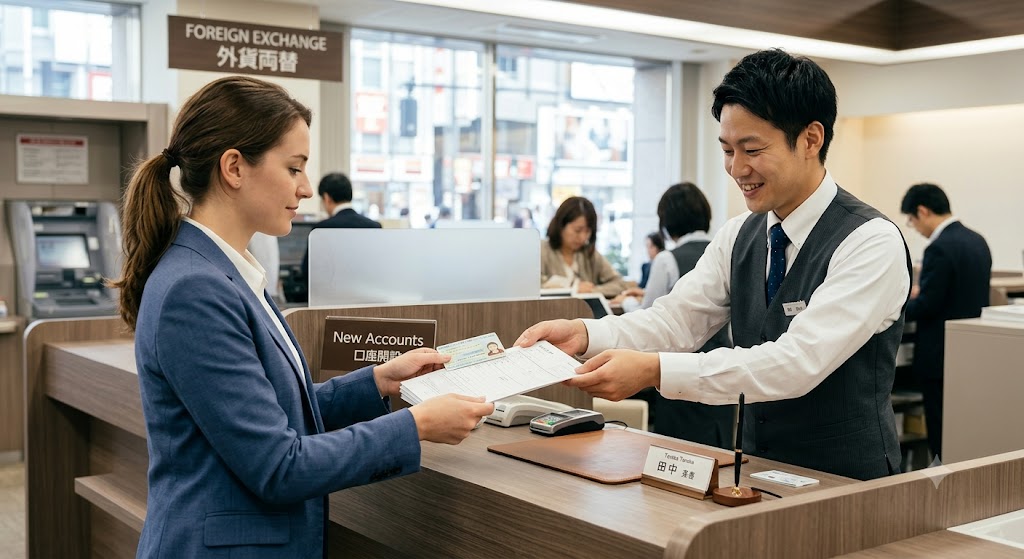
I’ve seen these challenges up close. As a Japanese, I recently helped my foreign spouse open a bank account, and the process gave me a clear picture of where people often get stuck.
The good news is that once you understand the requirements, opening a bank account in Japan becomes much easier. In this guide, I’ll share the exact steps, documents you need, and tips for choosing a bank that’s foreigner-friendly.
Requirements for Opening a Bank Account in Japan
To open a bank account in Japan, you need to meet certain requirements.
Residency status
You must have a valid visa and a residence card (zairyū card). Tourists are not allowed to open accounts.
Resident registration (jūminhyō)
Even if your visa allows you to stay in Japan for more than six months, you cannot open a bank account without being officially registered as a resident. This means you must file your address at the city hall and obtain a jūminhyō (住民票 / residence certificate).
Minimum stay
To open a standard Japanese bank account, you need a valid residency status and must have been living in Japan for at least six months.
- If your stay is less than six months, you are considered a non-resident under Ministry of Finance Notice No. 4672. In that case, most banks will only let you open a “Non-Resident Yen Deposit Account”, which has limited functions (for example, no international remittances).
- An exception is Japan Post Bank (ゆうちょ銀行), which allows foreigners to open a standard account as long as they have at least three months remaining on their visa. This is often the best solution for people planning to stay between three and six months.
No age requirement
There is no legal age limit for opening a bank account in Japan—you can open one from birth to old age. However, if you are under 18, a parent or guardian usually needs to complete the application on your behalf or provide consent.
Essential Documents for Opening a Bank Account in Japan
Before going to the bank, it’s important to prepare a few items in advance.
Hanko or signature? (you may not need a seal at all)
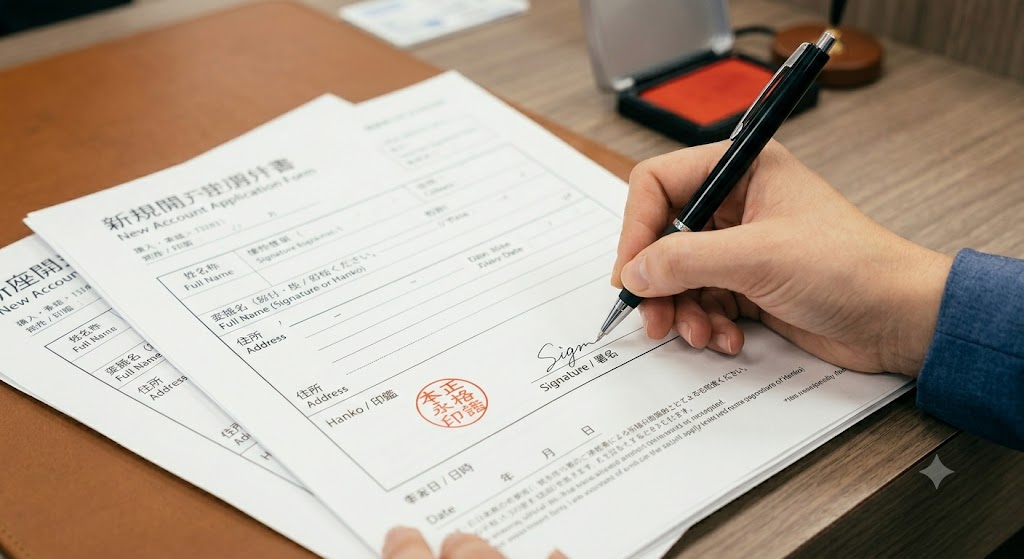
This is the question I get asked most, so let’s clear it up first: you probably don’t need a hanko to open a bank account anymore. The rules have loosened a lot. Most online banks (Rakuten, Sony, SBI Shinsei) are seal-free and run on a signature, the megabanks let foreigners register a signature instead of a seal, and MUFG even offers a dedicated seal-less account (印鑑レス口座). Japan Post Bank also accepts a signature for foreign customers.
So the honest advice: ask your bank whether they’ll register a signature—most will—and don’t rush out to buy a seal just for the bank. A hanko only becomes essential if a particular bank or branch insists on one, or if you’re managing certain in-person paperwork later.
That said, living in Japan, a hanko still comes in handy for other admin—signing a rental contract, work paperwork, or delivery slips—so plenty of foreigners end up getting one anyway. If that’s you, here’s what’s worth knowing.

Skip the cheapest seals for anything official. Mass-produced sanmonban seals from a ¥100 shop or stationery store aren’t unique—identical impressions are sold all over the country—so using one as a registered bank or contract seal genuinely raises your forgery and impersonation risk. A custom, hand-carved seal is unique and much harder to duplicate, which matters because banks still verify the physical impression at the counter.
If you decide to get one, a seal shop or an artisan seller online is the way to go (for example, handmade seals on Amazon Japan). A few practical tips:
- If you do register a seal, bring it when you open the account—the bank keeps the impression on file, and it must match exactly afterward.
- Treat your hanko like a bank card or passport, and store it in a case away from the seal’s registration record.
Phone number in Japan
Most banks require a local Japanese phone number when you open an account, but this can be tricky for foreigners. The type of SIM card you use often makes a difference:
- Postpaid SIMs (contract-based) are the safest option. Because you pay after usage, they are more trusted by banks. Many providers also offer “cheap SIMs” (格安SIM / MVNOs), which have lower fees and simpler contract requirements.
- Prepaid SIMs can be bought at airports and convenience stores, but they are often not accepted for bank account registration. They are useful for tourists, but not for opening a bank account.
👉 For long-term residents, one popular option is Sakura Mobile. Their postpaid plan provides a Japanese phone number, unlimited internet, and costs ¥3,278 per month. You can even set up from overseas before arriving in Japan.
Other standard documents
Besides a signature (or hanko) and a phone number, banks typically ask for:
- Residence card (在留カード / Zairyū card)
- Passport
- Proof of address: jūminhyō (住民票 / residence certificate) or utility bills such as electricity, gas, water, NHK, or landline phone. ⚠ Mobile phone bills are usually not accepted.
Step-by-Step Process for Opening a Bank Account in Japan
Choose a bank
Some banks are more foreigner-friendly than others. Japan Post Bank and Shinsei Bank are often easier for newcomers, while MUFG, SMBC, or Mizuho may require more Japanese ability.
Points to consider
- English support (available at some banks, limited at others)
- Online banking features
- Accessibility of branches and ATMs
Applying & Submitting Your Application
Many banks now offer multiple ways to open an account—either by visiting a branch (with or without an appointment) or applying online. For example, SBI Shinsei Bank provides an online application: you can apply digitally, and then receive a printed form by mail to return with your documents.
When preparing to apply, here’s what to expect at each step:
- You’ll fill in personal information like name, address, and contact number. If the bank requires a hanko, you’ll stamp it where indicated.
- Submit your documents, which generally include your:
- residence card
- passport
- proof of address
- phone number
- hanko
Challenges many foreigners face
- Most application forms are in Japanese.
- Mistakes often come from mixing up name order (surname vs given name). In Japan, your family name usually comes first.
Example: How SBI Shinsei’s Process Works
- You apply online and the bank mails a printed application form to your address (expected in about 1 week)
- You send the completed form plus identification documents back by mail. The review takes about 7–10 business days.
- Once approved, your cash card is mailed (via registered mail) and the PIN is sent separately.
SBI Shinsei also supports English internet banking via its PowerDirect platform, making it easier for non-Japanese users to manage their accounts online.
Receive your bank book and ATM card
If everything is in order, the bank will issue you a cash card and a passbook (tsūchō). Some banks give the card immediately, while others send it by mail within a few days to confirm your address.
Things to watch out for
- If your visa period is short, you may only be offered a limited account.
- Your registered hanko must match exactly, or transactions can be refused.
- Language support varies — bringing a Japanese-speaking friend can be helpful.
Best Banks for Foreigners in Japan

When selecting a bank in Japan as a foreigner, it helps to consider English support, ease of opening an account, online services, fees, and reliability. Below is a context-setting table of major banks by scale, followed by a list of banks often recommended for foreign residents.
Major Japanese Banks by Scale
To give you context on which banks hold the most deposits in Japan—and therefore have high stability and resources—here’s a ranking based on public data:
| Bank | Approx. Deposit Balance* | Key Characteristics / Notes |
|---|---|---|
| Japan Post Bank (Yūcho Bank) | ~ ¥190–192 trillion (2024) | Largest by retail reach. Nearly 120 million ordinary deposit accounts. |
| MUFG | Top-tier megabank | Japan’s largest financial group, strong domestic & global network |
| SMBC | Top-tier megabank | Extensive branch network, widely used by individuals and corporations |
| Mizuho Bank | Top-tier megabank | Strong presence in both retail and corporate sectors |
| Rakuten Bank | ~ ¥11+ trillion (2024) | Fully digital, fast-growing, convenient online features |
| SBI Shinsei Bank | Moderate scale, growing deposit base | Focuses on digital & foreign-friendly services |
* Approximate figures or relative rankings based on recent public data and press reports.
Foreigner-Friendly Banks & Their Strengths

| Bank | Advantages for Foreigners | Notes / Cautions |
|---|---|---|
| SBI Shinsei Bank | • English internet banking via PowerDirect • Supports foreign currency deposits and online features • Open online, then submit documents by mail | Branches operate mainly in Japanese; English support is not guaranteed at every branch, and some users report English phone support being reduced |
| SMBC Trust Bank (PRESTIA) | The strongest full English service for foreigners: English staff, branches, app, and multi-currency accounts | Best for mid-to-higher earners—you generally need to keep around ¥1,000,000 (or equivalent) to avoid a monthly maintenance fee |
| Rakuten Bank | Fully online, English-friendly interface, quick signup, low international-transfer fees | No physical branches—cash services depend on partner ATMs |
| Japan Post Bank | Most accessible thanks to the nationwide postal network; account-opening app supports 16 languages | International transfer and foreign-exchange fees tend to be higher—compare with Wise |
| Sony Bank | Online bank with an English app and 12-currency support | Still has English service, but new account applications via the English flow ended in 2025; no branches (ATM/partner networks only) |
| Seven Bank | Strong ATM network with 24/7 availability in 7-Eleven stores | Basic banking features; not all advanced services available |
Personally, I’ve found Shinsei Bank to be a great choice for our main account because of its English-language support and the availability of English forms. However, it’s worth noting that their phone customer service no longer offers direct English-language support. For day-to-day payments, we also use PayPay Bank, which allows easy online account setup. If you’re comfortable with Japanese, it’s highly convenient, especially since it integrates smoothly with the PayPay QR payment system, making transactions quick and hassle-free.
Common Challenges & Tips
Japanese-only forms & language barriers
Many banks in Japan only provide application forms and documents in Japanese. This can cause confusion over how to fill in your name, address, or other details. Using a translation app or having someone who speaks Japanese assist you can reduce mistakes.
Name order and consistency
In Japanese forms, the family name usually comes first. Errors can happen if your name in Katakana or Roman letters doesn’t match across documents. Always use the same spelling on your residence card, bank application, and other official papers.
Visa expiration and account access
There have been reports of accounts being frozen when a person’s visa or residence status expires. While rare, this can happen if banks suspect misuse or lapses in legal status. To prevent issues, renew your visa before it expires and inform your bank of any changes to your residency.
Strict identity checks and extra documentation
Banks may ask for additional proof if you’re new to Japan or don’t have local financial history. Be prepared to show documents like employment contracts, pay slips, or proof of income.
High cost of bank international transfers
Banks usually charge a fixed handling fee (e.g. around ¥5,000) plus a percentage of the transfer amount. On top of that, they often use an exchange rate with a hidden markup — meaning the rate given to you is worse than the mid-market rate, so you lose more in conversion. For these reasons, using Wise is strongly recommended. Wise offers transparent, lower fees and uses the real mid-market exchange rate, so you see exactly what you pay and what the recipient receives.
Frequently Asked Questions (FAQ)
Q: Can tourists open a bank account in Japan?
A: No. Most Japanese banks do not permit account opening for tourists. You typically need a valid residence visa.
Q: What if my visa is shorter than 6 months?
A: Many banks will only allow you to open a limited or “non-resident” type account. However, banks like Japan Post sometimes allow standard accounts if you have at least 3 months remaining.
Q: Do I always need a hanko (personal seal)?
A: Usually not. Most online banks are seal-free, the megabanks let foreigners register a signature, and MUFG even offers a seal-less account. A few branches still prefer a hanko for in-person paperwork, so it’s worth asking, but you can normally open an account with just a signature.
Q: Why is bank international transfer so expensive?
A: Japanese banks often charge a fixed processing fee (e.g. ¥5,000) plus a percentage of the transfer amount. On top of that, they tend to use an exchange rate with a markup. That means you lose more money in currency conversion.
Q: Can I use Wise instead for sending money overseas?
A: Yes. Wise offers much lower fees, transparent exchange rates (mid-market), and avoids hidden markups. For many foreigners in Japan, it’s a better option for international transfers.
Q: What if I change address or my visa expires?
A: Keep your jūminhyō (residence registration) and residence card updated. Inform your bank about any changes. Some accounts have been frozen after visa expiration in past cases, so being proactive is safer.
Related guides
- Just arrived?: Moving to Japan: A Timeline Checklist for Expats
- Registering at city hall & health coverage: Navigating Japan’s Healthcare System
- Signing a lease (and where your hanko matters): Japanese Rental Contracts Explained
Conclusion
Opening a bank account in Japan as a foreigner is not always simple, but with preparation and choice of the right bank, it becomes manageable.
Here’s a quick checklist as you move forward:
- Make sure your visa and residence card are valid
- Register your address (住民票) and have proof of address ready
- Get a Japanese phone number (postpaid SIM recommended)
- Decide whether you’ll use a hanko or signature
- Choose a bank that supports foreigners (English interface, online banking)
- Avoid high overseas fees—use Wise for sending money abroad
With these in hand, you’ll be ready to open and use your Japanese bank account with confidence. It feels like a lot the first time, but for most people it’s a one-morning job once the documents are in order.




4 thoughts on “How to Open a Bank Account in Japan as a Foreigner (2026 Guide)”