One of the first things you’ll want after landing in Japan is a local phone number. Not just for staying in touch—a Japanese number is a gatekeeper. You need one to open a bank account, to rent an apartment, and to sign up for most services that ask for an emergency contact. An email address or a WhatsApp handle won’t cut it; they want a real “090/080/070” number. So the question is how to get one, and which option fits your situation. Let’s sort it out.
Plans and prices below are current as of 2026. The Japanese mobile market changes fast—carriers rename plans constantly—so treat the figures as a snapshot and confirm before you sign.
Which Option Is Right for You?
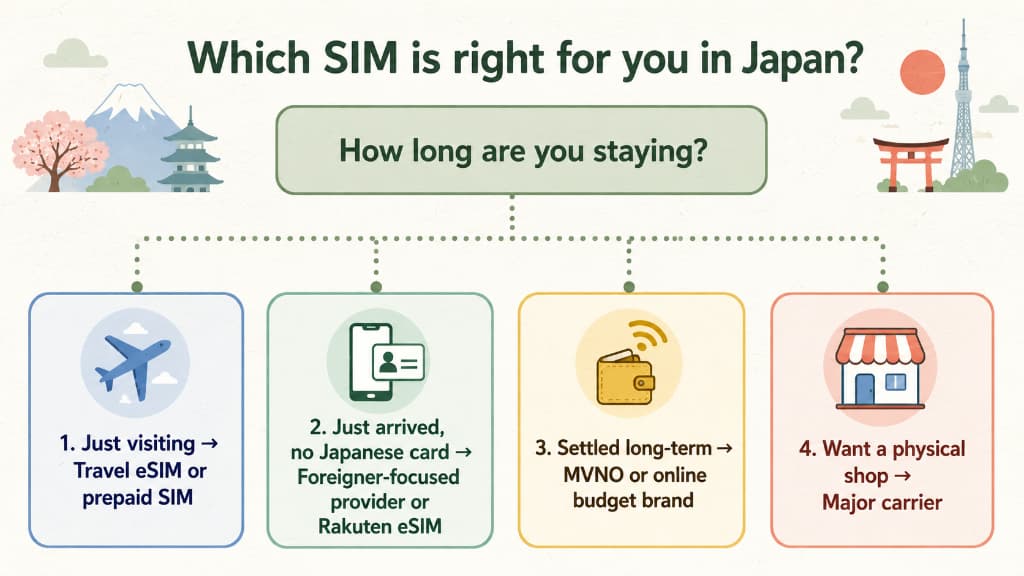
There’s no single “best” SIM in Japan—it depends entirely on how long you’re staying and whether you’ve already got a Japanese bank account or credit card. Start here:
| Your situation | Best option | Why |
|---|---|---|
| Just visiting (days to a few weeks) | Travel eSIM or prepaid SIM | No contract, works the moment you land, data-only is fine |
| Just arrived, no Japanese card or bank yet | Foreigner-focused provider or Rakuten eSIM | English support, pay at a convenience store or with a foreign card |
| Settled and staying long-term | MVNO or a carrier’s online budget brand | Cheapest monthly cost once you have a residence card and payment method |
| Want a physical shop and hand-holding | A major carrier (Docomo, au, SoftBank, Rakuten) | In-person help, bundled phones, the most reliable network |
eSIM or physical SIM?
Quick basics, because it trips people up. A physical SIM is the little chip you slot into your phone. An eSIM is a digital version you install by scanning a QR code—nothing to ship, nothing to swap, and you can set it up before you even arrive. Almost every recent iPhone and flagship Android supports eSIM, and most phones can run a physical SIM and an eSIM at the same time, so you can keep your home number active for messages while using Japanese data. If your phone is more than a few years old, check that it’s both eSIM-capable and SIM-unlocked before you count on it.
Do you even need a calling plan?
Here’s something newcomers don’t expect: in Japan, almost everyone communicates through LINE, not phone calls or SMS. Friends, coworkers, your kid’s school, even some clinics and tradespeople will ask for your LINE rather than your number. So while you do need a phone number for contracts and verification, you may barely use actual voice minutes. That’s a real argument for a cheaper data-focused plan with a number attached (a “voice SIM” on an MVNO), rather than a pricey big-carrier calling plan you’ll rarely tap. Worth keeping in mind as you compare the options below.
Short-Term: Prepaid SIMs and Travel eSIMs
If you’re here for a short stint or just need data the day you land, skip the contracts. Prepaid and travel eSIMs are hassle-free, available online and at convenience and electronics stores, with no long-term commitment. Most are data-only (no Japanese phone number), which is fine for maps, messaging apps, and getting set up. Here are three that newcomers reach for.
Airalo (travel eSIM)
Airalo is the easiest “install before you fly” option. It’s an eSIM marketplace covering 200+ countries, so you scan a code and have data the second you connect at the airport. Data-only, pay-as-you-go packages—ideal for tourists and the first few days before you sort out something longer-term.
IIJ Japan Travel SIM
The IIJ Japan Travel SIM comes from IIJ, a reputable Japanese internet company operating since 1992. The activation site is fully in English, and you can top up the data when you run out—a step above the typical use-it-and-bin-it prepaid card.
Nippon SIM
Nippon SIM, from DHA Corporation, offers large data buckets (15GB, 30GB, 50GB) and keeps working at reduced speed once you’ve used your allowance. Two caveats: you can’t recharge it, and some users report slower speeds at peak times.
One more short-term route worth knowing: pocket Wi-Fi. It’s a small mobile router you can rent by the day or week, often delivered to your hotel or the airport and returned by mail. It won’t give you a phone number, but it covers several devices at once, which suits families or anyone travelling with a laptop. For a single traveller, an eSIM is usually cheaper and simpler; for a group, the maths can tip the other way.

These are great for getting online fast—but if you need an actual Japanese phone number and you don’t have a local card or bank account yet, read the next section first.
No Japanese Credit Card or Bank Account Yet? Start Here
This is the wall most new arrivals hit. Domestic carriers and MVNOs usually want a Japanese credit card and a residence card (在留カード), and you often can’t get the card or the bank account without… a phone number. Chicken and egg. A few ways around it:
- Foreigner-focused providers. A handful of companies specialize in serving non-Japanese residents, with English support and payment options that don’t require a Japanese card:
- Sakura Mobile — flawless English support and quick eSIM setup; great if you want data and a number with minimal fuss.
- Mobal — ships a SIM with a Japanese number worldwide and accepts PayPal/Alipay, so you can have your number confirmed before you arrive. Handy for students and working-holiday folks who need an SMS-capable number on day one.
- GTN Mobile — built specifically for foreign residents, support in six languages, pay at a convenience store (no credit card or bank account needed), and they even help with apartment hunting. A good fit if you’re moving here to work.
- Rakuten Mobile’s remote eSIM. Rakuten is the only major carrier that lets you sign up remotely with a foreign passport via eSIM—useful before your residence card arrives. More on Rakuten below.
- A Wise debit card. If a provider accepts international cards, a Wise account gives you a debit card that works at many Japanese carriers, plus cheap currency transfers while you’re at it.
One heads-up on the paperwork: Japan is tightening online identity checks. More services now ask you to scan the IC chip in your residence card or My Number Card during sign-up rather than just uploading a photo, so have the physical card and an NFC-capable phone ready.
The Major Carriers: Docomo, au, SoftBank, and Rakuten
Japan now has four major network operators (MNOs), not three—Rakuten Mobile joined as the fourth in 2020 with its own network. The original big three (Docomo, au, SoftBank) are the oldest and run the most reliable, widest-reaching networks. You pay more for that reliability. You can buy just a SIM and use your own unlocked phone, or get a SIM bundled with a handset.
Rakuten is worth singling out for newcomers: its single plan is simple and cheap (around ¥880/month for 3GB, scaling up to roughly ¥3,278 for unlimited data), it offers multilingual support, and—as noted—it’s the one carrier that lets foreigners sign up remotely by eSIM. The trade-off is that its network, while much improved, still has thinner coverage in rural and indoor spots than the big three.
Getting a SIM at a carrier shop
For the big three, signing up in person is still common. Call the shop first to reserve a slot and confirm exactly which documents to bring, so you don’t end up making the trip twice. These English-language store locators help:
- au: foreign-language store locator
- Docomo: store locator (Docomo uses phone interpretation in every shop)
- Rakuten Mobile (English site)
You’ll typically need a valid credit card or Japanese bank account, an ID/residence card, and a Japanese address. No Japanese card yet? A Wise debit card is often accepted.
Buying a phone with your plan
Carriers sometimes bundle a handset at a steep discount with a specific plan. A quick reality check, though: the legendary “¥1 iPhone” is mostly history. Since a 2023 law change, carriers can’t discount a phone by more than a capped amount (roughly ¥20,000–44,000), so the giveaways have shrunk. What you’ll see now is more like “¥0 upfront, then 24 monthly installments.” You can still find good deals on slightly older models—check the carrier counters inside big electronics stores like Yamada Denki, Bic Camera, and Yodobashi Camera, where Docomo, au, and SoftBank often share the ground floor.
Budget Options: Online Brands and MVNOs
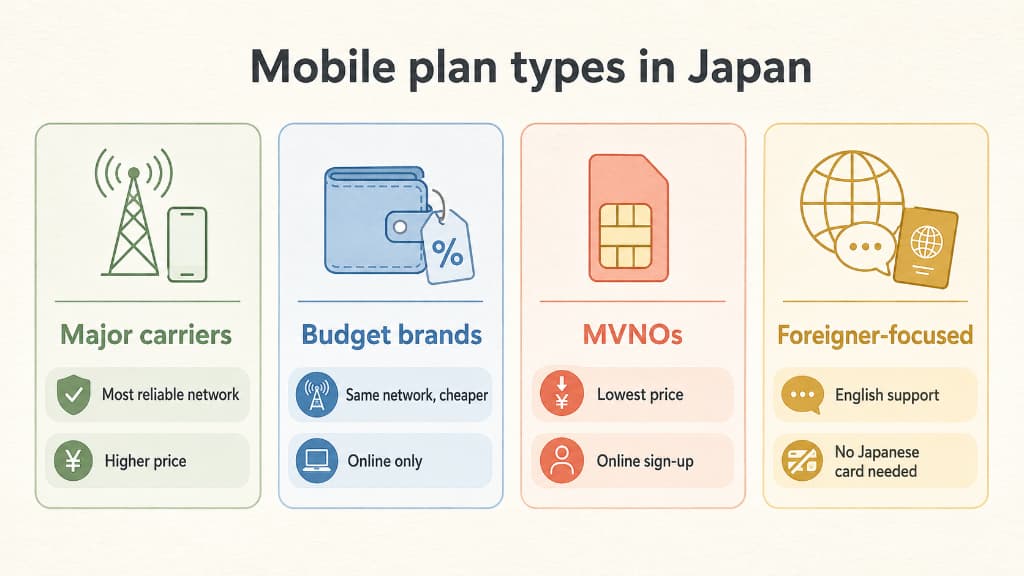
If you’ve got a residence card and a payment method and you want to stop overpaying, this is where most long-term residents land. Two flavors:
Carrier budget brands (online-only)
The big carriers run their own no-frills online brands. Same networks, lower prices, but support is chat/online rather than in-store:
- ahamo (Docomo) — about ¥2,970 for 30GB with some calls included; runs on Docomo’s strong network.
- povo (au) — a ¥0 base plan where you buy data “toppings” as needed; flexible for light or irregular use.
- LINEMO (SoftBank) — from around ¥990 for a small plan; the successor to the now-discontinued LINE Mobile.
- UQ mobile (au) and Y!mobile (SoftBank) — a half-step up: still cheaper than the flagship plans, but with physical shops and English help, which some newcomers prefer.
MVNOs (independent budget carriers)
MVNOs (Mobile Virtual Network Operators) rent capacity from the big carriers, so they skip the cost of shops and networks and pass the savings on. Service is mostly online. Pick a reputable one and it’s genuinely good value; here’s a current snapshot:
| Provider | Rough price (2026) | Notes |
|---|---|---|
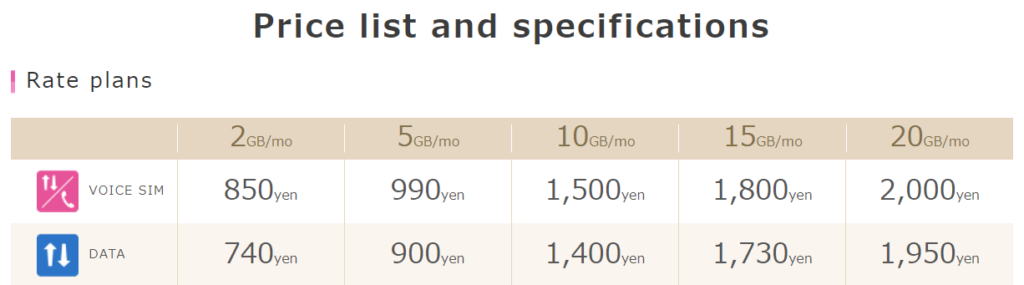
| IIJmio | ~¥850–2,000/mo | Run by IIJ (since 1992); decent English website; “voice” plans include a number, “data” plans don’t; min. term about 2 months. A solid default. |
| mineo | ~¥1,300–2,000/mo | Popular, flexible data sharing; Japanese-language sign-up. |
| Rakuten Mobile | ¥880–3,278/mo | Technically its own network now; remote eSIM sign-up for foreigners; unlimited-data tier. |
With an MVNO you’ll often choose which carrier’s network to ride (Docomo, au, or SoftBank). For most people it genuinely doesn’t matter—just make sure your phone isn’t SIM-locked to a different carrier.
The downsides to know: MVNOs mostly sell SIMs (handset deals aren’t as juicy as the carriers’), speeds can dip at peak hours like lunchtime, and in a major disaster the borrowed-bandwidth networks may degrade first. If you’re not comfortable doing everything online, an MVNO can feel inconvenient.
How to Sign Up With an MVNO: IIJmio Walkthrough
Here’s the actual process, start to finish, using IIJmio as the example. Most MVNOs work the same way.
1. Choose your SIM type and plan
First decide the SIM type. The standard choice is a Voice SIM, which gives you a phone number, SMS, and data. If you don’t need a number, a cheaper Data SIM works for internet only.
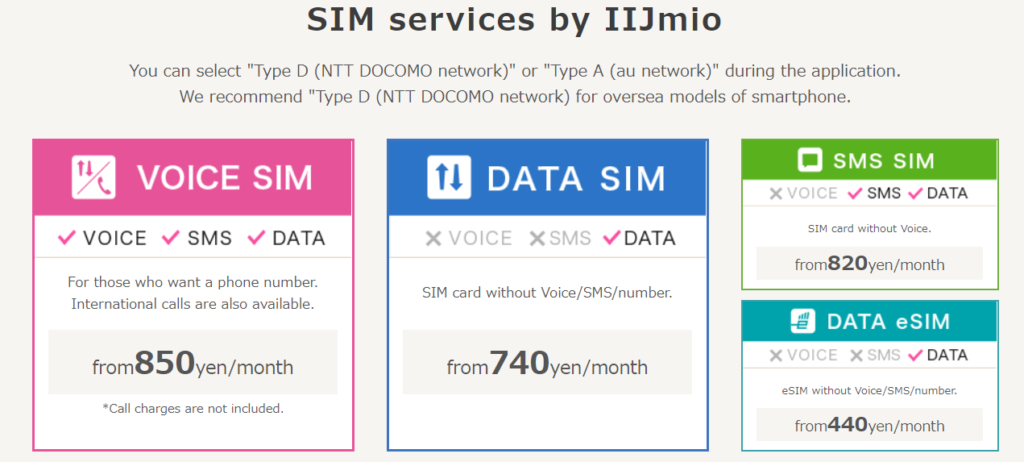
Then pick a data package to match your usage. If you’re unsure, a 20GB plan is a safe middle ground—it’s competitively priced and you’d rather have a little spare than run dry in a country where you lean on your phone for everything.
2. Place your order and verify your ID
Order online and complete the KYC (identity check). You’ll generally need:
- A credit card in the applicant’s own name
- Your residence card (在留カード, zairyū card)—increasingly verified by scanning its IC chip, so keep the physical card handy
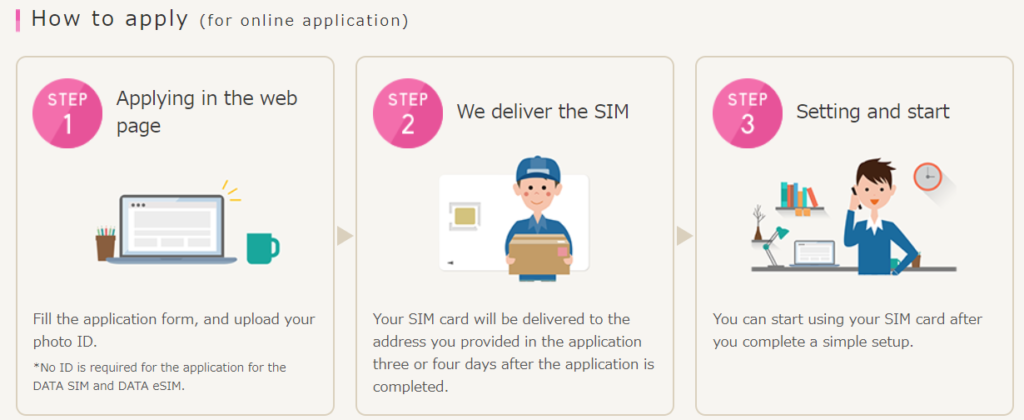
A few days later the SIM arrives in the mail, you pop it in (or install the eSIM), and you’re connected.
What You’ll Need to Sign Up
Whichever route you choose for a proper contract, having these ready saves a second trip or a stalled online order:
- Residence card (在留カード) — valid for more than three months. This is the big one; without it you’re limited to prepaid or foreigner-focused providers. Increasingly the IC chip is scanned, not just photographed, so bring the physical card and an NFC-capable phone.
- A Japanese address — where the SIM (and bills) will be sent.
- A payment method in your name — a Japanese credit card or bank account for most carriers/MVNOs, or a workaround (Wise debit card, convenience-store payment, PayPal/Alipay) with foreigner-focused providers.
- Your passport — sometimes requested alongside the residence card, and the primary ID for passport-based sign-ups before your card arrives.
- An MNP reservation number — only if you’re transferring an existing Japanese number (see below).
If any of these aren’t sorted yet—say your residence card hasn’t been issued—that’s exactly when the passport-friendly providers earn their slightly higher price.
Keeping Your Number When You Switch (MNP)
Once you’re settled, switching providers to save money is easy and you don’t lose your number. Ask your current provider for an MNP reservation number (these days often issued instantly online as a “one-stop” transfer), then enter it when you sign up with the new one. Your number moves with you. It’s worth a once-a-year look—Japanese plans drop in price often, and loyalty rarely pays.
Frequently Asked Questions
Can I get a Japanese SIM without a residence card?
For a short stay, yes—travel eSIMs and prepaid data SIMs (Airalo, Nippon SIM, IIJ Travel SIM) don’t need a residence card. But to get a contract with a real Japanese phone number, you’ll usually need a residence card valid for more than three months, or you go through a foreigner-focused provider that can set you up on a passport while you wait.
Can I sign up without a Japanese credit card or bank account?
Yes. Foreigner-focused providers like GTN Mobile let you pay at a convenience store, Mobal takes PayPal/Alipay, and many carriers accept an international debit card such as Wise. Rakuten also allows remote eSIM sign-up with a foreign passport.
What’s the cheapest mobile plan in Japan?
For low data use, online budget brands and MVNOs win—IIJmio and LINEMO start under ¥1,000/month, and povo’s base plan is ¥0 plus pay-as-you-go data. Rakuten is the value pick if you want unlimited data on a single simple plan.
eSIM or physical SIM—which should I get?
If your phone supports eSIM (most recent models do), it’s the more convenient choice: instant activation, nothing to ship, and you can keep your home-country number running alongside it. Go physical only if your phone is older or you prefer a card you can move between devices.
Can I keep my number if I leave Japan?
A Japanese number is tied to a Japanese contract, so it generally ends when you cancel. Some services let you “park” a number, but for most people the number lapses on departure. Switching between Japanese providers, though, keeps it via MNP.
The Bottom Line
Match the plan to your stay: a travel eSIM for a visit, a foreigner-friendly provider or Rakuten’s remote eSIM to bridge those first weeks, and an MVNO or online budget brand once you’re settled with a residence card. Sort the phone early—so much of life here, from your bank to your lease, waits on that number. Once it’s done, you can get on with actually living in Japan. For the rest of the setup, see our guides to opening a bank account and managing money in Japan.



3 thoughts on “Getting a Mobile Phone in Japan: SIM Cards & Plans for Foreigners (2026)”