Social insurance is one of those things nobody explains when you arrive in Japan—it just quietly starts coming out of your paycheck, or a stack of payment slips shows up in your mailbox. Either way, you’re in the system, because enrollment isn’t optional for residents. The good news is that it’s a genuinely solid safety net: medical care, pensions, unemployment support, and more. This guide lays out the five insurances that make up Japan’s system, what each one actually costs in 2026, who pays, and—the part most guides skip—what they mean specifically for you as a foreign resident, including how to get some of your pension money back when you leave.
Premiums and figures below are for fiscal year 2026. Rates change, so treat them as a current snapshot.
First, the split that explains everything: employee vs. everyone else
Before the individual insurances make sense, you need one mental model. Which system you’re in depends on whether you’re a regular employee or not.
- If you’re a full-time employee (社会保険, shakai hoken): Your company enrolls you in employees’ health insurance and employees’ pension, splits the premiums with you 50/50, and deducts your half automatically from your salary. You barely have to think about it.
- If you’re self-employed, freelance, a student, or between jobs: You enroll yourself in National Health Insurance (国民健康保険) and the National Pension (国民年金), and you pay the full amount yourself via slips from your city office. No employer is splitting the bill, so it can feel pricier.
Keep that fork in mind as you read on—almost every “how much do I pay?” question comes back to it. These premiums sit right alongside tax on your payslip—and they’re deductible—so it’s worth reading how taxes work in Japan together with them.
The five insurances, and what they cost in 2026
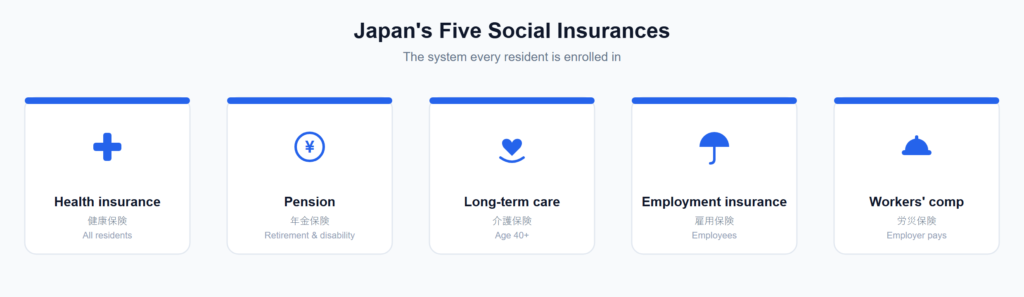
1. Health insurance (健康保険 / 国民健康保険)
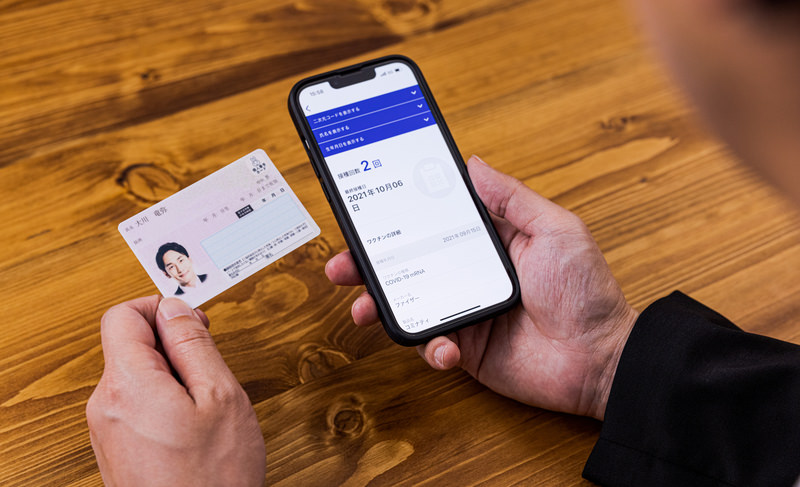
This is the one you’ll use most. It covers doctor visits, hospital stays, prescriptions, dental, and more, and it caps what you pay at the counter—most adults pay just 30% of the cost. Employees’ health insurance runs roughly 10% of your salary, split with your employer (so about 5% out of your pocket). For the self-employed, National Health Insurance premiums are set by your municipality and scale with your income. Because this is the insurance you’ll lean on day to day, we cover it in depth—enrollment, costs, the new My Number insurance card—in Navigating Japan’s Healthcare System.
2. Pension insurance (年金保険)
Japan’s pension pays out in retirement, but also for disability and to surviving family, so it’s not only an old-age fund. There are two tiers depending on your status:
- National Pension (国民年金): A flat monthly premium of ¥17,920 in fiscal 2026, paid by the self-employed, students, and others not in the employees’ system. Students and low-income residents can apply for exemptions or deferrals rather than simply not paying—worth doing, because unpaid months hurt you later.
- Employees’ Pension (厚生年金): For company employees, a premium of 18.3% of salary, split 50/50 with your employer (so 9.15% each). This already includes the National Pension layer, so employees don’t pay both.
If the idea of paying into a pension you might never collect bothers you—a common worry for people who don’t plan to retire here—hold that thought. The lump-sum withdrawal and social security agreements below exist for exactly this situation.
3. Long-term care insurance (介護保険)
This funds nursing and care services for older adults—a big deal in the world’s fastest-aging society. You start paying at age 40: from 40 to 64 it’s added on top of your health insurance premium at a national rate of 1.62% in 2026 (split with your employer if you’re an employee, so 0.81% each). Under 40, you don’t pay it yet.
4. Employment insurance (雇用保険)
This is unemployment insurance, plus support for job training and certain leaves. It’s only for employees. The employee’s share for fiscal 2026 is small—0.5% of wages (5 per 1,000)—while the employer pays more, 0.85% (8.5 per 1,000). If you lose your job through no fault of your own, this is what provides benefits while you look for the next one, with the amount and duration depending on why and how long you worked.
5. Workers’ compensation insurance (労災保険)
This covers work-related injuries, illness, and commuting accidents. Here’s the part employees like: it’s paid entirely by your employer—nothing comes out of your salary. The rate varies by industry based on risk. You don’t manage it, but it’s good to know it’s there if you’re ever hurt on the job or commuting.
Who pays what — 2026 at a glance
| Insurance | Who’s covered | 2026 rate / amount | Who pays |
|---|---|---|---|
| Health insurance | All residents | ~10% of salary (employees); income-based (self-employed) | Split 50/50 with employer; self-employed pay full |
| Pension — National | Self-employed, students, others | ¥17,920 / month (flat) | You (exemptions available) |
| Pension — Employees’ | Company employees | 18.3% of salary | Split 50/50 (9.15% each) |
| Long-term care | Age 40–64 | 1.62% (added to health premium) | Split 50/50 (0.81% each) |
| Employment insurance | Employees | Employee 0.5% / employer 0.85% | Both, employer more |
| Workers’ compensation | Employees | Industry-based | Employer only |
What social insurance means if you’re a foreigner

This is where Japan’s system has wrinkles that matter specifically to expats, and where a little knowledge saves real money.
Enrollment is mandatory—and skipping it has consequences
It’s tempting to think of these as optional if you’re only here a few years, but they’re not. Health insurance and pension enrollment is required for residents regardless of nationality. Beyond the legal obligation, unpaid premiums can come back to bite you—including when you renew your visa, where a record of meeting public obligations is looked on favorably. Pay them, or apply for a formal exemption; don’t just ignore the slips.
Getting pension money back when you leave: the Lump-Sum Withdrawal Payment
If you leave Japan without staying long enough to draw a pension, you’re not necessarily waving goodbye to all of it. The Lump-Sum Withdrawal Payment (脱退一時金, dattai ichijikin) refunds part of what you paid in. The basics:
- You must have contributed for at least 6 months, have left Japan and canceled your residence registration, and not otherwise qualify for a pension.
- You apply after you’ve left, and you must do so within two years of leaving.
- The refund is based on how long you contributed, capped at 5 years (60 months) of contributions.
- On the Employees’ Pension refund, 20.42% is withheld as tax—but you can reclaim most of it if you appoint a tax representative (納税管理人) in Japan before you go.
In my husband’s Indian community, this refund is a perennial topic of conversation—and the part that trips people up is never the eligibility, it’s the logistics after you’ve already moved away. Think about it: the tax refund notice gets mailed to your tax representative’s address in Japan, the money lands in their Japanese bank account, and only then does it get forwarded on to your account back home. So the real questions people swap tips about are practical ones—who’ll act as your representative, where your mail goes once your apartment’s gone, and how to actually move the money across borders. The lesson everyone passes around: sort out your tax representative and a reliable mail/forwarding arrangement before you leave, not after. It’s far harder to fix from abroad.
One more practical note: you’ll generally want to keep a Japanese bank account open until the refund clears, since the process runs through one. If you’re setting that up, our guide to opening a bank account in Japan is a useful companion.
Social security agreements: don’t pay twice
If you’re paying into a pension system back home too, you could end up contributing in both countries at once. Japan’s social security agreements exist to prevent that double payment and to let you combine your coverage periods across countries so they count toward a pension. Japan has agreements with around twenty countries, including the US, Germany, the UK, South Korea—and India, in force since October 2016.
The combining part is the underrated benefit. India’s pension (EPS), for example, generally needs 10 years of contributions to qualify; under the agreement, your years paying into the Japanese system can be totalized toward that threshold, so time in Japan isn’t simply lost. If your home country has an agreement with Japan, it’s worth checking the specifics before you assume your contributions here vanish when you go.
Changing jobs or leaving your company
This is the moment the system catches people out, because leaving employment means leaving the employee insurances—and you have to actively replace them. Do nothing and you end up with a coverage gap, which is exactly when a medical bill tends to arrive.
For health insurance, you usually have three choices:
- Continue your employer’s plan (任意継続, nin-i keizoku) for up to two years. You now pay both halves of the premium, but it can still beat National Health Insurance depending on your income—just apply quickly, usually within about 20 days of leaving.
- Switch to National Health Insurance at your city office.
- Become a dependent on a family member’s employee insurance, if someone in your household qualifies.
For pension, you move from the Employees’ Pension to the National Pension and start paying the flat premium yourself (or apply for an exemption while between jobs). The key admin step: notify your municipality within 14 days of the change to switch your health insurance and pension over. Budget for a jump, too—without an employer splitting the bill, your combined premiums can rise noticeably, which surprises people in their first month of self-employment or job-hunting.
FAQ
Do foreigners really have to enroll in social insurance?
Yes. Health insurance and pension enrollment is mandatory for residents regardless of nationality, whether through your employer or, if you’re self-employed, through your city office. It isn’t optional, and unpaid premiums can affect things like visa renewals.
What’s the difference between an employee and a self-employed person?
Employees get enrolled by their company in employees’ health insurance and pension, with premiums split 50/50 and deducted from salary automatically. Self-employed, freelance, and unemployed residents enroll themselves in National Health Insurance and the National Pension and pay the full amount via slips from the municipality.
Can I get my pension money back if I leave Japan?
Partly, through the Lump-Sum Withdrawal Payment. You need at least 6 months of contributions, must apply within two years of leaving, and the refund is capped at 5 years’ worth. Appoint a tax representative before you leave to reclaim the 20.42% tax withheld on the employees’ pension portion.
I pay into a pension back home too—am I paying twice?
Possibly, unless your country has a social security agreement with Japan (around twenty do, including the US, Germany, the UK, South Korea, and India). These prevent double contributions and let you combine coverage periods across countries toward a pension. Check your country’s specific agreement.
What happens if I just don’t pay?
Premiums can be pursued, and gaps in payment can count against you—including at visa renewal, and in lost future benefits. If money is tight, apply for an exemption or deferral (available for the National Pension for students and low-income residents) rather than ignoring the bills.
See also
- Navigating Japan’s Healthcare System — health insurance, costs, and the My Number insurance card in detail.
- How to Open a Bank Account in Japan as a Foreigner — useful for receiving a pension refund.
Social insurance is one of those things nobody explains when you arrive in Japan—it just quietly starts coming out of your paycheck, or a stack of payment slips shows up in your mailbox. Either way, you’re in the system, because enrollment isn’t optional for residents. The good news is that it’s a genuinely solid safety net: medical care, pensions, unemployment support, and more. This guide lays out the five insurances that make up Japan’s system, what each one actually costs in 2026, who pays, and—the part most guides skip—what they mean specifically for you as a foreign resident, including how to get some of your pension money back when you leave.
Premiums and figures below are for fiscal year 2026. Rates change, so treat them as a current snapshot.


2 thoughts on “Social Insurance in Japan: A Complete Guide for Foreign Residents (2026)”