Finding a home in Japan can be hard for newcomers. The rental market has its own rules—key money, deposits, renewal fees—that catch off guard anyone used to renting elsewhere. None of it is impossible to navigate, but it helps to know the customs before you start.

This guide covers the three main ways to rent in Japan—private rentals, UR, and public housing—plus the documents, fees, and cultural quirks that come with each. Some of it is drawn from my own household’s experience renting here; the rest is the practical stuff I wish someone had spelled out for us. Know these basics and you can sidestep the common mistakes and land a more comfortable home.
👉 Looking for a step-by-step guide on renting without a guarantor? See: How Foreigners Can Rent Apartments in Japan (Without a Guarantor)
Overview of Renting in Japan
Renting in Japan is different from what many foreigners are used to. Most landlords list their properties through real estate agencies, and nearly every rental goes through an agent. That makes searching easier, but it also means you play by Japan’s rental customs rather than your own.
The biggest shock is usually the cost structure. On top of monthly rent, you face a stack of one-time fees—key money, a deposit, an agency fee—so it’s common to need the equivalent of four to six months’ rent upfront just to move in. The full breakdown is in the next section, and yes, there are ways to bring it down: zero-deposit apartments, free-rent campaigns, UR housing, and foreigner-friendly agencies all help, and I’ll get to each.
Renting from Private Landlords
Most people in Japan find housing through real estate agencies, which act as intermediaries between tenants and landlords. This is the mainstream path and gives you access to the widest range of properties. Here’s how it usually goes:
- Search – Agencies list properties on the big real estate sites. Found one you like online? Ask the agency if it’s still available, then book a viewing (naiken) by appointment. Always arrange it in advance.
- Apply – Once you pick an apartment, you submit your documents through the agency.
- Sign – If approved, you sign the lease (keiyaku), typically a two-year term, and pay the initial costs—deposit, key money, agency fee, and first month’s rent.
- Guarantor – Most private rentals want a guarantor with stable income who lives in Japan. For foreigners, this is often the hardest part.
Private rentals give you the widest choice of location, size, and style, but they also bring the most steps and the highest upfront costs. Contracts are almost always in Japanese, and there’s less room to negotiate than you might expect. If you don’t read Japanese, lean on an English-speaking agent—or bring a Japanese-speaking friend to the signing.
Here’s something worth saying plainly: some landlords still refuse foreign tenants outright. It’s a real barrier, and it’s frustrating. I’ll be honest, though—my husband has never run into it himself, for the simple reason that he was never the one doing the apartment hunting. That’s almost a workaround in itself: having a Japanese-speaking partner, friend, or agent front the search quietly removes a lot of the friction before it ever reaches you.
👉 Tip: For the guarantor problem specifically, see the dedicated guide: How Foreigners Can Rent Apartments in Japan (Without a Guarantor).
👉 Major rental sites: SUUMO, LIFULL HOME’S, and At Home.
At the Viewing (Naiken): What to Check
A naiken is your one chance to catch problems before you sign a two-year lease, so don’t rush it. Photos online flatter every apartment; go see it in person whenever you can. A few things are easy to overlook but matter daily:
- Water pressure and hot water – Run the shower and taps. Weak pressure is a common complaint and won’t show in listing photos.
- Mobile signal – Check your phone has bars in every room, especially in older concrete buildings.
- Noise and light – Visit at the time of day you’ll actually be home. Listen for road, train, and neighbor noise; see how much sun the rooms get.
- Insulation and mold – Many Japanese apartments are poorly insulated. Look for damp, mold near windows, and whether there’s any heating beyond a single AC unit.
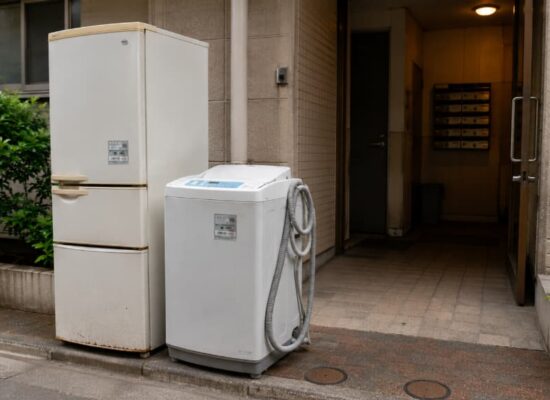
- Storage, outlets, and appliance space – Confirm there’s room (and a gas/electric hookup) for a washing machine and fridge, and that outlets are where you need them.
Documents Required for a Rental Contract
When you apply, the landlord and agent will ask for several documents. Having them ready makes the process smoother and marks you as a serious applicant.
- Photo ID – A government-issued ID such as a driver’s license or your My Number Card.
- Passport – A copy of the photo page.
- Residence Card (在留カード) and Certificate of Residence (住民票) – Proof you legally live in Japan. New arrivals must register their address at City Hall within 14 days of moving in. See: A Timeline Checklist for Moving in Japan.
- Proof of income – Recent payslips, a certificate of employment, or a withholding slip (gensen choshuhyo).
In many cases the landlord also requires a guarantor (保証人). If you can’t provide one, you’ll likely use a guarantor company, which charges a fee—often half to one month’s rent—to take on the risk for you.
Paperwork is where foreign residents most often get stuck. Documents are in Japanese, and many employers aren’t used to issuing income certificates in the expected format. Ask your HR to prepare the proof in advance, and don’t hesitate to request an English-speaking agent if anything feels unclear.
Initial Costs and Rental Fees
This is the part that surprises newcomers most. Japanese rentals come with fees that simply don’t exist in many countries, and they add up fast. Here’s the typical breakdown for a private rental:
| Fee | Typical amount | Refundable? | What it’s for |
|---|---|---|---|
| Key money (礼金) | 1–2 months’ rent | No | A non-refundable “gift” to the landlord. A postwar custom—less common now, but many properties still ask. |
| Deposit (敷金) | 1–2 months’ rent | Partly | Covers cleaning and repairs; the balance is returned when you move out. |
| Agency fee (仲介手数料) | 0.5–1 month’s rent + tax | No | Commission to the agent (see the note below on the legal limit). |
| First month’s rent | 1 month (often prorated) | — | Paid in advance. |
| Renewal fee (更新料) | 1–2 months’ rent | No | Charged later—usually every two years to extend the lease. |
| Fire insurance / lock change | ~¥15,000–25,000 total | No | Often required add-ons at signing. |
Add it up and the move-in bill commonly lands around four to six months’ rent. The system rewards staying put—one reason tenants in Japan move less often than in many other countries.
On key money, I’ll share a small household opinion: my husband’s instinct is to avoid it wherever possible. It’s not really about the money—it’s that he doesn’t like the feeling of committing himself far into the future for a place he might want to leave. Plenty of newcomers feel the same, which is exactly why the lower-cost options below are worth a look.
👉 How to spend less upfront:
- Skip key money entirely. Public housing and UR apartments charge none, and some privately built but publicly financed properties are exempt too.
- Know the law on agency fees. Under the Real Estate Brokerage Act (宅地建物取引業法, Art. 46), the legal default a broker may charge a tenant is half a month’s rent plus tax; charging a full month requires your prior consent, and the combined fee from both parties can’t exceed one month plus tax. In other words, the full month is negotiable—don’t assume it’s fixed.
- Hunt for zero-deposit apartments (ゼロゼロ物件) and free-rent campaigns, where the first month or two is waived. Not everywhere, but a real saving when you find one.
Housing Options Compared: Private vs UR vs Public
Before the details, here’s the big picture. These are the three routes most expats choose between:
| Private rental | UR housing | Public housing | |
|---|---|---|---|
| Key money / renewal fee | Usually yes | None | None |
| Guarantor | Usually required | Not required | Not required |
| Rent level | Market rate | Market rate (but no extra fees) | Lowest; income-based |
| Who can apply | Anyone approved | Income criteria; first-come | Low/mid income; lottery |
| Choice & availability | Widest | Limited; goes fast | Scarce; hard to win |
For most foreigners, UR is the sweet spot—no guarantor, no key money, and decent apartments—so it’s worth understanding both it and public housing before you default to a private rental.
Public Housing
Local governments manage public housing, offering affordable apartments for low- to middle-income residents.
- Eligibility – You must meet income limits set by the municipality. Priority usually goes to families, elderly residents, and people with disabilities.
- Cost – Rent is based on household income and location; some units start around ¥10,000 a month, far below private rentals.
- How to apply – Municipalities open applications several times a year and run lotteries for vacant units.
- Requirements – Legal residency, plus proof of income and household size.
The catch is that it’s hard to get. Lotteries run a handful of times a year, and in Tokyo a single unit can draw 50 applicants; in rural areas the odds can fall to one-to-one or better. Tokyo also splits family housing from single-person housing, and the single-person units come with strict rules—often a three-year Tokyo residency requirement. Even if you qualify, winning comes down to luck, so don’t pin all your hopes on it.
👉 Tip: Check your local city hall website for schedules and eligibility—every municipality runs its own system.
- Tokyo Metropolitan Government Public Housing Information
- Osaka Prefecture Public Housing Information
UR Housing (Urban Renaissance Agency)
The Urban Renaissance Agency is a semi-public body that manages apartments across Japan. UR sits between public housing and private rentals: fewer restrictions than public housing, higher rent than public housing, but none of the private-rental fees.
- No key money, no renewal fee, no guarantor, no agency fee – The single biggest reason UR is so popular with foreigners.
- Income requirement – UR drops the guarantor, but not the income check: you generally need a monthly income of roughly four times the rent (or you can prepay rent or meet a savings threshold instead).
- Cost – Rent follows market rates, but with no key money or renewal fees it often works out cheaper than a private rental over time.
- Quality & process – Generally well-maintained, often near stations. Vacancies are listed publicly and let on a first-come basis, so popular units go quickly.
I’ll put my cards on the table here: we rented UR ourselves, and it was my husband’s favorite thing about our early years in Japan. He genuinely couldn’t get over it—this cheap, and this much space? After what he’d braced for, a roomy apartment with no key money and no guarantor felt almost too good to be true. For a lot of foreigners, UR is the easiest door into the rental market. The only real downside is competition: the good units don’t sit empty long, so watch the listings closely.
👉 Tip: Search UR apartments in English on the official site: UR Housing (English).
Understanding Your Contract
A few contract basics save a lot of grief later:
- Term and renewal. Standard leases run two years; to stay on, you pay the renewal fee and sign again. Watch for fixed-term leases (定期借家), which end on a set date and don’t automatically renew.
- Moving out. You usually must give notice—commonly one month—before leaving, or you’ll owe extra rent.
- Deposit settlement (原状回復). Part of your deposit typically goes to cleaning and minor repairs. Normal wear is the landlord’s responsibility, but expect some deductions, and don’t assume you’ll get it all back.
Because contracts are dense and almost always in Japanese, get a bilingual agent or translation before you sign. For a full walkthrough of lease types, renewal fees, move-out settlements, and getting your deposit back, see our dedicated guide: Japanese Rental Contracts Explained.
Useful Tips for Expats
- Understand the contract. Leases are in Japanese—use a bilingual agent or translation service so you know the terms before signing.
- Photograph everything on move-in. Document existing wear in every room. It’s your proof you didn’t cause the damage when the deposit is settled.
- Budget for renewal fees. Beyond move-in costs, you may owe 1–2 months’ rent every two years. Plan for it.
- Mind the moving season. February to April is the busiest, with the highest prices and most competition. Move outside that window for better rates and more choice.
- Bring language backup. If you’re not confident in Japanese, take a Japanese-speaking friend to viewings and signings to avoid misunderstandings.
Useful Links and Resources
Private rental search sites
Official housing information
- Tokyo Metropolitan Government Public Housing
- Osaka Prefecture Public Housing Information
- UR Housing (English site)
Foreigner-friendly agencies
- GaijinPot Housing
- Balleggs (Tokyo)
- Village House (rents from around ¥20,000)
Between the official sources and the foreigner-friendly agencies, you’ll get a fuller picture of what’s actually available to you.
Conclusion
Renting in Japan looks complicated at first—the fees, the guarantor, the paperwork. But once the system clicks, whether you go private, UR, or public, you’ll know what to expect and how to prepare. Plan ahead with the right documents and a realistic budget and you’ll save yourself both money and stress. And if the guarantor requirement is your sticking point, don’t miss the companion guide: How Foreigners Can Rent Apartments in Japan (Without a Guarantor).
FAQ
Q1. How much money do I need upfront to rent an apartment in Japan?
A. For a private rental, plan for roughly four to six months’ rent: key money, deposit, agency fee, first month’s rent, plus fire insurance and a lock change. UR and public housing cut this sharply by charging no key money.
Q2. Can foreigners rent an apartment in Japan?
A. Yes. Some landlords still refuse foreign tenants, but plenty of properties are open to them—especially UR housing and foreigner-friendly agencies. Using an English-speaking or Japanese-speaking agent removes much of the friction.
Q3. What is key money, and can I avoid it?
A. Key money (礼金) is a non-refundable gift to the landlord, usually 1–2 months’ rent. You can avoid it with UR or public housing, and with zero-deposit (ゼロゼロ) private properties.
Q4. Do I need a guarantor, and what if I can’t get one?
A. Most private rentals require one. If you can’t provide a personal guarantor, you can use a guarantor company (for a fee) or choose UR housing, which needs no guarantor at all. See our guarantor-free guide for details.
Q5. How much is the agency fee, and is it negotiable?
A. By law the default a tenant pays is half a month’s rent plus tax; charging a full month requires your prior consent, and the total from both parties can’t exceed one month plus tax. So the full month is often negotiable.
Q6. Is UR housing a good option for foreigners?
A. Often, yes. UR charges no key money, renewal fee, agency fee, or guarantor. You do need to meet an income requirement (around four times the rent, or a savings/prepayment alternative). Popular units fill fast, so monitor listings.



11 thoughts on “How to Rent an Apartment in Japan: Key Money, Contracts, and Housing Options”
Comments are closed.