Getting rid of an old fridge or washing machine in Japan is not the “drag it to the curb” job you might be used to. The country has strict rules about how certain appliances are recycled, and if you try to shortcut them you’ll either get your item left behind on collection day or, worse, hand it to an illegal operator who dumps it. It sounds bureaucratic, and honestly parts of it are—but once you know which bucket your appliance falls into, it’s straightforward. This guide walks through exactly how to dispose of home appliances in Japan, what it costs, and the cheapest legal way to do it.
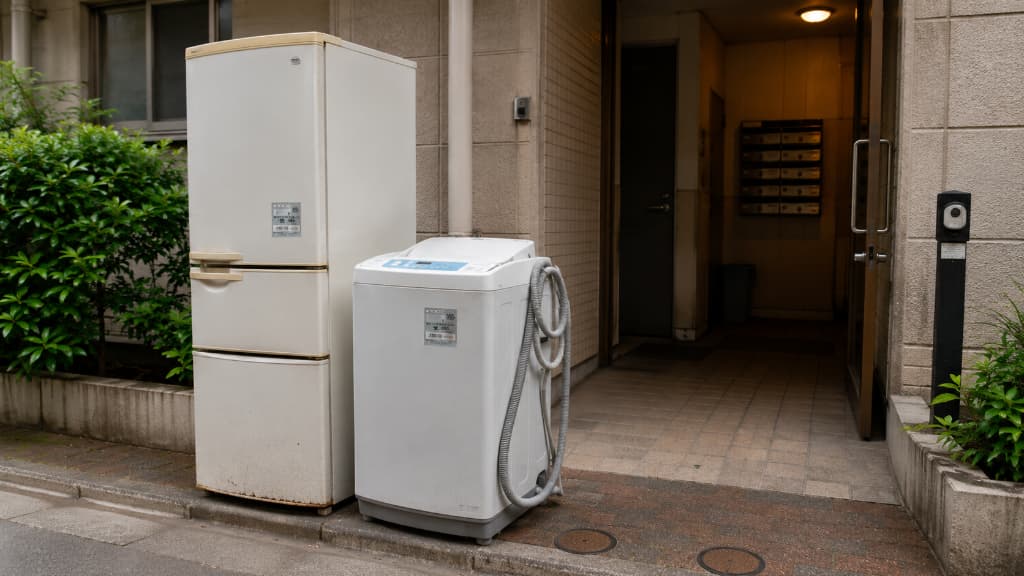
I write this as a Japanese person married to a foreigner, and appliance disposal is one of those quietly confusing chores that locals just know and no one thinks to explain. It comes up most when you’re moving or upgrading, usually at the worst possible moment, so it’s worth understanding before you’re standing next to a fridge you can’t get rid of.
The Four Appliances You Can’t Just Throw Away
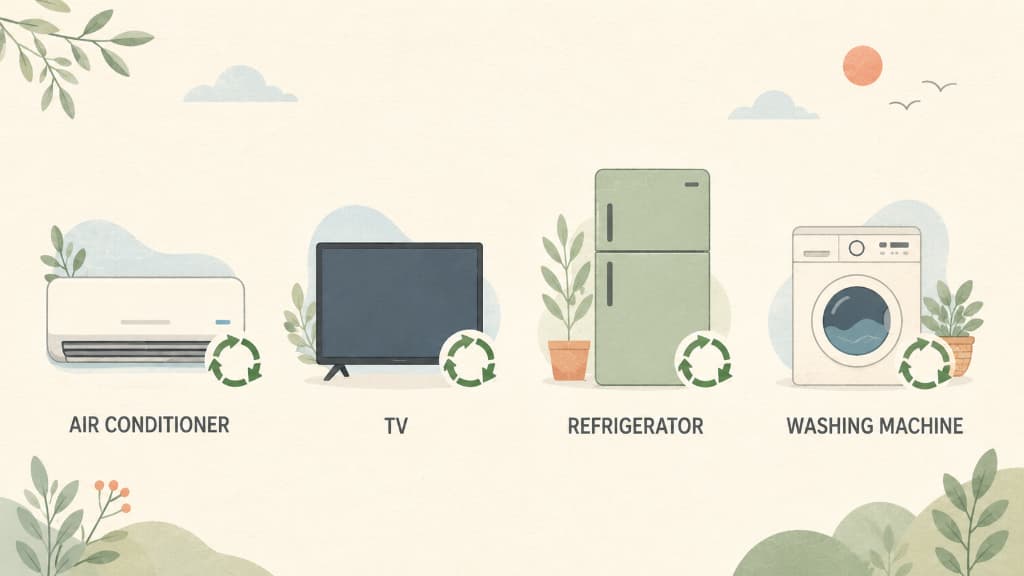
Japan’s Home Appliance Recycling Law (Kaden Recycle Hō, 家電リサイクル法) singles out four categories that must be recycled through a specific system. You cannot put these out as burnable trash or oversized garbage:
- Air conditioners (エアコン)
- Televisions (テレビ)—CRT, LCD, plasma, and OLED
- Refrigerators and freezers (冷蔵庫・冷凍庫)
- Washing machines and clothes dryers (洗濯機・衣類乾燥機)
The logic is that these are bulky, packed with reusable metals and glass, and—in the case of fridges and ACs—contain refrigerant gases that have to be captured rather than released. So instead of going to landfill, they’re routed to licensed recyclers, and you pay a recycling fee to cover it. Anything not on this list (microwaves, rice cookers, fans, vacuum cleaners, and so on) follows a completely different path, which I’ll cover further down.
It’s worth taking this seriously rather than looking for a loophole. Illegally dumping one of these—leaving it by the trash point, in a park, or on a mountain road—is an actual offense that can carry heavy fines, and abandoned fridges and ACs leak exactly the substances the law is trying to contain. The system can feel like a hassle for what is, after all, just an old washing machine, but it exists for a real reason, and the legal routes below aren’t that painful once you pick one.
What It Costs: Recycling Fees
Here’s the part that surprises people: you pay to dispose of these, not the other way around. There’s no single national price—the recycling fee depends on the manufacturer and, for TVs and fridges, the size. The figures below are typical for major makers (tax included) and give you a realistic ballpark, but always confirm your exact fee for your brand and model.
| Appliance | Typical recycling fee (major makers) |
|---|---|
| Air conditioner | from about ¥990 |
| TV (LCD/plasma/OLED), 15″ and under | about ¥1,870 |
| TV (LCD/plasma/OLED), 16″ and over | about ¥2,970 |
| TV (CRT/tube), by size | about ¥1,320–2,420 |
| Refrigerator/freezer, 170L and under | about ¥3,740 |
| Refrigerator/freezer, over 170L | about ¥4,730 |
| Washing machine / clothes dryer | about ¥2,530 |
To look up the precise fee for your appliance, use the official Recycling Ticket Center (RKC) fee list, which lets you search by manufacturer. One more cost to expect: on top of the recycling fee, most retailers add a collection and transport fee (収集運搬料, shūshū unpan-ryō) for coming to haul the item away. That’s set by each shop and commonly runs anywhere from a few hundred yen to a few thousand. The one way to skip it entirely is to deliver the item yourself, which brings us to your options.
Your Options for the Big Four
There are five legal ways to move one of the big four out of your home. Here’s how they stack up before we go through each:
| Method | What you pay | Effort | Best for |
|---|---|---|---|
| Store takes old one on delivery | Recycling fee + transport fee | Low | When you’re buying a replacement |
| Original retailer picks up | Recycling fee + transport fee | Low | You know where you bought it |
| Post office ticket + self-drop-off | Recycling fee only | High (need a car) | The lowest cost |
| Municipal licensed collector | Recycling fee + collection fee | Medium | Retailer unknown |
| Sell or give away | Free—or you get paid | Medium | Item still works |
1. Buying a replacement? Let the store take the old one
This is the easy button. When you buy a new fridge, washer, TV, or AC—online or in a big electronics store like Yodobashi or Bic Camera—the retailer will collect your old one when they deliver the new one. You pay the recycling fee plus their transport fee, and they handle all the paperwork. If you’re upgrading anyway, take this route and don’t think twice. (Shopping for the replacement first? See our guide to buying home appliances in Japan.)
2. Not replacing it? Call the shop that sold it
Under the law, the retailer who originally sold you an appliance is obligated to take it back for recycling, even if you’re not buying anything new. If you still remember (or have the receipt for) where you bought it, contact them and arrange a pickup. You’ll pay the recycling fee and a transport fee, same as above.
3. The cheapest way: post office ticket + self-drop-off
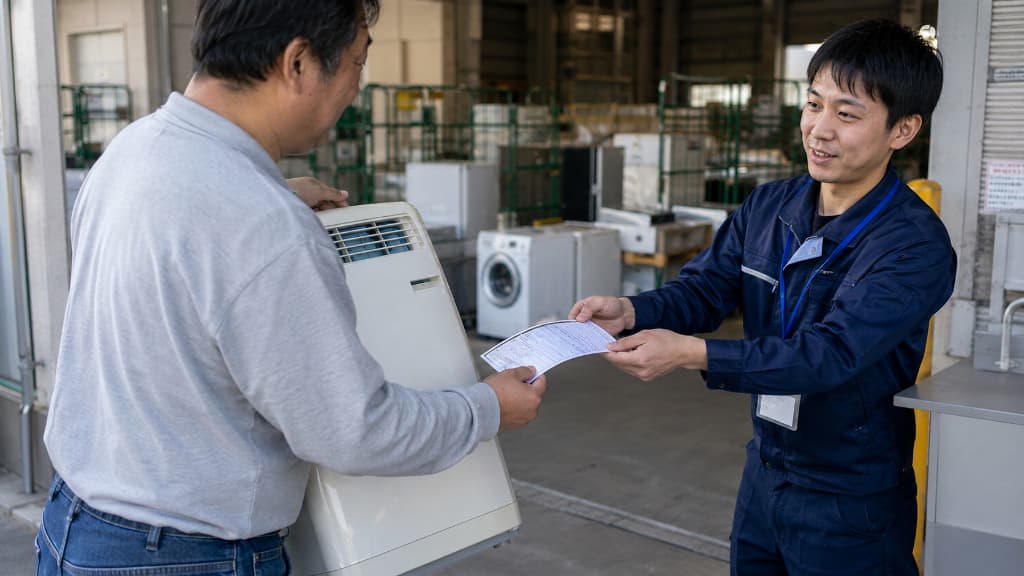
If you don’t mind moving the thing yourself, this is the budget option, because you pay the recycling fee only—no transport fee at all. The steps:
- Go to a post office and fill out a Home Appliance Recycling Ticket (家電リサイクル券) at the savings counter, writing in your appliance’s maker code, category, and size. Pay the recycling fee there.
- Get the payment slip stamped, and keep the certificate attached to your ticket—without it, they can’t confirm you paid.
- Take the appliance and the ticket to a designated collection site (指定引取場所, shitei hikitori basho) near you. You can find yours on the RKC website or by asking at the post office.
It’s more legwork—you’ll need a car or a friend with one—but for a single item it’s genuinely the least you can pay. Just don’t lose that stamped certificate.
Be realistic about the physical side, though. A full-size fridge or a drum washer is heavy and awkward, and if you’re on the fourth floor of a building with no elevator, the DIY route stops being worth it fast. In that case the small transport fee for a retailer pickup buys you two people and a dolly, which is money well spent. Weigh the fee you’d save against the afternoon and the back strain—sometimes “cheapest” and “smartest” aren’t the same line on the table.
4. Don’t know where it came from? Ask your city
If you inherited an appliance with your apartment, or genuinely can’t recall the shop, your municipality can point you to a licensed collector (許可業者) who will pick it up for the recycling fee plus a collection charge. Search “[your city] 家電リサイクル” or check your city’s garbage guide, which is often available in English.
5. Still works? Sell it or give it away
If the appliance is in decent shape, disposal isn’t your only option—and this is where you can dodge the fee entirely, or even make a little back. Second-hand shops (recycle shops) will take working appliances, sometimes paying you, sometimes just hauling them away free. Apps like Mercari and Jmty (ジモティー) are hugely popular for handing off furniture and appliances locally, and the departing-expat “sayonara sale” is a time-honored tradition—post in a local Facebook group and someone moving in will happily take your working microwave or fridge. When I moved out of a share house, I passed my appliances and my sofa straight to the housemates staying on—no fees, no hauling, and people I knew got the use of them. That’s the ideal version of this: the stuff barely has to leave the building. However you manage it, keeping a decent appliance in use beats sending it to the recycling stream.
Two practical notes. Jmty in particular runs on the “come and get it” model, so list it early and be ready for a stranger to collect—recent, clean, and complete (remote, hoses, manuals) items move fastest. And if you’re leaving Japan, line these sales up a few weeks before your flight; a working fridge is easy to give away with time in hand and a real headache to offload the night before you fly. The recycling fee is always there as a fallback, but a working appliance almost never needs it.
Small Appliances Have Their Own System
Smaller electronics fall under a separate Small Appliance Recycling Law (小型家電リサイクル法). Think phones, digital cameras, hair dryers, electric kettles, game consoles, and the tangle of cables in your drawer. Most cities put out collection boxes—often in city halls, community centers, and some large electronics stores—where you can drop these for free. It’s an easy, tidy way to clear out the small stuff, and it keeps the valuable metals inside (the so-called “urban mine”) in circulation. Check your city’s website for box locations and the exact list of accepted items, since it varies a little by municipality.
The usual size limit for the drop boxes is whatever fits through the slot—commonly around 30cm on the longest side, so a hair dryer or a router goes in but a rice cooker won’t. Anything too big for the box but too small to be one of the “big four” simply falls back to your municipal garbage, covered next. And a quick reminder: anything that stores data—phones, old laptops, some cameras—should be wiped before it leaves your hands. The recyclers are legitimate, but data hygiene is on you.
Computers and Phones
Computers have yet another route. Under the PC Recycling scheme, manufacturers take back their own machines—if your PC carries a PC Recycling mark (PCリサイクルマーク), recycling is already paid for and free to return via the maker. No mark (older machines) usually means a small fee. There are also free PC-collection services that accept them by mail. Whatever route you choose, wipe your data first—physically destroying the drive is the safest bet if you’re worried.
Phones can go in the small-appliance boxes above, but your mobile carrier (or any carrier shop, regardless of brand) will also take old handsets for free recycling and shred the SIM in front of you. If you’re sorting out a new line at the same time, our guide to getting a phone and SIM in Japan covers that side.
Everything Else: Microwaves, Fans, and Oversized Garbage
Appliances that aren’t covered by either recycling law—microwaves, rice cookers, vacuum cleaners, fans, kotatsu, toaster ovens—go through your municipal garbage system. Depending on size and your city’s rules, that means either oversized garbage (粗大ゴミ, sodai gomi) or, for small items, sometimes burnable or non-burnable trash. For oversized garbage the usual drill is:
- Phone or go online to your city’s oversized-garbage center to book a collection date.
- Buy a disposal sticker (粗大ゴミ処理券) at a convenience store for the quoted amount.
- Stick it on the item and put it out at the assigned spot on the morning of collection.
Fees are modest—often a few hundred to a thousand-odd yen per item. The rules for what counts as oversized (usually anything over 30cm, but it varies) live in your city’s garbage guide. For the full picture of how Japan sorts and disposes of household waste, see our guide to garbage and recycling in Japan.
Beware the “Free” Collection Trucks
Sooner or later you’ll hear a truck crawling through your neighborhood with a loudspeaker offering to haul away your old appliances “for free” (muryō kaishū), or you’ll spot flyers promising the same. Be careful here. Many of these operators are unlicensed, and the “free” pitch often turns into a demand for cash once your item is on the truck. Worse, unlicensed collectors are a known source of illegal dumping and unsafe overseas scrapping—the whole reason the recycling law exists in the first place. A legitimate hauler can show a municipal license (ippan haikibutsu shūshū unpan gyō kyoka). If in doubt, skip the truck and use one of the proper routes above. It’s one of those situations where “free” quietly becomes the most expensive option.
A Word on Timing (Especially If You’re Moving)
Appliance disposal is the classic moving-week scramble. Pickups have to be booked, post office tickets bought, drop-off sites visited during business hours—none of it happens on the same day you suddenly decide the fridge has to go. Plenty of people leave it to the final week and end up either paying a premium for a rush collection or, tempted by convenience, flagging down one of those dubious trucks. Give yourself a couple of weeks. If you’re in the middle of a bigger move, our moving timeline and checklist folds this into the wider to-do list, and if you’re handing back a rental, the renting guide covers move-out basics.
Frequently Asked Questions
Can I put a microwave in the regular trash?
A microwave isn’t covered by the Home Appliance Recycling Law, so it goes through your city’s garbage system—usually as oversized garbage (sodai gomi) with a paid disposal sticker, or as non-burnable trash if it’s small enough. Check your municipality’s rules for the size cutoff. Only the “big four” (AC, TV, fridge/freezer, washer/dryer) require the recycling-fee route.
What’s the cheapest way to get rid of a fridge?
If it works, selling or giving it away (recycle shop, Mercari, Jmty, a sayonara sale) can cost you nothing or even earn a little. If it’s dead, the cheapest legal route is to buy a recycling ticket at the post office and deliver it to a designated collection site yourself—that way you pay only the recycling fee (around ¥3,740–4,730 for a fridge) and skip the transport charge.
Do I still have to pay if the appliance works fine?
Not necessarily. The recycling fee only applies if you’re scrapping it. A working appliance can be sold or given away instead—second-hand shops, resale apps, and departing-resident sales all keep it in use and let you avoid the fee entirely. The fee route is really for items that have reached the end of their life.
Where do I find my designated collection site?
Look it up on the Recycling Ticket Center (RKC) website, or ask when you buy the recycling ticket at the post office. Sites are spread across the country, but they’re not on every corner, so confirm the nearest one and its hours before you load up the car.
Are those trucks offering free appliance pickup legit?
Usually not. Many are unlicensed and either demand a fee once your item is loaded or dump it illegally later. A proper collector can show a municipal waste-collection license. Unless you can verify that, stick to a retailer, a licensed municipal collector, or the post-office-and-drop-off route.
The Bottom Line
Appliance disposal in Japan feels fussier than it is. Sort your item into one of three buckets—one of the recycling-law “big four,” a small appliance, or ordinary oversized garbage—and the right path follows from there. When you’re buying a replacement, let the store take the old one and be done with it. When you’re not, the post-office ticket plus self-drop-off is the cheapest legal route, and selling a still-working unit is better yet. Whatever you do, give it a little lead time and steer clear of the “free” trucks. Handle it properly and you’ll never think about it again—until the next move.
Related reading
- Buying home appliances in Japan — how and where to buy the replacement once the old one is gone.
- Must-try Japanese appliances worth knowing — the locally loved gadgets worth considering for the upgrade.
- Everyday garbage and recycling rules — how ordinary trash and recycling work the rest of the time.

3 thoughts on “How to Dispose of Home Appliances in Japan: Recycling Law, Fees & Methods (2026)”