Having a place where you feel you belong changes everything about life abroad. It’s the difference between “I live in Japan” and “this is my home.” But community doesn’t come knocking on its own here—especially when the language barrier keeps you on the outside of the easy, casual connections you took for granted back home. The good news: there are far more doors in than newcomers realize. You just have to know where to look and be willing to walk through a few.
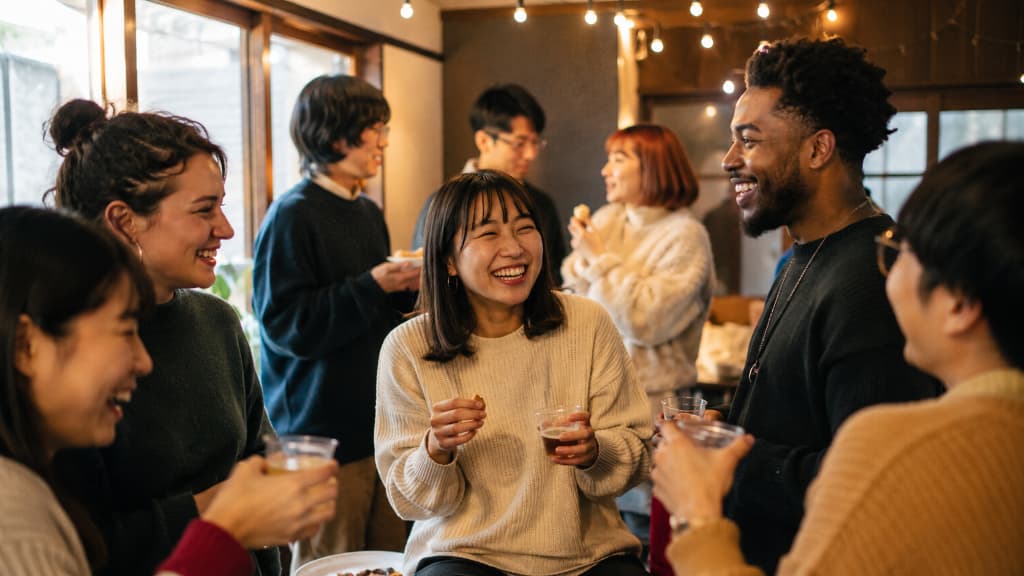
I write this as a Japanese person married to a foreigner, so I’ve had a front-row seat to how my husband built a life here from zero—the dead ends, the lucky breaks, and the handful of things that actually worked. This isn’t a list of clubs to join. It’s a guide to the different routes into community in Japan, with the real ones we’ve seen pay off mixed in.
Start With a Thread You Already Have
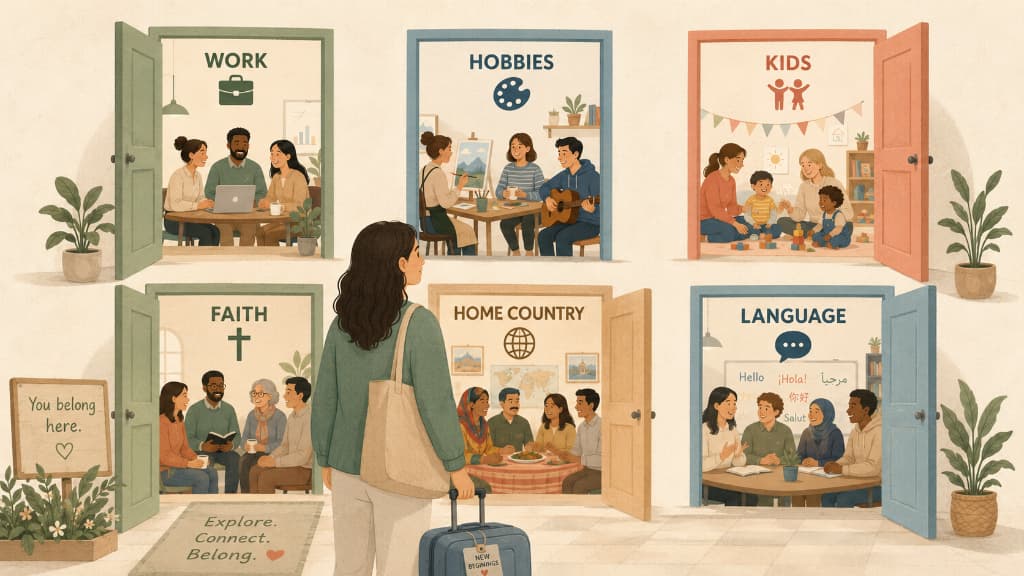
The mistake is going looking for “the expat community” as one big abstract thing. It isn’t one thing, and chasing it that way feels hollow. What works better is pulling a thread you’re already holding: your job, a hobby, your kids, your religion, your home country, the language you speak. Each of those is a doorway into a group of people who already share something real with you. The rest of this guide is organized around those threads—skim to the ones that fit you, and don’t feel you need all of them. One good community beats five you attend out of obligation.
Here’s the quick map, so you can jump to whatever fits your situation:
| If you want to… | Start with… |
|---|---|
| Meet people this week, low commitment | Meetup, TIFE, InterNations events |
| Make Japanese friends and practice the language | Your local International Association, community Japanese classes, Otonari-san |
| Have community built into daily life | A UR apartment or a share house |
| Connect through your background or faith | Places of worship, nationality associations, embassies |
| Find people in the same life stage | School/daycare networks, AFWJ, parent and hobby groups |
| Get started before you leave the house | r/japanlife, city Facebook groups, Discord and LINE chats |
The Easiest Door: Meetups and Events
If you want to meet people this week, start with organized events. They’re low-commitment—you show up, and if it’s not your crowd, you never go back, no harm done.
- Meetup is the workhorse. Search your city plus an interest—hiking, board games, photography, language exchange—and you’ll usually find something. Groups like Tokyo Expats run events constantly.
- Tokyo International Friends & Events (TIFE) is one of the biggest, with tens of thousands of members and dozens of free or cheap events a month—dinners, workshops, day trips—open to foreigners and locals alike.
- InterNations is the more polished, professional-networking flavor of the same idea, with chapters worldwide. Some events are members-only, but it’s a solid option if you want a slightly more grown-up room than a casual meetup.
One honest word of advice: the first event is always a little awkward, and the magic is almost never in the first one. It’s in going back a second and third time until the faces start to repeat. Consistency does more than charisma here. A small tip that helped my husband—pick an event built around doing something (a hike, a cooking class, a board-game night) rather than pure mingling. Having a task in front of you takes the pressure off the conversation, and you walk away having actually shared an experience with someone instead of just swapping business cards.
The Hidden Gem: Your Local International Association
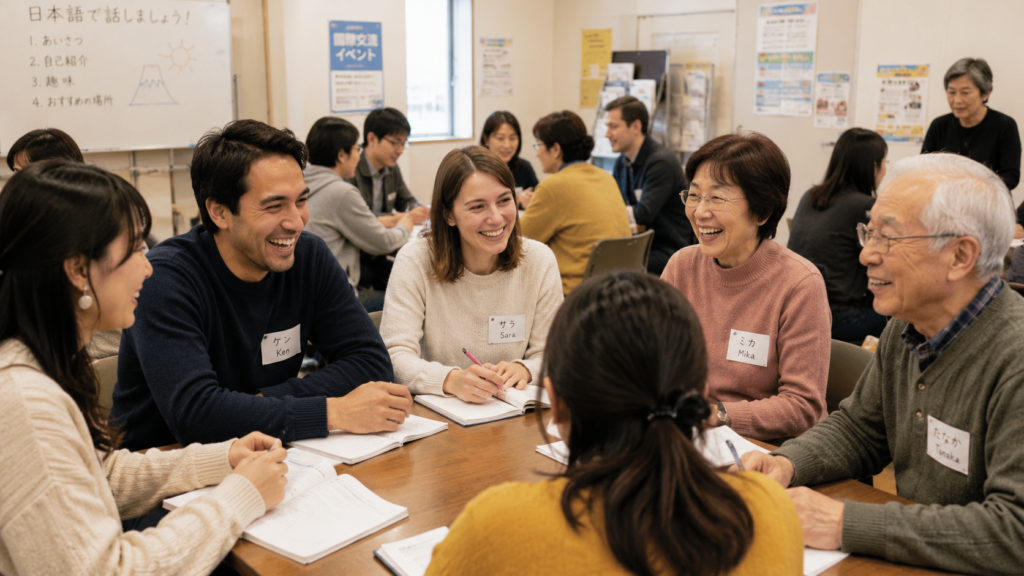
This is the resource almost no one tells newcomers about, and it might be the most useful on the page. Nearly every ward and city in Japan runs an International Association (国際交流協会, kokusai kōryū kyōkai)—a public or semi-public body whose whole job is helping foreign residents settle in. They typically offer free or nearly-free Japanese classes (often volunteer-run), regular exchange events and cultural festivals, and life-in-Japan consultation in multiple languages. Best of all, this isn’t a Tokyo thing—it exists whether you’re in Sapporo, Nagoya, or a small city in Shizuoka.
To find yours, search “[your city] international association” or just ask at your local city hall when you register your address. It’s the rare option that gives you Japanese practice, local friends, and practical help all in one place—and it puts you next to Japanese volunteers who want to meet foreign residents, which is exactly the connection that’s hardest to make on your own.
Along the same lines, the Otonari-san Family Friend Program (OFP) pairs you one-on-one with a Japanese volunteer in your neighborhood for a few months—someone to help you learn the ropes and get a foothold in local life. Hundreds of people from dozens of countries have gone through it.
Learn the Language, Meet the People
Language learning and community are the same project in Japan—each one feeds the other. Beyond the International Association classes above, look at:
- Community Japanese classes (地域日本語教室)—usually volunteer-run, very cheap, and as much about conversation and connection as grammar.
- Language exchange apps like HelloTalk and Tandem, and the many “language exchange” events on Meetup. The deal cuts both ways: plenty of Japanese people are keen to practice English (or Korean, or French), so your native language is a genuine social asset, not just a crutch.
There’s a nice quirk worth leaning on here: Japan is in the middle of a long love affair with learning foreign languages, and Korean has joined English as something huge numbers of people are actively studying, thanks to K-pop and Korean dramas. If you’re a Korean, English, or French speaker, that means there are Japanese people out there who would love to meet you specifically to practice—your language is a magnet, not a barrier. Post in a language-exchange group and you’ll often get more replies than you expected.
Even shaky Japanese opens doors that stay shut otherwise. You don’t need to be fluent—you need to be willing to be a little clumsy in public, which, honestly, is most of the battle for anyone moving here.
Where You Live Can Be a Community
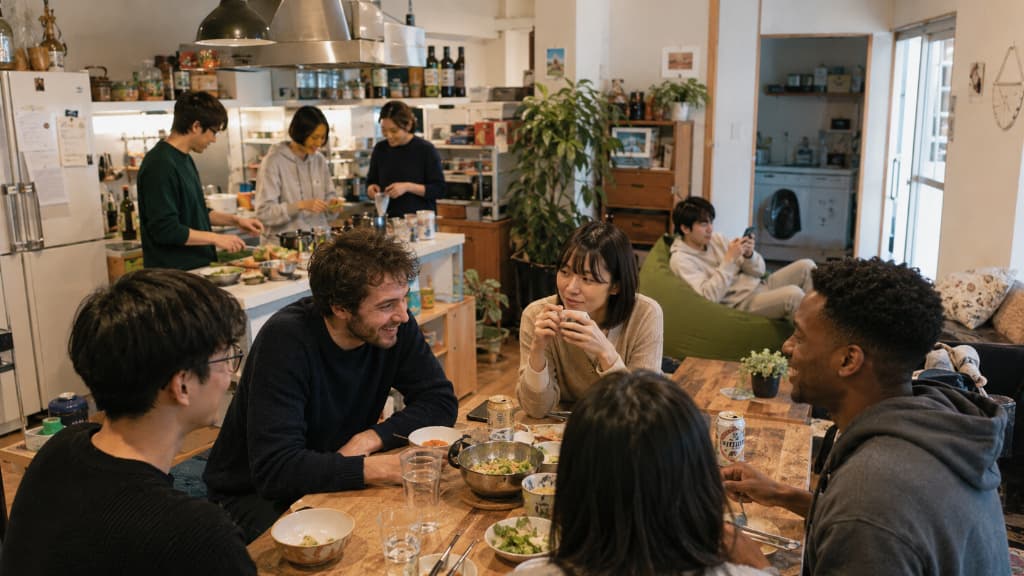
This one surprised even me, and it’s become one of my favorite bits of advice. Your housing choice can hand you a ready-made social circle.
UR rental apartments (UR賃貸住宅) are worth knowing about. UR is a large public-oriented landlord with no key money, no guarantor, and no renewal fees—which, not coincidentally, makes UR complexes popular with foreign residents, so you often find real international communities inside them. Many UR estates also have shared community facilities, like a common hall residents can book. My husband lived in one with a genuine Indian community, and they’d use the shared hall to throw birthday parties and get-togethers. That kind of built-in neighborhood life is hard to buy, and it comes more or less free with the address. (For how UR fits into the wider rental picture, see our guide to renting an apartment in Japan.)
Share houses are the other underrated move. Room-sharing is genuinely uncommon in Japan, so it doesn’t occur to most people—but for someone arriving alone, a share house is close to a cheat code for instant community. My husband lived in a huge one, around 200 residents, and there was always something going on: events, shared meals, easy introductions with people from all over. You trade some privacy for an instant social life, and when you’re new and know no one, that’s often a trade worth making. Large “social apartment” style share houses are especially built around this, with lounges and organized events baked in.
It’s not for everyone—if you value your quiet, it can be a lot of people—but it’s worth a look while you’re deciding where to land. Oak House is one of the larger operators, with an English-language site, no key money, and social-style properties that run resident events—an easy place to see what’s out there.
Community Through Work
It’s easy to overlook the obvious: for a lot of people in Japan, the first real friendships form at the office. You spend long hours with your colleagues, and those hours add up. My husband’s earliest close friends here were coworkers—the people he saw every day simply became his circle. The after-work drink (nomikai) plays a real part in that, and it’s often where the formal work relationship loosens into an actual friendship—see our guide to Japanese etiquette for how those drinking sessions work. Many companies also have bukatsu (club activities)—futsal, running, music—that are an easy, low-pressure way to know colleagues as people rather than job titles.
If you work remotely or freelance, you miss this built-in circle entirely, which can make Japan feel lonelier than it needs to. The fix is to manufacture the thing an office would have given you: join a coworking space rather than working from your apartment every day. The good ones run member events and put you in regular contact with the same faces—often a mix of foreign founders, freelancers, and remote workers who are in exactly the same boat. It costs money, but for many remote workers it’s the single best purchase for their social life in Japan.
Volunteering and Giving Back
If meeting strangers over small talk drains you, volunteering is a gentler way in—you’re all pointed at the same task, so conversation happens sideways instead of head-on. Your local International Association is usually the easiest starting point: many run volunteer Japanese-teaching, interpreting, and event programs where foreign residents are genuinely wanted, not just welcomed. Beyond that, community cleanups, food banks, children’s cafeterias (kodomo shokudō), disaster-relief groups, and neighborhood festivals all lean on volunteers and put you shoulder-to-shoulder with locals who care about the same things you do. It tends to build a warmer, stickier kind of friendship than a one-off meetup, because you keep coming back for the work and the people come with it.
Faith, Nationality, and Home-Country Communities
Sometimes the fastest route to belonging is the people who share your background or beliefs. A few anchors worth knowing:
- Places of worship. Tokyo Camii, Japan’s largest mosque and a Turkish culture center, holds prayers and community events and even runs an online halal market. Churches, temples, and gurdwaras across the country double as social hubs for their communities.
- Nationality communities. Some are large and geographic—Chinese communities around Yokohama’s Chinatown and Nishi-Kawaguchi in Saitama, for instance—while others run on festivals and events, like the annual Japan-Korea friendship festival. Search your country’s name plus “association Japan” and you’ll usually turn something up.
- Embassies and cultural centers often host events, film nights, and national-day gatherings—an easy way to find your compatriots.
Communities for Your Situation
Whatever stage of life you’re in, someone else is navigating it in Japan too:
- Parents. Your kid’s daycare or school pulls you into a network fast—park playgroups, class events, other international families. Our guide to preschools and daycare in Japan covers that world.
- Foreign spouses of Japanese partners. The Association of Foreign Wives of Japanese (AFWJ) connects non-Japanese women married to Japanese spouses, with members across the country.
- Pregnancy and new parents. Groups aimed at expecting and new mothers in Japan—often organized around international clinics and English-speaking support—are a lifeline during a stressful, paperwork-heavy time.
- Sports and hobbies. Clubs like Yokohama’s YC&AC mix international and local members through sport, and amateur teams and circles exist for almost everything from rugby to rock climbing.
Online Communities (and Getting Them Offline)
Online is where a lot of expat life is coordinated, and it’s the easiest first step when you’re still finding your feet:
- Reddit—r/japanlife is the big one for residents (as opposed to r/japan, which leans toward tourists), full of practical advice and the occasional meetup.
- Facebook groups—search your city plus “expats,” or your nationality, or a hobby. City-specific groups are gold for local questions and events.
- Discord servers and LINE open chats—increasingly where younger crowds and hobby groups actually hang out day to day.
The trick with all of these is to treat online as a doorway, not a destination. A Facebook group only becomes community when you show up to the picnic it’s organizing. Since so much coordination in Japan happens on LINE, having it set up early helps—our guide to getting a phone and SIM in Japan covers that.
Making It Actually Stick
Every route above only works if you follow through, and following through is the genuinely hard part—harder than finding the event in the first place. Say yes when you’d rather stay in. Go back to the same group a third time even when the first two were meh. Be the one who suggests coffee. None of it is complicated, but it does take a small, repeated act of courage, especially in a language you’re still learning. Watching my husband do it taught me that the people who build a life here aren’t the most outgoing ones—they’re the ones who kept showing up. You will too.
Turning those repeated encounters into real friendships is a skill of its own—reading Japanese indirectness, moving from a polite acquaintance to a genuine friend. That’s the subject of our companion guide, how to make friends in Japan.
Frequently Asked Questions
Where’s the easiest place to start if I’m brand new?
Your city or prefecture’s International Association—every region has one, and it’s built precisely for newcomers, with low-pressure events and classes. A Meetup hobby group or a community Japanese class is the next-easiest door. If what you’re really asking is how to turn those first meetings into lasting friendships, that’s covered in how to make friends in Japan.
How do I make Japanese friends, not just other expats?
Go where Japanese people are specifically open to meeting foreigners: your local International Association, community Japanese classes, language exchanges, and the Otonari-san program. Work and hobby circles help too. A little Japanese effort goes a long way—even basic phrases signal that you’re meeting them halfway.
Can I find community if I don’t speak Japanese?
Yes. English-language meetups, international events, faith and nationality communities, online groups, and English-speaking workplaces all run without much Japanese. That said, learning even a little dramatically widens the pool—and community Japanese classes are themselves a great way to meet people while you learn.
What is a share house, and is it a good way to meet people?
A share house is a home where you rent a private room and share common areas with other residents—uncommon in Japan, but a fast track to a social life, especially if you arrive alone. Large “social apartment” style houses even organize events for residents. You give up some privacy in exchange for instant connections, which is often worth it when you’re new.
How do I find events near me if I’m not in Tokyo?
Start with your city or prefecture’s International Association—every region has one, and they run local events and classes. Then search Meetup and Facebook for your city’s name, and ask at city hall when you register. Community outside the big cities is often smaller but warmer and easier to break into.
The Bottom Line
You won’t find community in Japan by looking for it in the abstract. You’ll find it by pulling one thread—your job, your street, a class, a hobby, your faith, your home country—and giving it a few honest tries. The doors are there, more of them than you’d guess from the outside. Pick one this week and walk through it. A year from now, the version of you that felt like a stranger will be hard to remember.


One thought on “Finding Community in Japan: A Guide for Expats”