Choosing a school is one of the heaviest decisions an expat family makes in Japan, and the international-school question is rarely as simple as “find the best one and apply.” Tuition can run as high as a full salary, the Japanese-language trade-off is real, and the better schools are genuinely hard to get into. This guide is built to help you decide whether an international school is right for your child and, if so, which one—with honest pros and cons, the costs nobody puts on the homepage, and a close look at six established Tokyo schools as they stand in 2026.

For the wider picture beyond international schools, see our guide to the Japanese education system for expat parents and our breakdown of childcare and preschool options for the early years.
First, an Honest Question: Do You Actually Need One?
It’s worth sitting with this before you tour a single campus, because plenty of long-term foreign residents land on “no.” Japanese public schools are free, and the good ones are very good—strong on fundamentals, attentive teachers, and often more support for non-Japanese-speaking newcomers than people expect. Paying two to three million yen a year for an alternative is only worth it if that alternative genuinely fits your child and your plans.
The honest case for international school usually comes down to a few things: your timeline in Japan is uncertain and you want a curriculum that transfers to another country; your child isn’t a native Japanese speaker and you want them in classes and friendships immediately; you (the parent) don’t read Japanese and want to be able to engage with the school; or your child simply doesn’t thrive in the more rigid, exam-driven Japanese classroom. The case against is just as real: cost, long commutes, and the language trade-off we’ll get to below. There’s no universal right answer—only the right fit for one specific child.
What “International School” Actually Means in Japan
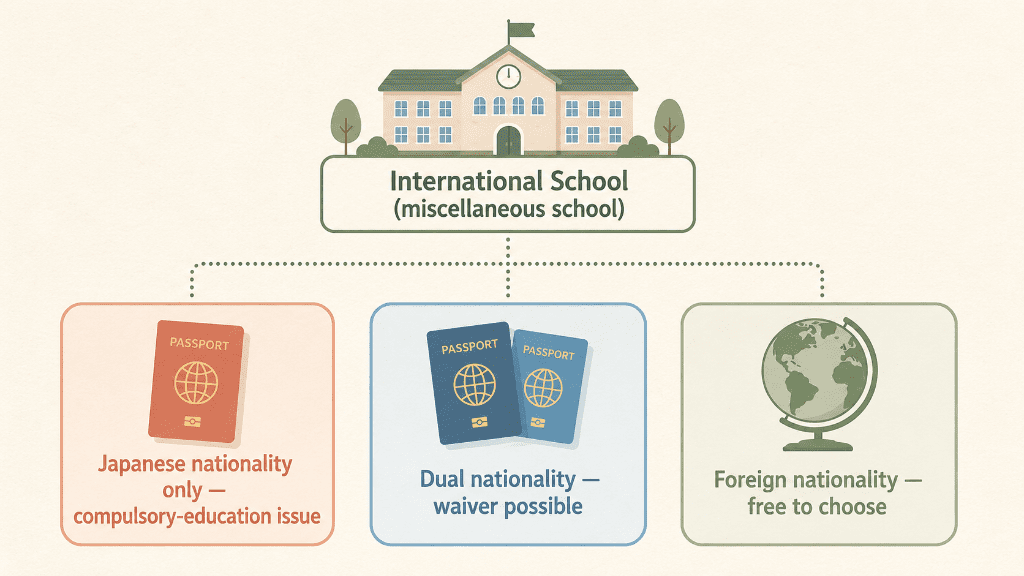
This is the part that catches families off guard, so it comes early. Most international schools in Japan are not “Article 1 schools” (一条校) under Japanese law—they’re classified as kakushu gakkō (各種学校, “miscellaneous schools”) or operate as unaccredited facilities. That status has consequences that depend heavily on your child’s nationality:
- Children with only Japanese nationality: Sending them to a non–Article 1 international school instead of a recognized Japanese school does not satisfy Japan’s compulsory-education obligation (就学義務). In practice this can make it hard to move back into the Japanese system later—for example, transferring into a municipal junior high after an international elementary isn’t guaranteed. See the Ministry of Education (MEXT) guidance on this.
- Dual nationals (Japanese + foreign): The obligation can be waived or suspended, typically where the child is likely to choose foreign nationality and has another educational path secured. Confirm with your local ward office.
- Foreign-nationality children: No Japanese compulsory-education issue applies—you’re free to choose.
There’s a related catch on the way out: some Japanese universities won’t recognize credits from a non-accredited international curriculum, and re-entry into the Japanese system is bumpy. None of this is a reason to avoid international schools—it’s a reason to decide your child’s likely endpoint (a Japanese university, an overseas one, or “we don’t know yet”) before you commit, because that endpoint should drive the whole choice. Tokyo’s metropolitan government keeps an official portal of international schools if you want to check a school’s status.
How to Choose: The Factors That Actually Matter
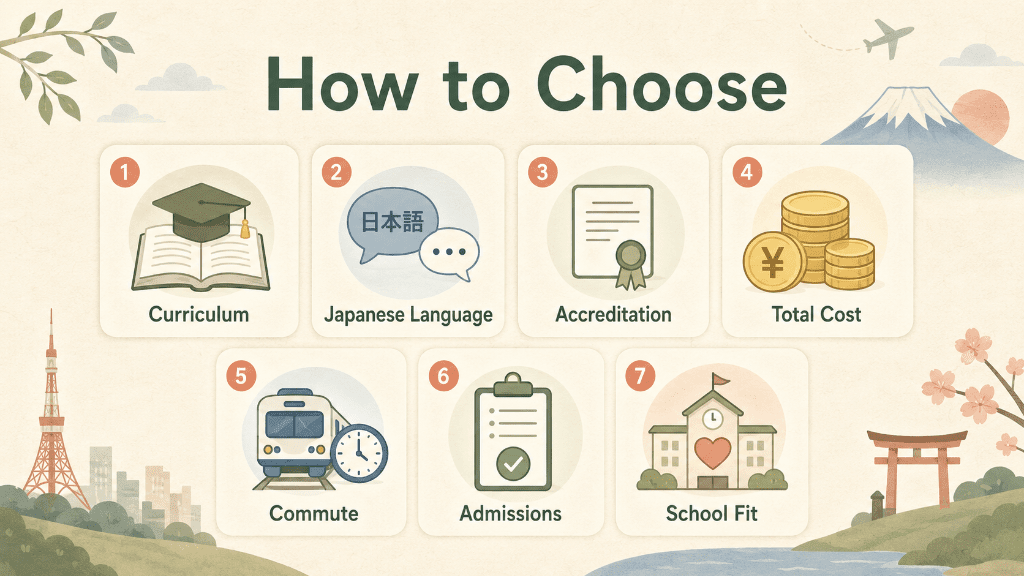
Glossy campuses blur together fast. These are the dimensions that actually separate a good fit from an expensive mistake.
1. Curriculum—and where it leads
The curriculum isn’t an abstract preference; it’s a pipeline to a particular kind of university and country. Broadly:
- IB (International Baccalaureate): The most portable option, recognized by universities worldwide and the dominant framework in Tokyo’s international schools. Inquiry-driven and broad.
- American + AP: Continuous assessment (homework, quizzes, midterms, finals), well suited to U.S. universities and to kids who do better with steady feedback than one big exam.
- British (IGCSE / A-Level): A higher ceiling and more self-directed, with grades often resting on end-of-course exams—great for a focused student, tougher for one who needs structure.
- National systems (French, Indian/CBSE, etc.): Often cheaper and centrally regulated, ideal if you may return to that country—though usually a poor bridge to a Japanese university.
One framing that gets repeated by experienced parents: Japanese schooling through high school is about raising the floor (solid fundamentals for everyone), the American system leans toward social development and learning to work with people, and the British system aims for a high ceiling. None is objectively best—match it to the child you actually have.
2. The Japanese-language trade-off
This is the single most common regret you’ll hear from families who chose international, especially those staying in Japan long-term. Many international schools teach little or no serious Japanese, and children can grow up here yet never reach a native level—unable to read kanji comfortably or function fully in a Japanese workplace as adults. If you plan to stay in Japan indefinitely, weigh this heavily. Some schools mitigate it: a few keep a genuine Japanese-language track (or follow MEXT’s kokugo guidelines), which can make the difference between a graduate who works comfortably in Japanese and one who’s locked out of it.
3. Accreditation and teacher quality
The international-school market has expanded fast, and quality now varies wildly. Established schools carry recognized accreditation (WASC, CIS, or IB authorization) and require licensed, experienced teachers. Newer, profit-driven operations—particularly some English “preschools” and kindergartens—may staff classrooms with enthusiastic but untrained instructors. The good news is that this is easy to screen for: ask directly about accreditation and what share of teachers hold a teaching license and several years of experience. Vague answers are an answer.
4. Total cost, not the headline tuition
The tuition on the website is rarely the real number. Budget for one-time enrollment and “building/development” fees that can add one to two million yen in year one, plus annual extras like bus service (up to ~¥390,000), lunch, uniforms, trips, and English-as-an-additional-language (EAL) support billed separately. Fees also rise most years, and a weak yen has pushed them higher. Note too that the national High School Tuition Support grant (up to ¥396,000/year) generally does not apply to “miscellaneous school” international schools—so don’t count on it.
5. Commute and location
Easy to underrate until you’re living it. A 60–90 minute each-way commute is a daily tax on a young child’s energy and your logistics. A school within walking distance of a station—or inside your bus zone—can matter more to daily life than a marginally stronger reputation across town. Location also quietly affects cost: walkable means you skip the bus fee entirely.
6. Admissions reality: waitlists, English level, and timing
Demand for the well-regarded schools is intense. Waitlists often function less like a queue and more like a pool the admissions office selects from, and many schools screen applicants—your child generally needs near-native English at grade level to pass entry assessments. A practical consequence: if English isn’t your home language, it’s far easier to enter in kindergarten (when kids absorb the language) than to transfer an older child in cold. Plan early, apply to several, and don’t assume you can pick and choose.
One scheduling quirk to plan around: international schools run on a September start, roughly seven months ahead of Japan’s April year. Switching from a Japanese school means your child’s grade placement can shift by a year depending on their birthday, so map the grade alignment before you transfer.
7. Fit—and special-needs support
Visit before you commit; a campus tour tells you things a brochure can’t, and a bad atmosphere is a real signal. Ask specifically about learning support, too: international schools vary enormously here, and some have little provision for children with ADHD, dyslexia, or other needs—occasionally to the point of declining to re-enroll a student. If your child needs support, make it a direct, early question.
What It Really Costs in 2026
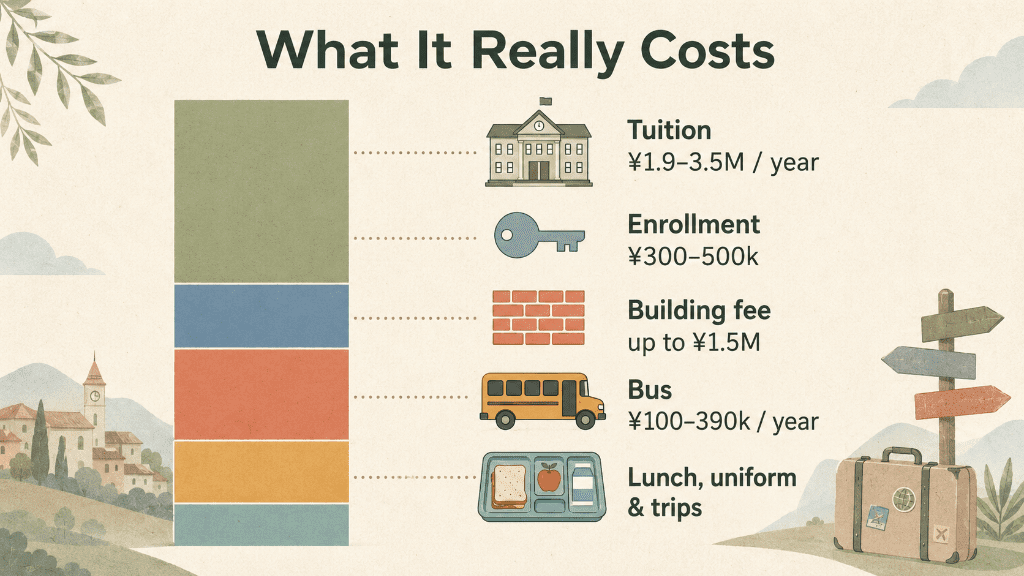
As a working frame for the 2026 school year, annual tuition at established Tokyo international schools runs roughly ¥1.9–3.5 million, with most mid-tier schools clustering around ¥2.5–3 million and the priciest crossing ¥3.5 million. On top of tuition, plan for:
- Application fee: ¥20,000–50,000 (non-refundable)
- Enrollment / registration fee: ¥300,000–500,000, one-time
- Building / capital / development fee: ¥300,000 up to ~¥1.5 million, often one-time (sometimes annual)
- Bus: ¥100,000–390,000/year; lunch, uniforms, trips, EAL: billed on top
Realistically, a first year often lands 40–60% above the headline tuition once one-time fees are in. Many schools offer sibling discounts, so ask if you’re enrolling more than one child.
Six Established Tokyo International Schools (Snapshot as of 2026)
Rather than list every school, here’s a closer look at six long-running, well-regarded options spanning the main curricula—American, British, IB, bilingual IB, and single-sex Catholic. Figures are for the 2025–26 / 2026–27 school year and rise most years, so treat them as a point-in-time snapshot and confirm the current schedule on each school’s site before deciding.
| School | Curriculum | Ages / grades | Area | Co-ed? | Annual tuition (2026, approx.) |
|---|---|---|---|---|---|
| American School in Japan (ASIJ) | American + AP | 3–18 (N–G12) | Chofu | Co-ed | ¥3.27M–3.53M |
| The British School in Tokyo (BST) | British (IGCSE/A-Level; IBDP being added) | 3–18 (Nursery–Y13) | Shibuya / Showa / Azabudai Hills | Co-ed | ¥2.82M–2.93M |
| K. International School Tokyo (KIST) | IB (PYP/MYP/DP) + IGCSE | 3–18 (K1–G12) | Koto | Co-ed | ¥2.85M–3.02M |
| Aoba-Japan (A-JIS) | IB (PYP/MYP/DP), bilingual | 3–18 (K–G12) | Meguro (+ other campuses) | Co-ed | ¥1.91M–2.65M |
| Seisen International School | IB (PYP/MYP/DP) + Montessori K | 3–18 (K–G12) | Setagaya | Girls (K co-ed) | ¥2.50M–2.70M |
| St. Mary’s International School | IB DP + broad curriculum | ~5–18 (G1–12) | Setagaya | Boys | ¥2.70M–2.85M |
The American School in Japan (ASIJ)
Founded in 1902 and based in Chofu (with an early-learning center in central Tokyo), ASIJ is one of the city’s most prestigious schools and—despite the name—genuinely international in its student body. It runs a U.S.-style program with Advanced Placement and is WASC-accredited, with strong university placement in the U.S. and beyond. Tuition for 2025–26 ranges from ¥3,269,000 (elementary) to ¥3,533,000 (high school), plus hefty one-time fees—a ¥1,525,000 building-maintenance fee and ¥250,000 capital assessment among them—and a ¥390,000 annual bus fee. One practical note families discover late: a large share of seats go to corporate-sponsored expat families, which can make private (self-paying) admission competitive. Official fees →
The British School in Tokyo (BST)
BST delivers the English National Curriculum from nursery through Year 13, with IGCSEs and A-Levels—and an IB Diploma pathway being introduced—across campuses in Shibuya, Showa, and Azabudai Hills. Like ASIJ, it’s national in name but very mixed in practice. Tuition for 2025–26 runs ¥2,820,000 (primary) to ¥2,930,000 (senior years), with one-time enrolment (¥500,000) and educational-resources (¥680,000) fees plus a ¥100,000 annual capital-development charge. A solid pick for families oriented toward the UK or a high-ceiling, exam-focused track. Official fees →
K. International School Tokyo (KIST)
In Koto-ku, KIST is a full IB continuum (PYP through the Diploma, with IGCSE in between) and has a reputation as one of Japan’s stronger academic IB schools. That rigor is a feature or a caveat depending on your child: families seeking a gentler study-life balance sometimes find it intense (though rigorous isn’t the same as rigid). Tuition for 2026–27 is ¥2,850,000 (Grades 1–9) to ¥3,020,000 (kindergarten), with a ¥700,000 one-time capital fee. The school receives no government funding and relies on fees. School site →
Aoba-Japan International School (A-JIS)
Aoba is a bilingual IB school (PYP/MYP/DP) and the most affordable of this group, with 2026 tuition from ¥1,908,000 in kindergarten to ¥2,650,000 in the upper grades, plus modest one-time fees and sibling discounts (10% off the second child, 15% off each additional). Now operated under the BBT group after an earlier ownership transition, it’s valued by some families for taking Japanese seriously—its kokugo curriculum follows MEXT guidelines, which can leave graduates more comfortable in a Japanese-language environment than typical international-school leavers. Official fees →
Seisen International School (girls)
A Catholic girls’ school in Setagaya (its kindergarten is co-ed), Seisen pairs a Montessori early-years program with the full IB continuum and posts strong university outcomes. Tuition for 2026–27 is ¥2,650,000 (elementary) to ¥2,700,000 (middle/high), with a ¥700,000 one-time land-and-building fee. A natural option for families who want a single-sex, values-based environment with IB portability. Official fees →
St. Mary’s International School (boys)
Effectively Seisen’s brother school—also Catholic, also in Setagaya—St. Mary’s is Japan’s best-known all-boys international school, offering the IB Diploma alongside a broad curriculum and a strong sports and technology tradition. Tuition for 2025–26 is ¥2,700,000 (elementary) to ¥2,850,000 (high school), with one-time registration (¥400,000) and a ¥1,000,000 development fund. Families often consider Seisen and St. Mary’s together when they want single-sex schooling in the same part of the city. Official fees →
A Common Middle Path: Local School Now, International Later
One strategy comes up again and again among foreign families in Tokyo: put your child in local public elementary—free, and the years when Japanese is most easily absorbed—then switch to an international school at junior high or high school, when the educational approach and the stakes change. Done well, it gives a child solid Japanese and an internationally portable diploma, and many such students go on to good universities in Japan or abroad.
Two honest caveats. First, it puts the burden on you to keep your child’s English at grade level until the switch—straightforward for a native-English household, harder otherwise, since international schools test for near-native English at entry. Second, this path has gotten markedly more competitive: seats are scarce, waitlists are selective pools, and an older transfer applicant competes against a steady stream of children with very strong English. A strong private Japanese junior high with a serious English program (or a designated returnee/bilingual public school) is a realistic alternative worth comparing.
Frequently Asked Questions
How much does an international school in Tokyo cost per year?
Tuition alone is roughly ¥1.9–3.5 million a year in 2026, depending on the school and grade. Add one-time enrollment and building fees (¥300,000 to ~¥1.5 million), plus bus, lunch, uniforms, and trips, and a first year commonly runs 40–60% above the headline tuition.
Can a Japanese citizen attend an international school?
Yes, but for a child with only Japanese nationality, attending a non–Article 1 international school doesn’t satisfy Japan’s compulsory-education requirement and can complicate moving back into the Japanese system. Dual nationals can often obtain a waiver. Check with your ward office and review the MEXT guidance.
Will my child still learn Japanese?
Not necessarily to a high level. Many international schools teach limited Japanese, and graduates can struggle to read kanji or work in Japanese as adults. If you’re staying in Japan long-term, prioritize schools with a genuine Japanese-language track and plan on outside tutoring to keep it up.
Is it hard to get in?
For the well-regarded schools, yes. Expect waitlists, entrance assessments, and a near-native English requirement, with some seats reserved for corporate-sponsored families. Apply to several schools early rather than counting on one.
Can international-school graduates get into Japanese universities?
Some can—English-track universities like Sophia and ICU, and a growing number of others, accept international-school students. But many Japanese universities don’t recognize credits from a non-accredited international curriculum, so confirm the pathway if a Japanese university is a likely goal.
Key Takeaways
- Decide your child’s likely endpoint first—Japanese university, overseas university, or undecided—because it should drive the curriculum and school choice.
- International school isn’t automatically the better choice; Japan’s public schools are strong and free, and the language trade-off is real if you’re staying long-term.
- Most international schools are “miscellaneous schools,” which has real compulsory-education and university-recognition implications, especially for Japanese citizens.
- Budget the full cost—one-time fees, bus, and extras push the first year well above the headline tuition—and verify accreditation and teacher qualifications.
- Apply early and to several schools, visit in person, and consider the common “local elementary, international later” middle path.