Being arrested in a country whose language and legal system you don’t fully know is genuinely frightening—and Japan’s process works differently from what most newcomers expect. The detention is longer, the questioning is done without your lawyer in the room, and the pressure to “just admit it and move on” is real. The good news is that you have clear rights from the very first hour, and using them well makes an enormous difference. And if you’re a foreign resident, there’s a second concern running in parallel—your residence status—which we flag below and cover fully in a companion guide. This guide starts with what to actually do, then explains the process so nothing blindsides you.

This article is general information, not legal advice. If you or someone you know is actually arrested, the single most important step is to get a lawyer involved quickly—everything below is here to help you do that and protect yourself in the meantime.
“Voluntary” Questioning vs. Actual Arrest
Before the arrest rules apply at all, it’s worth knowing this distinction—because some readers aren’t under arrest yet, and this is the most useful thing for them to understand. Police often ask people to come to the station or answer questions on a “voluntary” basis (任意, nin’i)—voluntary accompaniment (任意同行) or voluntary questioning. Legally, voluntary means exactly that: you are not under arrest, you are free to decline, and you can leave.
In practice it rarely feels voluntary—officers can be very persistent, and many people agree simply because they don’t realize they can say no. You’re within your rights to politely decline, to ask whether you’re under arrest, and to say you’d like to consult a lawyer first. Once an actual arrest warrant (逮捕状) is executed, though, the rules change: from that point it’s compulsory, the clock on the detention timeline starts, and the rights described below apply. If you’re ever unsure which situation you’re in, asking “Am I under arrest?” is a fair and useful question.
First: What to Do in the First Hours
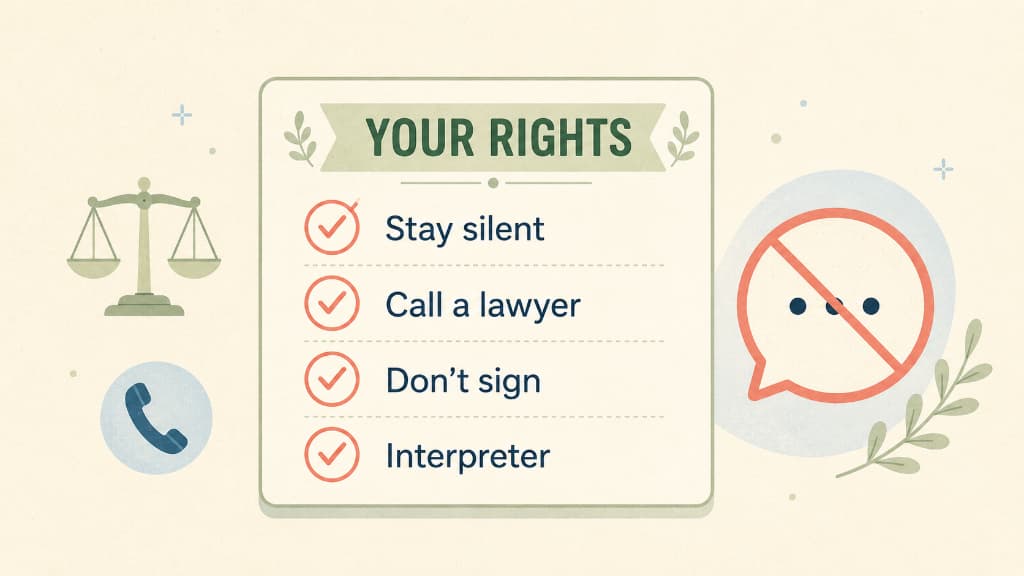
If you remember nothing else, remember these. They cost you nothing and they protect you the most.
The two that matter most—do these first:
- Use your right to remain silent (黙秘権, mokuhiken). You are not required to answer questions, and silence cannot legally be treated as proof of guilt. You can simply say you’ll wait until you’ve spoken to a lawyer.
- Ask for a duty attorney (当番弁護士, tōban bengoshi). Anyone who’s been arrested can request a one-time free visit from a duty lawyer through the local bar association. Say clearly that you want to call the tōban bengoshi.
Then, as soon as you can:
- Stay calm and stay polite. Resisting or arguing only makes things worse. Cooperating with the process is not the same as admitting guilt.
- Do not sign anything you don’t fully understand. This is critical—see the warning about written statements below. If you’re unsure, don’t sign, and say you want your lawyer first.
- Ask for an interpreter. You have the right to a free interpreter when dealing with police, prosecutors, and the court. Don’t try to get by in shaky Japanese on something this serious.
- Ask to contact your embassy or consulate. Under international law you’re entitled to consular access. Your consulate can’t run your defense, but it can help with interpreters, lawyer lists, and contacting your family.
- Have someone notified. You have the right to have your arrest communicated so that family or friends—and ideally a lawyer—know where you are.
The Reality of Pre-Charge Detention
Here’s the part that genuinely surprises people from other countries. In Japan you can be held for a long time before you’re ever charged—up to 23 days for a single set of allegations—and during that time you’re usually kept in a police cell (a system often called daiyō kangoku, 代用監獄), questioned repeatedly.
Two features catch foreign nationals off guard. First, your lawyer is not allowed to be present during interrogation. You can meet your lawyer separately, but the questioning itself happens without them in the room. Second, the system leans hard toward confessions—critics call it “hostage justice” (人質司法), because denying the charge can mean staying detained longer and being refused bail. None of this means you should give up; it means the opposite. Silence and a lawyer are your two strongest tools precisely because the pressure is so one-sided.
Never sign a statement you don’t understand
During questioning, an officer typically writes up your answers as a written statement (供述調書, kyōjutsu chōsho)—in Japanese, in their wording, not yours. Once you sign and seal it, it becomes powerful evidence that’s very hard to walk back later, even if it doesn’t quite match what you meant. You have the right to refuse to sign it. If the wording is off, if you don’t understand it, or if you simply want to wait for your lawyer, don’t sign. This single habit has saved a lot of people from a statement they never really agreed with.
The Timeline: From Arrest to Trial
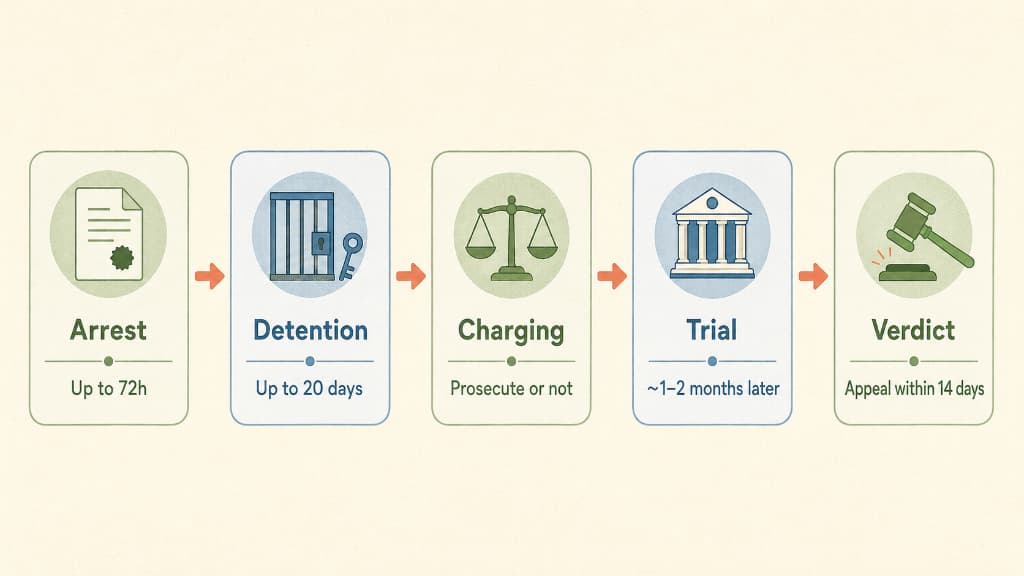
Knowing the stages helps you understand where you are and what’s coming next. Here’s the standard path:
| Stage | How long | What happens |
|---|---|---|
| Arrest & initial hold | Up to 72 hours | Police hold you (up to 48h), then hand the case to a prosecutor (up to 24h), who decides whether to ask a judge for detention or release you. |
| Pre-charge detention (勾留) | Up to 20 days (10 + 10) | A judge can grant detention in two blocks of up to 10 days. Questioning continues. (A small set of grave crimes allows up to 25 days.) |
| Charging decision | End of detention | The prosecutor either prosecutes (起訴), declines to prosecute (不起訴), or releases you. Non-prosecution means no trial and no conviction. |
| After being charged | Until the verdict | You’re generally detained until sentencing unless you’re granted bail (保釈)—which only becomes possible after charging. |
| Trial | First date ~1–2 months after charge | The prosecution must prove the crime; you and your lawyer present a defense or mitigating factors. A standard trial spans a few sessions. |
| Verdict & appeal | Appeal within 14 days | If acquitted, you’re released immediately. If convicted, the sentence applies unless you appeal within 14 days. |
One important note on bail: it does not exist during the pre-charge detention stage. Bail (保釈) only becomes an option once you’ve been formally charged, and it’s far from automatic—you’ll usually need a lawyer to argue for it with concrete grounds.
Your Rights If You’re Arrested
These are granted by law to everyone, regardless of nationality. Police make arrests under a warrant (逮捕状) based on reasonable suspicion; if you believe an officer is genuinely overstepping, you can raise it with a senior officer—but do that through your lawyer where possible.
- The right to remain silent (黙秘権) throughout questioning.
- The right to consular access—to contact the consulate of your country.
- The right to a one-time free duty attorney (当番弁護士) after arrest, regardless of income.
- The right to a free interpreter when communicating with police, prosecutors, and judges.
- The right to choose a private defense lawyer at your own expense—or a court-appointed one if you can’t afford it (see below).
- The right to have someone notified of your arrest.
- The right to refuse to sign the investigator’s written record of your statement (供述調書).
Getting a Lawyer: Duty, Court-Appointed, and Private

There are three routes to a lawyer, and the differences matter because they kick in at different stages.
- Duty attorney (当番弁護士) – Run by the local bar association. One free visit, available right after arrest, before any court process. This is your fastest first contact. Continued representation after that first visit is paid—unless you qualify for the court-appointed route below.
- Court-appointed lawyer for suspects (被疑者国選, higisha kokusen) – If you can’t afford a private lawyer, you can have one appointed once a detention order (勾留状) has been issued. Since a 2018 reform this covers all cases at the detention stage, not just serious ones—an important update, because older guides wrongly say court-appointed lawyers only come after charging.
- Private lawyer (私選弁護人) – A lawyer you hire and pay yourself. You can do this at any stage, and many people switch from a duty attorney to a private one for ongoing defense.
If your income is low, a court-appointed lawyer can also come with interpreter support. Whatever the route, the principle is the same: get a lawyer in early, and say as little as possible until you have.
Finding English-Speaking Legal Help
If you’re supporting someone who’s been arrested—or want to know where to turn before anything happens—save these contacts now, while you’re calm and have a working phone. In an emergency, family or friends on the outside can make most of these calls on the detained person’s behalf.
- The local bar association’s duty-attorney line. This is how you request the free tōban bengoshi visit—and family or friends can call to arrange it, not just the detainee. The Japan Federation of Bar Associations keeps a nationwide list of duty-attorney contact numbers by region. When you call, it helps to have the detained person’s name, date of birth, the suspected offense, which police station is holding them, and whether an interpreter is needed.
- Hōterasu multilingual line — 0570-078377 (from IP or prepaid phones: 050-3754-5430), weekdays 9:00–17:00. The Japan Legal Support Center (法テラス) runs a free three-way interpreted phone service in English, Chinese, Korean, Spanish, Portuguese, Vietnamese, Tagalog, Nepali, Thai, and Indonesian. They explain the system and point you to the right window; note that their low-income legal-aid funding is limited to foreign residents with legal status and an address in Japan.
- Your embassy or consulate. Many maintain lists of English-speaking or bilingual lawyers and can help families coordinate from abroad. They can’t run the defense, but consular support is genuinely useful—don’t hesitate to call.
- Immigration Information Center — 0570-013904 (from abroad or IP phones: 03-5796-7112), weekdays 8:30–17:15. Run by the Immigration Services Agency in multiple languages, this line is the one to use for the residence-status side of things—relevant if detention risks overlapping with a visa renewal or period-of-stay deadline.
- Private criminal-defense firms that handle foreign cases. Several specialize in non-Japanese clients and interpreter-supported defense; speed matters, so reach out early rather than waiting for the case to develop.
Whoever you reach first, the message to pass on to the detained person is simple and consistent: stay calm, stay silent until the lawyer arrives, and don’t sign anything in the meantime.
Possible Outcomes
A case can end in several ways. The best is non-prosecution (不起訴)—often the goal of a good early defense—where there’s no trial and no conviction. If the case goes to trial and you’re convicted, the typical sentences are a fine or imprisonment, sometimes with a suspended sentence (執行猶予) that keeps you out of prison as long as you stay out of trouble for a set period.
A note on terminology, because the law changed recently: as of June 2025, Japan merged its two old prison sentences (懲役 with labor and 禁錮 without) into a single imprisonment penalty (拘禁刑, kōkinkei) focused on rehabilitation. You may still see the older terms in documents and older articles. Foreign nationals who receive an actual prison term are held in designated facilities equipped to handle non-Japanese inmates.
After It’s Over: Records and Daily Life
If your case ends without a conviction, you walk away without a formal criminal record—but it’s worth understanding what the system keeps. Japan distinguishes between a criminal record (前科, zenka), which means an actual conviction, and an investigation history (前歴, zenreki), the record that you were investigated or arrested even if you were never convicted. Non-prosecution leaves you without a 前科, but a 前歴 can still exist in police and prosecutor files.
For everyday life, a criminal record in Japan isn’t something that shows up on a routine background check the way it might elsewhere—it’s not printed on your residence card and employers can’t simply look it up. Where it genuinely matters is in specific, high-stakes contexts: future criminal cases, certain professional licenses, and—crucially for foreign residents—immigration decisions like renewals, permanent residency, and naturalization, all of which weigh your conduct. In other words, the cleaner the outcome you fight for now, the fewer doors it closes later.
It’s Not Just the Criminal Case—Your Visa Is Also at Stake
For foreign residents there’s a second track running alongside the criminal one: your residence status. Certain outcomes—an actual prison sentence, a drug conviction (even a suspended one), or simply having your period of stay expire while you’re detained—can lead to losing your status and being deported. The criminal case and the immigration case are decided by different authorities, so handling them well often takes two kinds of specialist. We cover this in detail in How Criminal Proceedings Affect Visas in Japan—read it next if status is a concern.
The Bottom Line
An arrest in Japan is a serious situation, but it’s one you can navigate if you act early and use your rights. Stay calm and polite, stay silent until you’ve spoken to a lawyer, ask for the duty attorney, refuse to sign anything you don’t understand, and get your consulate and family informed. The system allows long detention and questions you without your lawyer present, so the protections you do have—silence, a lawyer, an interpreter—are the ones to lean on hard. And if you’re a foreign resident, don’t lose sight of the immigration side running in parallel. The earlier the right people are involved, the better your odds of a good outcome.
For background on Japan’s defense system and the duty-attorney scheme, the Japan Federation of Bar Associations (JFBA) publishes information in English.
FAQ
Q1. How long can I be held after being arrested in Japan?
A. Up to 72 hours initially, then up to 20 more days of pre-charge detention if a judge approves it—about 23 days total for one set of allegations, before the prosecutor even decides whether to charge you. A few grave crimes allow slightly longer.
Q2. Do I have the right to remain silent?
A. Yes. You have the right to remain silent (黙秘権), and silence cannot legally be treated as proof of guilt. It’s usually wise to stay silent until you’ve spoken with a lawyer, especially since your lawyer cannot be present during the interrogation itself.
Q3. Can I get a free lawyer?
A. Yes. Anyone arrested can request a one-time free visit from a duty attorney (当番弁護士). If you can’t afford a private lawyer, a court-appointed lawyer (被疑者国選) is available once a detention order is issued—covering all cases since a 2018 reform, not only serious ones.
Q4. Should I sign the statement the police write up?
A. Not until you understand it fully and ideally have legal advice. A signed written statement (供述調書) is strong evidence that’s hard to retract later, even if it doesn’t match what you meant. You have the right to refuse to sign.
Q5. What can my embassy or consulate actually do?
A. Under international law you have the right to consular access. Your consulate can visit you, notify your family, and provide a list of English-speaking or bilingual lawyers. What it cannot do is act as your lawyer, pay your legal fees, or intervene in the case itself—so a defense lawyer is still your priority.
Q6. Will an arrest affect my visa or residence status?
A. An arrest alone doesn’t cancel your status, but some outcomes can—an actual prison sentence, a drug conviction even if suspended, or letting your period of stay expire while detained. See our companion guide, How Criminal Proceedings Affect Visas in Japan, for the details.



2 thoughts on “Know Your Rights: What to Do If Arrested in Japan”