Renting an apartment in Japan without a guarantor sounds like a dead end, but it usually isn’t. The system has quietly shifted over the past decade, and most foreigners now sign a lease without ever lining up a personal guarantor. The catch is that the rules aren’t written down anywhere obvious, so it’s easy to panic when an agent first asks, “And who is your guarantor?”

I’ve pulled together the questions foreigners actually ask about this—about guarantor companies, UR housing, share houses, screening, and the documents you’ll be asked for—and answered them in plain English. My husband moved to Japan from India, and across three apartments here he was never once blocked by the guarantor problem: his first place was rented through his company, the second was a UR apartment, and the third was a share house. Those three routes aren’t a coincidence—they’re basically the three ways around the guarantor wall, and they’re how this guide is organized.
If you don’t have a guarantor, you have three main paths:
- Path 1 — Use a guarantor company. This is what most people do, and most landlords now expect it. Start at Q4.
- Path 2 — Pick housing that needs no guarantor at all—UR apartments or share houses. Jump to Q10.
- Path 3 — Let your company or school cover it. Many act as guarantor or provide housing outright. See Q11.
If you’re in a hurry, skim those three. If you want to understand how screening works and how to pass it, read straight through.
Table of Contents
- Q1. Is a guarantor required to rent an apartment in Japan?
- Q2. What are the requirements for a guarantor?
- Q3. What if I don’t have a guarantor?
- Q4. What is a guarantor company and how does it work?
- Q5. Are all guarantor companies the same?
- Q6. What do guarantor companies check in screening?
- Q7. What documents do I need for screening?
- Q8. Why might my application be rejected?
- Q9. How can I raise my approval chances?
- Q10. Are there housing options with no guarantor at all?
- Q11. Can my company or school help if I don't have a guarantor?
- Q12. What happens after approval?
- Q13. How can I reduce initial costs?
- Q14. Where should I search?
- Q15. Is UR the best choice for everyone?
- Frequently Asked Questions
- Conclusion
Q1. Is a guarantor required to rent an apartment in Japan?
In most cases, yes—at least on paper. Landlords want assurance that rent will be paid even if the tenant can’t pay. Traditionally that role is filled by a personal guarantor (連帯保証人, rentai hoshōnin)—usually a close relative with stable income who lives in Japan.
The guarantor promises to cover unpaid rent or damages, which is a serious commitment. Plenty of Japanese tenants struggle to find someone willing. For foreigners it’s harder still, because the people closest to you usually live abroad and can’t legally serve.
That’s exactly why the system changed. Today most landlords no longer expect a personal guarantor at all—they want a guarantor company (保証会社) instead, or one of the alternatives I cover below. So “I don’t have a guarantor” is rarely the deal-breaker it sounds like.
Q2. What are the requirements for a guarantor?
If a landlord does ask for a personal guarantor, that person usually has to:
- Live in Japan – Most landlords require a guarantor with a registered Japanese address. If rent goes unpaid, the landlord needs someone whose assets can realistically be pursued through a Japanese court.
- Have stable income – A full-time job or a steady pension is the usual bar. The guarantor has to look capable of covering your rent if it ever comes to that.
- Provide official documents – Typically a seal-registration certificate (印鑑証明書, inkan shōmeisho), proof of income, and ID.
For foreigners this is the awkward part: relatives are overseas, and friends in Japan may not meet the income or residency bar—or may simply not want the liability. When my husband was renting, his plan was to ask a Japanese colleague or a close friend if a guarantor was ever demanded. As it turned out, none of his three places needed one, which is more typical than people expect. If you’re stuck here, don’t force it—skip ahead to the guarantor-company route, which is what replaced this whole process for most tenants.
Q3. What if I don’t have a guarantor?
Then you’re in the same boat as almost every foreign tenant—and it’s a boat that floats. Most landlords now accept a guarantor company in place of a personal guarantor.
A guarantor company (保証会社) promises the landlord your rent will be paid even if you fall behind. In exchange you pay the company an initial fee (usually 50–100% of one month’s rent) plus a small annual renewal fee.
This is now the default, not the exception. By 2020, roughly 80% of rental contracts used a guarantor company, according to a Ministry of Land, Infrastructure, Transport and Tourism (MLIT) report. One big reason: a 2020 change to Japan’s Civil Code made personal guarantor contracts more cumbersome, pushing landlords toward companies instead. So needing a guarantor company isn’t a sign you’re a risky tenant—it’s just how renting works here now.
Q4. What is a guarantor company and how does it work?
A guarantor company is a paid stand-in for a personal guarantor. When you apply for a place, the landlord usually requires you to use a specific company they already work with.
The flow looks like this:
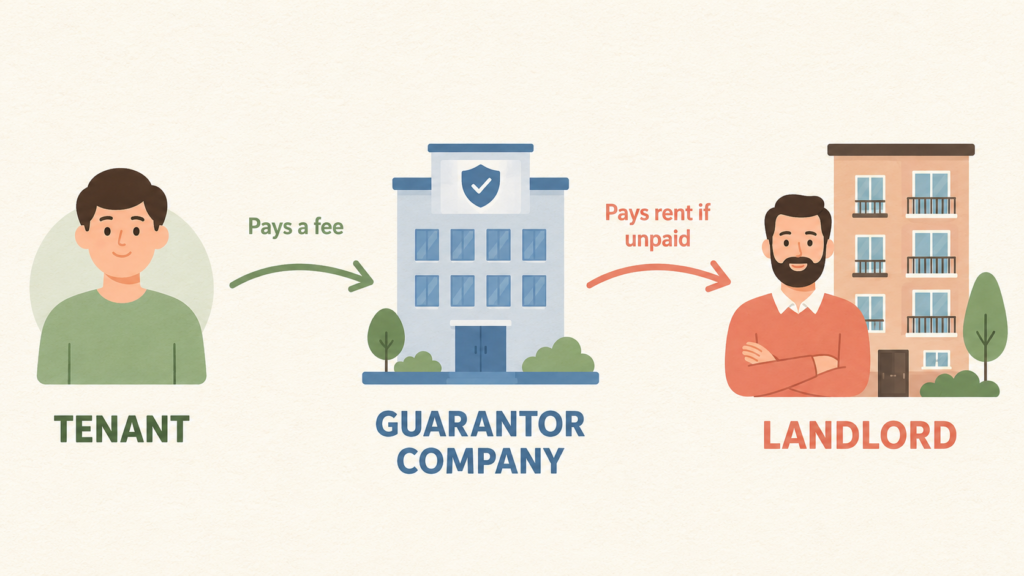
- You apply through the landlord or agent. The guarantor company reviews your income, job stability, and credit history.
- You pay a fee. The initial fee is usually 50–100% of one month’s rent, plus an annual renewal fee (often around ¥10,000).
- The company guarantees your rent. If you miss a payment, it pays the landlord first, then collects from you—so it’s a safety net for the landlord, not free money for you.
One thing that surprises people: you usually can’t pick the guarantor company yourself—the landlord chooses. But some landlords work with more than one, and screening standards vary a lot between them. If your situation is borderline, it’s worth telling the agent so and asking whether a more flexible company is an option.
Q5. Are all guarantor companies the same?
No, and the differences matter if your finances are thin. Guarantor companies fall into three broad types, each with its own screening style:
- Credit-based (信販系) – Run by credit-card or finance companies. They pull your credit history, loans, and payment records. Screening is the strictest of the three.
- LICC-affiliated (LICC系) – Members of a nationwide rental-guarantee association that shares tenant data, so past unpaid rent in Japan follows you and makes approval harder.
- Independent (独立系) – Smaller private companies with their own rules. They often don’t share data, so screening can be more forgiving—handy if you have a thin or troubled record. The trade-off is that their fees can run higher.
If you’ve had credit trouble or you’re brand new to Japan with no track record, an independent company is often the more realistic door. You generally can’t request one by name, but knowing the categories helps you have a smarter conversation with your agent.
Q6. What do guarantor companies check in screening?
Screening is really one question dressed up in paperwork: can you pay this rent, reliably, for as long as you live here? They look at:
- Income – Usually shown with payslips or a tax certificate. If you’ve just started a job, a contract stating your expected salary works.
- Job stability – Time at the same employer helps. A brand-new job isn’t a deal-breaker, but it gets more scrutiny.
- Employment type – Full-time (正社員) scores highest. Dispatch (派遣) or part-time can pass, but very short contracts often don’t.
- Residence status and period – As a foreigner, this is the extra column they read. A longer remaining visa period reassures them; if your residence card expires in a few months, expect more questions.
- Emergency contact – Almost always required, and usually someone reachable in Japan. More on this in Q7.
In short, they reward steady income and stability. The stronger those are, the lighter the rest of the screening feels.
Q7. What documents do I need for screening?
Gather these before you apply—having them ready is half the battle:
- Passport and Residence Card (在留カード) – Proof of legal stay in Japan.
- Certificate of Residence (住民票) – Available at your city hall. Here’s how to get it: A Stress-Free Guide to Moving in Japan.
- Proof of income – Recent payslips, a tax certificate, or your employment contract. Self-employed applicants need tax-return documents (確定申告).
- Photo ID – A driver’s license or My Number Card to confirm identity.
- Emergency contact in Japan – A name, address, and phone number. This isn’t a guarantor and carries no financial liability—but if everyone you know is overseas, sort out who you’ll list before you sit down with the agent, because they’ll ask on the spot.
Requirements vary by property, so ask the agent what’s needed in advance. If you don’t have a Japanese speaker helping you, bring every document you might conceivably need—going back for one missing paper can cost you days, and sometimes the apartment.
Q8. Why might my application be rejected?
Even with a guarantor company, approval isn’t automatic. The usual reasons are:
- Rent too high for your income – As a rule of thumb, screeners get nervous when rent climbs past about a third of your monthly income. To rent a place at ¥100,000/month, you’ll generally want income around ¥300,000/month or more.
- Unpaid bills or credit issues – Late payments on credit cards, phone plans, or loans are shared in databases (especially with credit-based and LICC companies). Clear what you can before applying.
- Inconsistent or false information – Companies frequently call your employer and verify income. If the numbers don’t match what you wrote, the application almost always fails.
- Short remaining visa, or status mismatch – A residence period ending soon, or rent that doesn’t fit your visa type, can trigger a no.
Rejected? It’s not the end. A “no” from one guarantor company doesn’t mean every door is shut. You can: ask the agent whether the landlord works with a more flexible (often independent) company; apply for a cheaper unit that fits the income ratio; offer to pay a few months’ rent upfront; or switch to a property that uses a different company entirely. Many tenants who get knocked back on their first choice are approved on their second within the same week.
Q9. How can I raise my approval chances?
- Keep rent to no more than about 25–30% of your income—the comfortable zone screeners like to see.
- Show proof of funds (bank statements), or offer several months of rent upfront if your income looks borderline.
- Prepare every document in advance and hand them over complete—gaps slow things down and read as disorganized.
- Be easy to work with. Landlords often ask the agent for their impression of you, and a good word genuinely helps.
- If you can, apply with a Japanese speaker—or through an agent who handles foreign clients (see Q14). It removes a lot of friction.
Q10. Are there housing options with no guarantor at all?
Yes—this is Path 2, and for some people it’s the easiest route of all. A few types of housing skip both the personal guarantor and the guarantor company:
- UR Apartments (UR賃貸住宅) – Managed by the Urban Renaissance Agency, UR units require no guarantor, no guarantor company, no key money, no renewal fee, and no agency fee. The trade-off is an income or savings requirement (see Q15) and first-come, first-served availability—popular units go fast.
- Share houses – Most skip deposits, key money, and guarantors entirely. Contracts are flexible (a month to two years), which makes them popular with working-holiday residents, students, and anyone who wants to land first and figure out the rest later. You also meet people instantly, which softens the move.
- True no-guarantor / no-company rentals – These exist but are rare. A 2016 MLIT survey (PDF, p.2) put them at only about 3% of rentals. If you find one that fits, treat it as a lucky break.
My husband’s second and third apartments were a UR unit and a share house, in that order—so two of his three Japanese homes used no guarantor at all. For a lot of newcomers, starting in a share house and moving to a regular lease once you have a job and a paper trail is the smoothest path.
Q11. Can my company or school help if I don’t have a guarantor?
Often, yes—this is Path 3, and it’s the one people forget to ask about. Many employers and universities provide housing support for foreigners:
- Company housing (社宅 shataku or 寮 ryō) – Larger companies sometimes offer dorms or apartments for staff, often acting as guarantor themselves so you never have to find one.
- University housing – Many universities run dorms or apartments for international students, usually with no guarantor and far simpler paperwork.
- Company or school as guarantor – Even without housing of their own, some organizations will sign as your guarantor or cover the guarantor-company fee.
My husband’s very first apartment in Japan was rented through his company—he didn’t have to think about guarantors at all. So if you’re moving here for work or study, ask your employer or school about housing support before you start searching on your own. It can save you serious money and a stack of stress.
Q12. What happens after approval?
Once the guarantor company and landlord both approve you:
- You sign the rental contract—almost always in Japanese.
- You pay the initial costs (the table below breaks these down).
- You register your new address at city hall within 14 days of moving in. See the moving checklist for the full sequence.
- You collect the keys and move in on the agreed date.
That Japanese-only contract is worth taking seriously. Bring a Japanese-speaking friend or use an English-speaking agent so you actually understand what you’re signing—especially the renewal, restoration, and cancellation clauses. For a clause-by-clause walkthrough, see Japanese Rental Contracts Explained.
Typical initial costs in Japan
Move-in costs are the part that blindsides newcomers. Budget for roughly 4.5–5 months’ rent upfront on a standard lease. Here’s where it goes:
| Cost | Typical amount | Notes |
|---|---|---|
| Deposit (敷金) | 1–2 months’ rent | Refundable, minus cleaning/repairs |
| Key money (礼金) | 0–2 months’ rent | Non-refundable; often ¥0 on newer or “zero-zero” units |
| First month’s rent | 1 month (often prorated) | Paid in advance |
| Agency fee (仲介手数料) | 0.5–1 month + tax | Capped at one month by law |
| Guarantor company fee | 50–100% of 1 month, then ~¥10,000/yr | First-year fee plus annual renewal |
| Fire insurance (火災保険) | ~¥15,000–20,000 / 2 yrs | Usually mandatory |
| Key exchange (鍵交換) | ~¥15,000–25,000 | New lock for the new tenant |
| Rough total | ~4.5–5 months’ rent | Have this ready before you start applying |

Q13. How can I reduce initial costs?
That 4.5–5 months can sting, so here’s how to shrink it:
- “Zero-zero” properties (ゼロゼロ物件) – No deposit, no key money.
- Free-rent campaigns (フリーレント) – Some apartments waive the first 1–2 months of rent. Specialist landlords like Village House list units with no deposit, no key money, no renewal fee, and no agency fee, with rent starting around ¥20,000—and they’re used to foreign tenants.
- UR housing – No key money, no renewal fee, no guarantor.
- Share houses – Often no deposit or agency fee, with flexible short-term contracts.
For a deeper look at fees and how the whole rental system fits together, see How to Rent an Apartment in Japan: Key Money, Contracts, and Housing Options.
Q14. Where should I search?
- UR Apartments (English site): UR Rentals
- Foreigner-friendly platforms: GaijinPot Housing, Village House
- General portals: SUUMO, HOME’S, At Home
On the Japanese portals, search with keywords like 保証人不要 (no guarantor needed) or 保証会社利用可 (guarantor company accepted) to filter for the right listings.
One tip that genuinely changes the experience: look for an agent who specializes in foreign tenants. My husband applied for his UR place through an agency that handles Indian and Chinese clients, and the person who showed up for the viewing spoke Hindi. Suddenly the questions about documents, residence status, and the contract were easy instead of stressful. These agencies know which landlords and guarantor companies are foreigner-friendly, which saves you from wasting time on places that will quietly say no.
One thing to skip: platforms like Craigslist or Facebook groups aren’t really part of the rental market here. In my experience they’re thin and far less reliable than the sites above, so I wouldn’t lean on them.
Q15. Is UR the best choice for everyone?

UR is excellent if you qualify and want to dodge most upfront costs—no guarantor, no key money, no renewal fee, no brokerage fee. But it isn’t a fit for everyone, and there’s an income test people don’t always expect.
The income requirement. As a guideline, UR wants your monthly income to be about four times the rent (so roughly ¥320,000/month for an ¥80,000 apartment). If you don’t clear that, you can still qualify two other ways: hold savings of at least 100 times the monthly rent, or pay rent in advance. Full details are on the official UR application-requirements page.
The downsides:
- Many UR buildings are older and can feel a little dated.
- Locations can be inconvenient—plenty of units sit a 15-minute walk from the nearest station, which is a real drawback in Tokyo.
- On the upside, rents undercut the private market and some complexes have shared community rooms, which is part of why they’ve become popular with foreign families, especially Indian and Chinese households.
If you don’t meet the income or savings bar, or you want something newer and more central, a standard rental with a guarantor company is usually the more practical pick.
Frequently Asked Questions
How much does a guarantor company cost?
The initial fee is usually 50–100% of one month’s rent, followed by an annual renewal fee of around ¥10,000 (sometimes ~10,000 yen or 1万円, sometimes a small percentage of rent). It’s a recurring cost, so factor the renewal into your yearly budget, not just move-in.
How long does guarantor-company screening take?
Often just 2–4 business days once your documents are in. Credit-based companies can take a little longer; independent ones are sometimes faster. Missing paperwork is the usual cause of delays, which is why Q7’s checklist matters.
Can I rent if my visa or residence period is short?
Yes, but expect more questions, and some guarantor companies will hesitate if your residence card expires within a few months. A share house or UR is often easier in that situation, and renewing your visa before applying removes the issue entirely.
Can I rent an apartment before I arrive in Japan?
For a standard lease, rarely—you usually need a residence card and a Japanese address first. Share houses are the big exception: many accept applications and deposits from overseas, which makes them a popular soft landing for your first weeks.
Do I still need a guarantor if I use a guarantor company?
Usually no—the company replaces the personal guarantor. Occasionally, if your finances look weak, a landlord may ask for both a company and an emergency contact or joint guarantor, but that’s the exception rather than the rule.
Conclusion
Renting in Japan without a guarantor is not only possible—it’s how most foreigners do it. The trick is knowing which of the three paths fits you:
- Most landlords now want a guarantor company, used in about 80% of rentals—so understand how they screen and what they cost.
- UR apartments and share houses skip guarantors entirely, and your company or school may cover the problem for you.
- Approval rests on income, clean documents, and—more than people expect—how easy you are to work with.
Keep your rent within about 25–30% of your income, get your documents in order before you apply, and work with foreigner-friendly agents or platforms. Do that and the guarantor question stops being a wall and turns into a form you fill out.
Want the bigger picture—key money, deposits, renewal costs, and how leases work? Read How to Rent an Apartment in Japan, and before you sign, Japanese Rental Contracts Explained. With a little preparation, you’ll find a safe, affordable home in Japan—guarantor or not.



One thought on “How to Rent an Apartment in Japan Without a Guarantor: 15 Questions Answered (2026)”