Signing a rental contract in Japan can feel like putting your name to a document you only half understand—because it’s in dense Japanese, full of clauses about renewal fees, restoration costs, and notice periods that work differently from back home. This guide walks through what’s actually in a Japanese lease, what you’re agreeing to, and how to protect your deposit when you move out. If you’re still at the searching stage, start with How to Rent an Apartment in Japan first, then come back here before you sign.
Two Types of Lease: Ordinary vs Fixed-Term
The first thing to check on any contract is which of two types it is. This single detail decides whether you can stay as long as you like—or have to leave on a fixed date.
| Ordinary lease (普通借家) | Fixed-term lease (定期借家) | |
|---|---|---|
| Typical term | 2 years | Set period (e.g. 1–3 years) |
| Renewal | Renews almost automatically | Ends on the date; no renewal (a new contract may be offered) |
| Can the landlord refuse to renew? | Only with “justifiable cause” (正当事由)—hard to prove, so you’re well protected | Yes, simply by letting it expire |
| Rent level | Standard | Sometimes cheaper, since the term is limited |
| Best for | Most long-term tenants | Short, defined stays |
The vast majority of rentals are ordinary leases, and that’s good news for tenants: Japanese law leans heavily in your favor once you’re in. A landlord can’t just decide not to renew because they’d prefer someone else. A fixed-term lease (定期借家) is different—it genuinely ends on the stated date. These are common for company-owned units or owners who plan to use the property later, and they’re often labeled clearly, but always ask which type you’re signing.
Reading Your Lease: Clauses That Matter
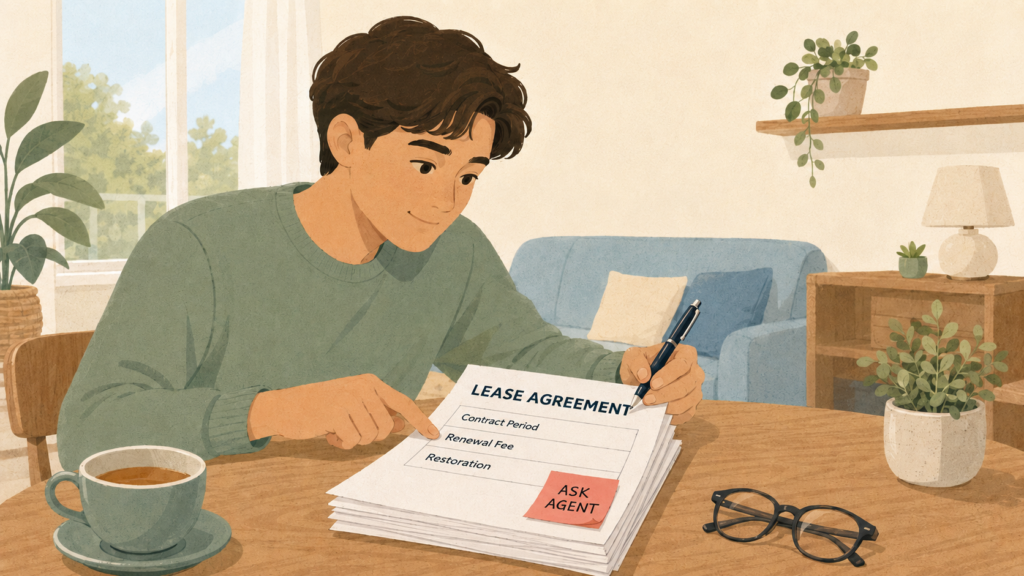
You don’t need to decode every line, but a handful of clauses are worth finding before you sign. Ask your agent to point each one out:
- Contract period (契約期間) – Start and end dates, and whether it renews.
- Rent and other monthly charges – Watch for management/common-area fees (管理費・共益費) on top of rent.
- Renewal fee (更新料) – How much, and how often.
- Cancellation notice (解約予告) – How far ahead you must tell the landlord you’re leaving.
- Restoration clause (原状回復) and any special clauses (特約) – Especially a cleaning-fee clause. This is where deposit disputes start.
- Use restrictions – Pets, musical instruments, subletting, running a business from home.
Contracts are almost always Japanese-only, and a signed lease is binding even if you didn’t fully follow it. If your Japanese isn’t strong, use a bilingual agent or a translation service—this is not the place to nod along and hope.
Before You Sign: The Important Matters Explanation (重要事項説明)
Here’s a step that surprises a lot of newcomers, and it’s actually in your favor. Before you sign, a licensed real estate agent is legally required to sit down and walk you through the key terms of the property and contract. This is the Important Matters Explanation (重要事項説明, jūyō jikō setsumei), and only a staff member holding the national real estate license (宅地建物取引士) can deliver it.
It can feel like a long, formal reading of fine print, but don’t tune out—this is your moment to ask questions before anything is binding. Listen for:
- The full breakdown of rent, fees, and what’s due at signing
- The cancellation and renewal terms
- The restoration rules and any special clauses (特約)
- Use restrictions and anything specific to the building
If your Japanese isn’t strong, ask in advance whether the explanation can be given in English or with an interpreter present. By law it can now be done online by video call, which makes arranging language support easier. Whatever you do, don’t sign anything you were rushed through—a polite “can you explain this clause again?” is completely normal here.
Rent, Late Payments, and the Guarantor Company
Rent in Japan is usually paid monthly in advance—next month’s rent is due near the end of this month—most often by automatic bank transfer (口座振替) or standing transfer. Set this up correctly and most of the contract runs itself.
Two things to know. First, pay on time. These days most rentals use a guarantor company (保証会社) instead of, or alongside, a personal guarantor, and the company tracks your payments closely. A late payment can trigger reminder calls and, if it becomes a pattern, real problems at renewal. Second, that guarantor company usually charges an initial fee (often half to one month’s rent) plus a smaller annual or renewal fee—budget for both, because they’re easy to forget after move-in. If the guarantor requirement is your main obstacle, see How Foreigners Can Rent Apartments in Japan (Without a Guarantor).
Renewal and Renewal Fees (更新料 kōshinryō)
With an ordinary lease, renewal is mostly a formality—you sign again and continue. The sting is the renewal fee (更新料): many contracts, especially in the Kanto region, charge 1–2 months’ rent every two years to extend. It feels like paying for nothing, and tenants regularly question whether it’s even legal.
It is. Japan’s Supreme Court ruled in 2011 that renewal-fee clauses are valid as long as the amount is reasonable and clearly written into the contract. So you can’t refuse to pay a properly stated renewal fee—but you can factor it into your budget from day one, and you can favor properties that don’t charge one (UR housing, for instance, has no renewal fee at all).
Not every region uses renewal fees, and some landlords waive them to keep good tenants. It never hurts to ask—politely—whether the fee can be reduced, particularly if you’ve paid on time and looked after the place.
Renewal is also when a landlord may propose a rent increase. They can’t simply impose one—any change has to be reasonable and, in practice, agreed between you—so it’s open to discussion. If a proposed increase seems steep, you can negotiate, and the strong renewal protection of an ordinary lease gives you room to do so calmly.
Moving Out and Breaking a Lease Early
Plans change. A new job, a move abroad, a family that’s outgrown the place—at some point the keys go back. The good news is that leaving an ordinary lease early is straightforward: you give notice and go. The key is the notice period.
- Give written notice in time. Most contracts require one month’s notice (some ask for two). Tell the landlord or management company in writing, and you’ll owe rent up to the end of the notice period.
- Fixed-term leases are stricter. A 定期借家 generally can’t be cancelled early unless the contract allows it. The exception: for residential units under 200㎡, the law lets you end the lease one month after notice for unavoidable reasons such as a job transfer, medical treatment, or caregiving—and clauses that try to take this right away are invalid.
- Don’t forget the admin. Stop or transfer utilities, file your move-out notice at City Hall, and arrange disposal of large items. See A Timeline Checklist for Moving in Japan.
Your Deposit and Restoration (敷金 shikikin & 原状回復 genjō kaifuku)
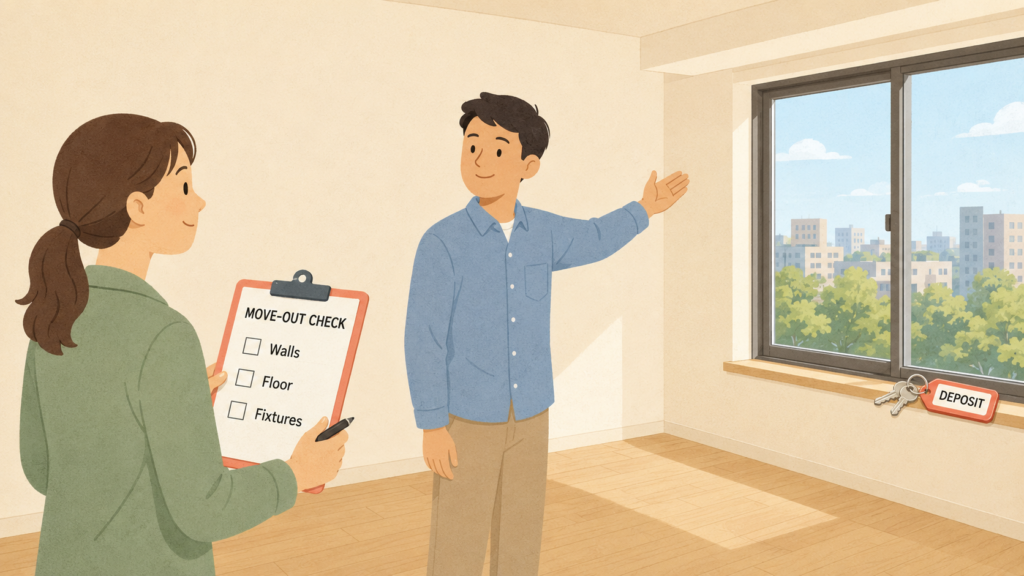
This is the part that causes the most friction—and the part where knowing the law really pays off. When you move out, the landlord settles your deposit (敷金): they keep what’s owed for unpaid rent and for damage you’re responsible for, and return the rest. Deposits usually run one to two months’ rent—more for pet-friendly units—so this is real money, not a token sum. The fight is always over what counts as “damage you’re responsible for.”
Here’s the rule, and it’s firmly on your side. Japan’s Civil Code (revised in 2020) and the Ministry of Land, Infrastructure, Transport and Tourism’s restoration guidelines make the split clear: you are not responsible for normal wear and tear (通常損耗) or aging (経年変化). That’s considered already covered by your rent. You only pay to fix damage caused by negligence, misuse, or carelessness.
| Usually the landlord’s cost (normal wear) | Usually your cost (damage/neglect) |
|---|---|
| Sun-faded flooring or wallpaper | Stains and burns from spills or cigarettes |
| Furniture dents in the floor or carpet | Scratches and holes from moving carelessly |
| Pin holes from hanging a few pictures | Large screw holes or anchor damage to walls |
| Wear on tatami or flooring over time | Mold from failing to ventilate or report a leak |
| Equipment that wears out with age | Pet damage and odors (where pets weren’t allowed) |
It’s genuinely common to walk out of a move-out inspection feeling you were charged for things that weren’t your fault. The inspection itself is usually conducted in Japanese and on the spot, so if your Japanese is shaky, bring a Japanese-speaking friend or ask for the charges in writing rather than agreeing to anything verbally. If a deduction looks like normal wear, you can—and should—push back, pointing to the MLIT guidelines. Keep it calm and factual; this is a well-trodden dispute and landlords know the rules too.
One more thing that works in your favor: depreciation. Even when damage is your responsibility, you don’t pay for a brand-new replacement of an old item. The guidelines treat materials as losing value over time—wallpaper, for example, is generally depreciated to almost nothing over about six years. So if you damage years-old wallpaper, your share is a fraction of a full re-papering, not the whole bill. If an invoice charges you full price for worn materials, that’s a fair point to raise.
A quick example, because the math surprises people. Say you put a noticeable scratch in the wallpaper of a room you’ve lived in for four years. Wallpaper is treated as losing value over six years, so by year four it’s already worth only about a third of new. Your share is that remaining fraction of the repair for the damaged area—often a few thousand yen—not the cost of re-papering the room. Stay six years and the same damage can come to essentially nothing. This is exactly why it’s worth reading a move-out invoice line by line instead of just paying the total.
As for timing: once the keys are back and the inspection is done, the landlord or management company sends an itemized settlement and returns the balance of your deposit, usually within about a month (some contracts state an exact deadline—hold them to it). If the statement just says something like “cleaning and repairs, ¥80,000,” you’re entitled to ask for an itemized breakdown before you accept it.
One regional wrinkle if you’re renting around Kansai (Osaka, Kyoto, Kobe): some contracts use a shikibiki (敷引き) arrangement, where a fixed slice of your deposit is non-refundable from the outset—settled up front rather than itemized at move-out. It’s legal when it’s clearly written in and not unreasonably large, but it does mean part of your 敷金 was never coming back. If you’re moving between regions, don’t assume the deposit rules you learned in Tokyo carry over unchanged.
Watch for the cleaning-fee special clause (ハウスクリーニング特約 house cleaning tokuyaku)
One big exception to the wear-and-tear rule: a special clause (特約) in your contract can shift some costs to you that you’d otherwise not owe—most commonly a fixed cleaning fee on move-out. These clauses can be enforceable if they’re clearly written and you agreed to them, so read this part before signing, not after. If you see a flat cleaning charge, that’s a normal cost you’re accepting up front.
Cleaning fees aren’t the only special clause worth a second look. Scan for these too:
- Short-term cancellation penalty (短期解約違約金) – Some leases charge a penalty (often one month’s rent) if you leave within the first year or two. If there’s any chance you’ll move soon, find this clause first.
- Key exchange fee (鍵交換費用) – A one-time charge, often ¥15,000–25,000, to re-key the lock for you. Usually fair, but confirm it’s in the move-in costs.
- Pets, smoking, and instruments – Often restricted outright. Breaking these can mean extra restoration charges or, in serious cases, being asked to leave.
And while you’re checking the itemized move-in costs, look for optional add-ons quietly slipped into the list. The classic one is a “disinfection” or anti-bacterial treatment for around ¥15,000. It’s almost never required—it just gets added by default. I take it off every time: a simple “I don’t need this one, please remove it” is all it takes, and it always comes off the bill. Don’t assume every line is mandatory; ask which charges you can decline.
Protect yourself from day one
- Photograph everything on move-in. Date-stamped photos of existing scratches, stains, and wear are your best evidence later.
- Report problems early. Tell the management company about leaks or mold the moment you notice them, in writing.
- Ventilate. Mold from poor ventilation is one of the most common charges pinned on tenants—and easy to avoid.
- Keep the contract and all receipts. You’ll want the exact wording of the restoration and special clauses when settling up.
If a Dispute Goes Too Far
Most deposit disagreements get resolved with a calm conversation and a reference to the guidelines. If one doesn’t, you have options: your local consumer affairs center (消費生活センター) offers free advice, and small claims court (少額訴訟) handles deposit-sized amounts cheaply and relatively quickly. You rarely need to go that far, but it helps to know the backstop exists—and landlords know it too, which makes a reasonable request more likely to land.
Quick Checklist Before You Sign
Run through this before you put your name on anything:
- Confirm whether it’s an ordinary or fixed-term lease.
- Add up the real monthly cost—rent plus management/common-area fees.
- Note the renewal fee amount and how often it’s charged.
- Find the cancellation notice period and any short-term penalty.
- Read the restoration clause and any special clauses (cleaning fee, key exchange).
- Check the guarantor company’s initial and annual fees.
- Ask for the Important Matters Explanation in a language you understand.
- Photograph the apartment the day you get the keys.
Conclusion
A Japanese lease looks intimidating, but the system is more tenant-friendly than it first appears. Ordinary leases protect your right to stay, the law shields you from paying for normal wear, and even renewal fees are predictable once you budget for them. Check which lease type you’re signing, find the renewal and restoration clauses before you commit, photograph the place on move-in, and you’ll avoid almost every nasty surprise. For the wider picture of finding a place and the upfront costs, see How to Rent an Apartment in Japan, and if a guarantor is your hurdle, How Foreigners Can Rent Apartments in Japan (Without a Guarantor).
FAQ
Q1. How long is a typical apartment lease in Japan?
A. Most are two-year ordinary leases (普通借家) that renew almost automatically. Fixed-term leases (定期借家) run for a set period and end on the date without renewal, so always check which type you’re signing.
Q2. Are renewal fees (koshinryo) legal?
A. Yes. The Supreme Court ruled in 2011 that renewal fees are valid when the amount is reasonable and clearly stated in the contract. They’re typically 1–2 months’ rent every two years, though not all regions or landlords charge them.
Q3. How much notice do I need to give before moving out?
A. Usually one month, sometimes two—check your contract’s cancellation clause. Give written notice and you’ll pay rent through the end of the notice period.
Q4. Will I get my full deposit back?
A. Not always in full, but more than many tenants assume. By law you’re not liable for normal wear and tear or aging—only for damage you caused. A cleaning-fee special clause, if your contract has one, is the common exception.
Q5. Who pays for restoration (genjo kaifuku) when I move out?
A. The landlord covers normal wear and aging (faded wallpaper, furniture dents, small pin holes). You cover damage from negligence or misuse (burns, large holes, mold from poor ventilation), per the 2020 Civil Code and MLIT guidelines.
Q6. Can the landlord refuse to renew my lease?
A. With an ordinary lease, only for “justifiable cause,” which is hard to establish—so you’re well protected. With a fixed-term lease, yes: it simply ends on the agreed date unless a new contract is offered.



2 thoughts on “Japanese Rental Contracts Explained: Renewal, Move-Out & Your Deposit”