It’s easy to assume you’ll stay calm in an emergency — until you’re standing there, heart pounding, blanking on whether it’s 119 or 110. (It’s 119 for an ambulance. We’ll get to why that mix-up is so common.) The time to learn this is now, while nothing is wrong. This guide walks through the emergency numbers in Japan — 119 for fire and ambulance, 110 for the police — what to actually say when you call, and how to get English-speaking help on the line even if your Japanese stops at konnichiwa.
Quick Reference: Emergency Numbers in Japan
Save these numbers in your phone now. They are toll-free and work anywhere in Japan, including Tokyo, Osaka, and rural areas. You can dial them from any mobile phone, even one without a SIM or with a locked screen.
| Number | Use it for | Cost | English support |
|---|---|---|---|
| 119 | Fire & ambulance (medical emergency) | Free | Yes — phone interpretation in many areas |
| 110 | Police: crimes, accidents, lost items | Free | Yes — phone interpretation in many areas |
| 118 | Japan Coast Guard (maritime emergencies) | Free | Limited |
| #7119 | Medical advice when it may not be an emergency | Free* | Varies by region |
| 050-3816-2787 | Japan Visitor Hotline (24h tourist/emergency help) | Call charges apply | English, Chinese, Korean |
*#7119 is a free service, but standard call charges may apply depending on your phone plan and region.
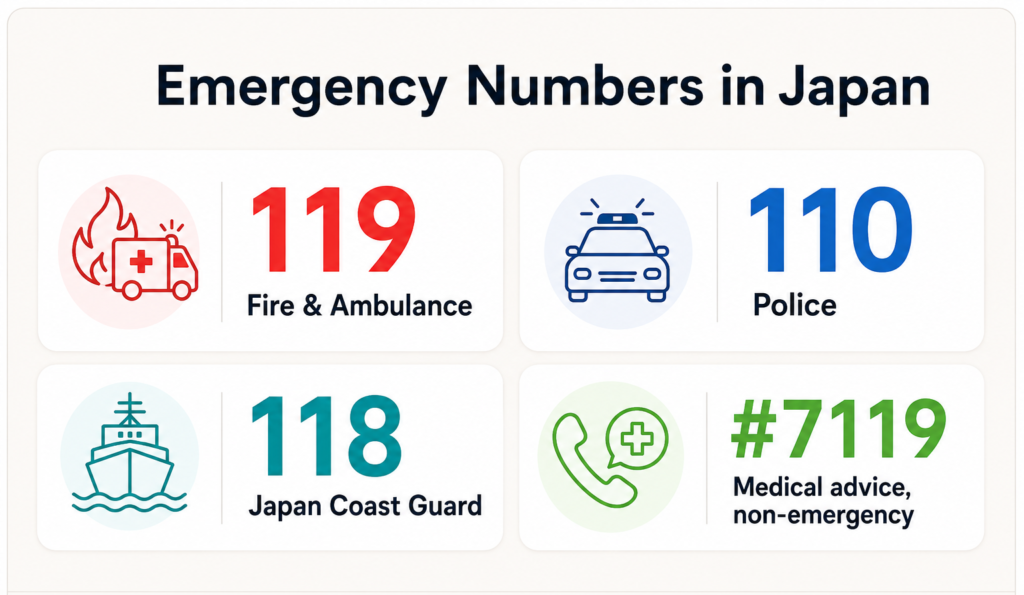
What Are the Key Emergency Numbers in Japan?
Japan uses a small set of dedicated three-digit emergency numbers, each connected to a specific service:
- 119 — Call for fire emergencies and medical emergencies, including when you need to call an ambulance. The same number covers both.
- 110 — Call the police to report crimes, traffic accidents, or lost property.
- 118 — Call the Japan Coast Guard for accidents or emergencies at sea, such as boating incidents or suspicious activity along the coast.
- #7119 — A medical consultation line for when you’re unsure whether your situation is a true emergency (more on this below).
Here’s the part that trips people up: in Japan, 119 handles both fire and ambulance, and the police sit on a separate number, 110. If you grew up dialing one all-purpose number — 911 in the US, 112 across the EU — splitting it into two feels backwards at first. A simple way to keep them straight: 119 is for when a body or a building is in danger, 110 is for when a person is the problem.
How to Dial 119 or 110 in Japan
Calling for help is straightforward once you know the steps:
- Dial directly. From a mobile phone, just enter 119 or 110 — no area code is needed. There is no charge.
- State which service you need. For 119, the operator’s first question is whether you need the fire department (火事 / kaji) or an ambulance (救急 / kyūkyū).
- Give your location first. Provide the address, or describe nearby landmarks, intersections, or store names. Your location is the single most important piece of information.
- Describe the emergency. Say what happened, how many people are involved, and the condition of anyone hurt.
- Stay on the line and don’t hang up until the operator tells you to. They may give you instructions while help is on the way.
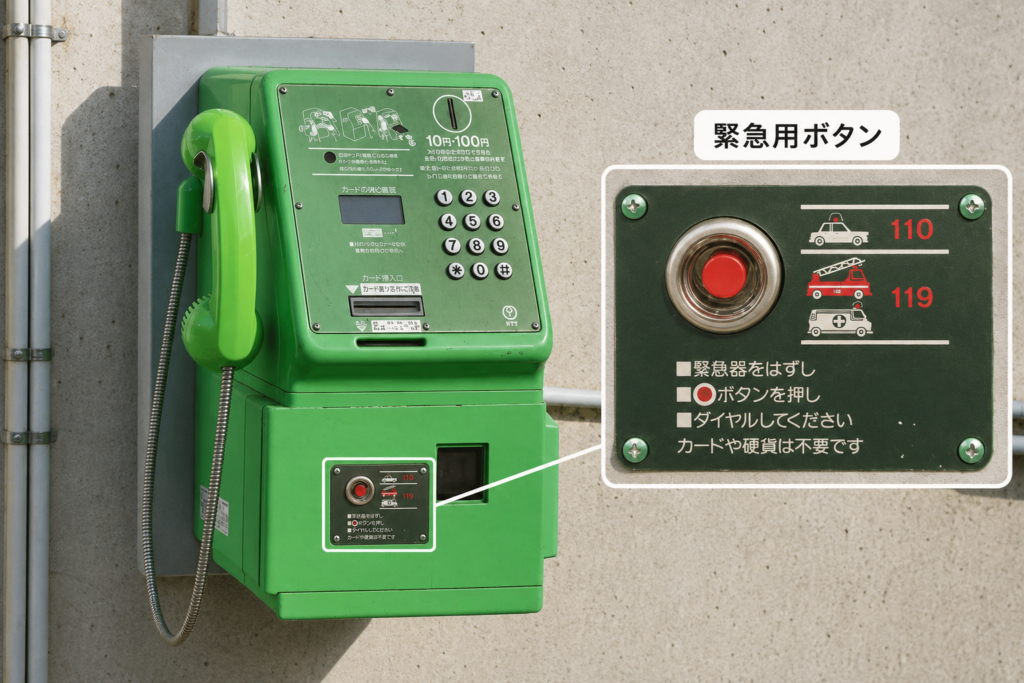
Using a green public phone? Lift the receiver and press the red emergency button — you don’t need a coin or card. Public phones are increasingly rare, but they’re worth knowing about during a power outage or network congestion after a disaster, when they often keep working.
How to Get English Support When You Call 119 or 110
You do not need to speak fluent Japanese to call for help. Across most of Japan — including Tokyo, Osaka, and other major regions — fire and police call centers now offer a three-way phone interpretation service. When you call, the operator brings a professional interpreter onto the line so you, the operator, and the interpreter can all speak at the same time.
Supported languages typically include English, Chinese, Korean, Portuguese, and Spanish, among others. One key tip: after you connect, it may take a number of seconds to bring the interpreter on, so stay on the line and do not hang up. If you can manage one Japanese word, saying “English (イングリッシュ)” helps the operator route you faster.
What Happens When You Dial 119?
When you dial 119, you reach your local municipal fire department (in central Tokyo, that’s the Tokyo Fire Department). The call usually goes like this:
- The operator asks whether you need the fire department or an ambulance.
- For an ambulance, be ready to give a precise location and a brief description of the patient’s symptoms and consciousness.
- If you can’t communicate in Japanese, ask for an interpreter and stay on the line until one joins.
About Ambulances in Japan
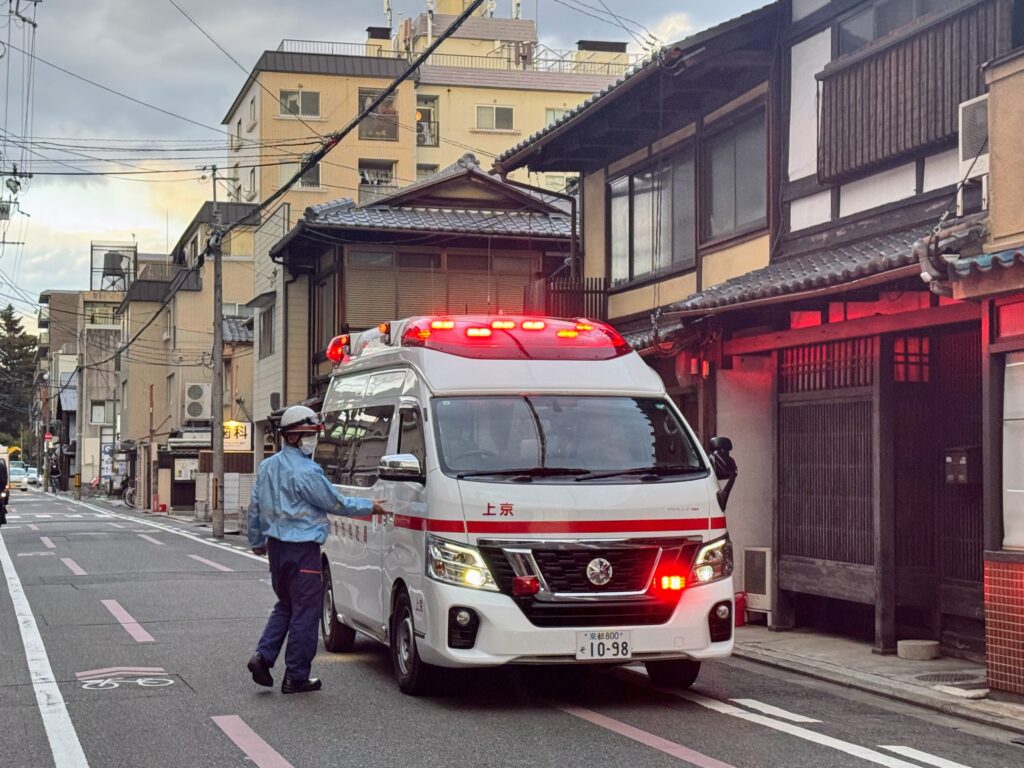
An ambulance (救急車 / kyūkyūsha) responds to sudden illness or injury and is operated by the fire department. You request one by calling 119. If the patient recovers before the ambulance arrives, you can call back and cancel the request.
Japanese paramedics are not licensed doctors, but they are trained to provide first aid and stabilize patients during transport. Those with advanced certification — 救命救急士 (kyūmei kyūkyūshi) — can perform a higher level of emergency care under medical direction.
Demand for ambulances has been climbing. According to Japan’s Fire and Disaster Management Agency, ambulances were dispatched a record 7.64 million times in 2023 — roughly 20,900 dispatches a day, or about one every 4 seconds somewhere in the country.
Is an Ambulance Free in Japan?
My husband still remembers the night a friend of his sliced his hand open with a kitchen knife. He grabbed the phone and dialed 119, and as it rang, a very foreign worry hit him: is this about to cost a fortune? It didn’t. The ride was completely free.
In almost all cases, calling an ambulance in Japan is free — for foreign residents and visitors alike. There’s no charge for the ride itself, unlike in the US or Germany, where one trip can run into tens of thousands of yen. You’ll still pay your usual share of any hospital treatment, of course. And one thing nobody warns you about: the ambulance only takes you there. Getting home afterward is on you, so once the panic passes, expect to call a taxi.
One recent change is worth knowing: because ambulances are increasingly used for minor, non-urgent complaints, a small but growing number of areas have introduced a fee for clearly non-emergency use. For example, since June 2024, several large hospitals in Matsusaka City, Mie Prefecture charge a “selective medical treatment fee” (選定療養費 / sentei ryōyōhi) of ¥7,700 when a patient is brought in by ambulance but the hospital determines the case did not require emergency transport and the patient is not admitted. Anyone genuinely judged to need emergency care is exempt.
So, to be clear: in a real emergency, call 119. No hesitating, no second-guessing the cost — that’s exactly what it’s there for. What you shouldn’t do is reach for it over a mild fever or a hangover. That’s how it can now cost you, and worse, how it ties up a crew someone else may be dying for.
Not Sure It’s an Emergency? Call #7119
If you feel unwell but aren’t sure whether to call an ambulance, dial #7119, the Emergency Medical Consultation line (救急安心センター事業). A nurse or trained staff member helps you decide whether to call 119, visit a hospital now, or wait and see a doctor during regular hours, and can point you to a suitable clinic.
One catch: #7119 isn’t available everywhere yet. Coverage, hours, and language support all vary by prefecture and city — some areas answer in English and a dozen other languages, others in Japanese only. If it doesn’t connect where you live, your local government or fire department website usually lists an equivalent medical hotline. For non-urgent care, our guide to booking English-speaking doctors and pharmacies in Japan is a good next step.
Useful Japanese Phrases for an Emergency Call
Even with interpretation available, a few simple phrases can speed things up at the very start of a call:
- “救急車をお願いします (Kyūkyūsha o onegaishimasu)” — “Please send an ambulance.”
- “火事です (Kaji desu)” — “There’s a fire.”
- “〇〇で事故です (〇〇 de jiko desu)” — “There’s an accident at [location].”
- “住所がわかりません (Jūsho ga wakarimasen)” — “I don’t know the address.” (Then describe nearby landmarks.)
- “英語をお願いします (Eigo o onegaishimasu)” — “English, please.”
What to Do While You Wait for the Ambulance
The minutes between your call and the ambulance’s arrival matter. After you hang up (or while still on the line, if the operator is guiding you), a few simple actions can help:
- Make the location easy to find. If you can, send someone outside to flag down the crew, turn on outdoor lights, and unlock the building entrance or gate.
- Gather key information. Have the patient’s health insurance card, any medications, and a note of allergies or existing conditions ready to hand to the paramedics.
- Keep the patient comfortable and monitored. Don’t move someone with a possible spinal injury unless they’re in danger. Watch their breathing and responsiveness, and tell the crew about any change.
- Follow the operator’s instructions. They may walk you through CPR or first aid over the phone — stay calm and do exactly as told.
Paramedics will ask which hospital to take the patient to, but the final destination depends on bed availability and the severity of the case, so be flexible. If you ride along or follow, bring the patient’s ID, insurance card, and some cash for the hospital.
When Should You Call 110 for the Police?
Dial 110 for a crime in progress, a traffic accident, or any threat to your safety. It’s also the number if you lose something important, like a wallet or passport. This is where Japan quietly amazes newcomers: lost things really do come back here, cash and all, more often than you’d believe anywhere else. Still, file a report and keep the receipt — your insurer or embassy will usually ask for it before they replace anything.
Like 119, the 110 line offers phone interpretation in major languages in most regions, so don’t let a language barrier stop you from reporting a crime or accident.
Using a Kōban (Police Box)
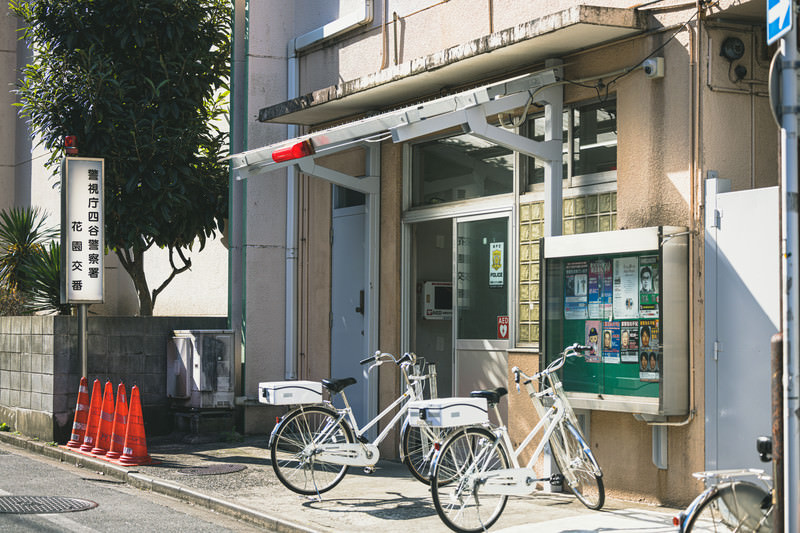
For non-emergencies — directions, a lost umbrella, a minor concern — visit a kōban (交番), the small neighborhood police boxes found near stations and busy intersections. Officers there routinely help residents and tourists. Save 110 for situations that need an immediate response; use a kōban or the police’s non-emergency line for everything else.
Emergency Hotlines for Non-Japanese Speakers
Beyond the core 119/110 numbers, several services are designed specifically to help non-Japanese speakers. Keep these saved alongside your embassy’s contact details:
- Your embassy or consulate: Keep their number handy for help with lost passports, serious incidents, or repatriation.
- Japan Visitor Hotline — 050-3816-2787: Run by the Japan National Tourism Organization (JNTO), this 24-hour line handles accidents, sudden illness, natural disasters, and general guidance in English, Chinese, and Korean. From abroad, dial +81-50-3816-2787.
- Tokyo “Himawari” Medical Information — 03-5285-8181: Helps you find hospitals and clinics with foreign-language support in the Tokyo area, and offers emergency interpretation by phone.
- AMDA International Medical Information Center: Provides multilingual guidance on medical institutions and the healthcare system, and can help bridge communication with providers.
- TELL Lifeline — 0800-300-8355: A free, confidential English-language counseling and crisis line for mental-health support. If you or someone you know is in immediate danger, call 119 first.
What Should You Do in a Natural Disaster?
Japan is prone to earthquakes, typhoons, and floods, so preparation matters as much as any phone number. When a disaster strikes:
- Get alerts in English. Install the NHK World Japan app and the Japan Safe Travel (JNTO) information service for disaster alerts and instructions. Japan Shelter Guide (Safety tips) is another popular multilingual app for residents.
- Know your nearest evacuation center (避難所 / hinanjo). These are marked on local hazard maps; look yours up in advance.
- Follow official broadcasts. TV and radio carry emergency information, and your phone will receive loud J-Alert earthquake and disaster warnings automatically.
- Have a plan to reach loved ones and keep your embassy and emergency contacts written down in case your phone dies.
During a strong earthquake, the standard advice is “Drop, Cover, and Hold On” — get low, take cover under a sturdy table, and protect your head until the shaking stops. Only then move to safety and check for hazards like gas leaks or fire. For tsunami risk near the coast, head to higher ground immediately rather than waiting for an official instruction.
Remember that 119 (fire/ambulance) and 110 (police) still work during disasters, though lines may be congested. For life-threatening situations, keep trying.
Common Mistakes to Avoid When Calling for Help
Knowing the numbers is only half the battle. These are the slip-ups that most often trip up newcomers in a real emergency:
- Using an ambulance for minor issues. For non-urgent symptoms, call #7119 or visit a clinic instead, both to keep ambulances free for emergencies and to avoid a possible non-emergency fee in areas that charge one.
- Mixing up 119 and 110. 119 is fire and ambulance; 110 is police. Calling the wrong one wastes precious seconds.
- Hanging up too early. Interpretation can take a moment to connect, and operators often have follow-up questions. Stay on the line until they release you.
- Leading with the problem instead of the location. Always give your address or landmarks first — if the call drops, help can still be sent.
- Assuming nobody speaks English. Phone interpretation is widely available; ask for it rather than struggling alone or not calling at all.
- Using an ambulance for minor issues. For non-urgent symptoms, call #7119 or visit a clinic instead, both to keep ambulances free for emergencies and to avoid a possible non-emergency fee in areas that charge one.
Frequently Asked Questions
What is the emergency number in Japan?
There are two main ones: 119 for fire and ambulance (medical emergencies), and 110 for the police. Both are free and work from any phone, anywhere in Japan. There is no single combined number like 911.
Is calling an ambulance free in Japan?
Yes, in almost all cases the ambulance ride is free for residents and visitors alike. The only exception is a recent rule in a few areas (such as Matsusaka City, Mie) where a ¥7,700 fee can apply if a hospital judges that ambulance transport was clearly not an emergency. You still pay your normal share of any hospital treatment.
Can I call 119 or 110 if I don’t speak Japanese?
Yes. Most fire and police call centers offer three-way phone interpretation in English, Chinese, Korean, Portuguese, Spanish, and more. Stay on the line after connecting — it can take a short while to bring the interpreter on. Saying “English” at the start helps.
What number do I call if it’s not an emergency but I need medical advice?
Dial #7119, the emergency medical consultation line, where staff help you decide whether to call an ambulance or see a doctor. Availability and language support vary by region. For finding clinics, see our guide to booking English-speaking doctors and pharmacies.
Will my health insurance cover the hospital after an ambulance ride?
If you’re enrolled in Japan’s public health insurance, you typically pay only 30% of covered treatment costs, the same as any hospital visit. To understand how the system works, read our simple guide to Japan health insurance for expats (EHI vs NHI).
Stay Prepared
Nobody wants to think about the night they’ll need any of this. But the people who handle an emergency well in Japan aren’t the ones who speak perfect Japanese — they’re the ones who weren’t starting from zero. Take two minutes now: save 119, 110, #7119, and the Japan Visitor Hotline (050-3816-2787) in your phone, and jot your home address and embassy number somewhere you can find them in a hurry. That’s the whole job. Your future self, hand shaking over the keypad, will be grateful.
Once the emergency passes, these guides cover what comes next: visiting a clinic in Japan step by step, how prescriptions work in Japan, and Japan health insurance for expats.


3 thoughts on “Emergency Numbers in Japan: How to Call for Help – 119 & 110”