Starting a business in Japan as a foreigner is very doable, but the rules are specific and a few of them changed dramatically in the last couple of years — most notably the visa that lets you run a company from scratch. This guide walks through the essentials: whether your visa even allows it, choosing between sole proprietor and company, the paperwork, and the taxes. It’s the practical overview I wish someone had handed me. One caveat up front: this is general information, not legal or tax advice, and the details below shift with each reform — confirm your own situation with an immigration lawyer (gyōsei shoshi) and a tax accountant (zeirishi) before you commit.

1. Can You Start a Business on Your Visa?
This is the first gate, and getting it wrong can cost you your residence status. Whether you can run a business depends entirely on what visa you hold.
Visas That Already Let You Run a Business
If you hold one of these, you can start a business freely, the same as a Japanese national:
- Permanent Resident
- Long-Term Resident
- Spouse or Child of a Japanese National
- Spouse or Child of a Permanent Resident
- Highly Skilled Professional (some activity limits apply)
If you’re on a work visa (Engineer/Specialist in Humanities, for example), you generally can’t run your own company on the side without permission — that visa is tied to employment. A small side income may be possible with “permission to engage in activity outside your status,” but a real business usually means changing your status of residence.
The Business Manager Visa — and Its Big 2025 Overhaul
If you don’t hold one of the statuses above, the route to running your own company is the Business Manager visa — and you need to know that it got far harder in late 2025. Effective October 16, 2025, the requirements jumped:
- Capital of ¥30 million — up sixfold from the old ¥5 million.
- At least one full-time employee (a Japanese national, permanent resident, spouse of either, or long-term resident).
- Japanese ability at roughly JLPT N2 (CEFR B2) for either you or that employee.
- Three years of management/business experience, or a master’s in business.
- A real, independent office — home offices are no longer accepted — plus a business plan reviewed by a certified expert (a licensed consultant, CPA, or tax accountant).
The change was aimed at shell companies set up purely to obtain a visa, but it raises the bar for everyone. There’s a transitional period for existing Business Manager visa holders renewing between October 2025 and October 2028, but if you’re planning a fresh application, budget and staff accordingly, and talk to an immigration specialist early. The official source is the Immigration Services Agency of Japan.
Check Whether Your Business Needs a License
Some industries — generally those touching food, health, safety, or money — require a permit or license before you can legally operate. Running without one is a serious problem. If your idea falls into any of these areas, factor the licensing into your timeline:
2. Choose Your Business Structure
There are two main paths: a sole proprietorship (kojin jigyō) or a company (kaisha). For most people starting out, the sole proprietorship is the simpler and cheaper place to begin.
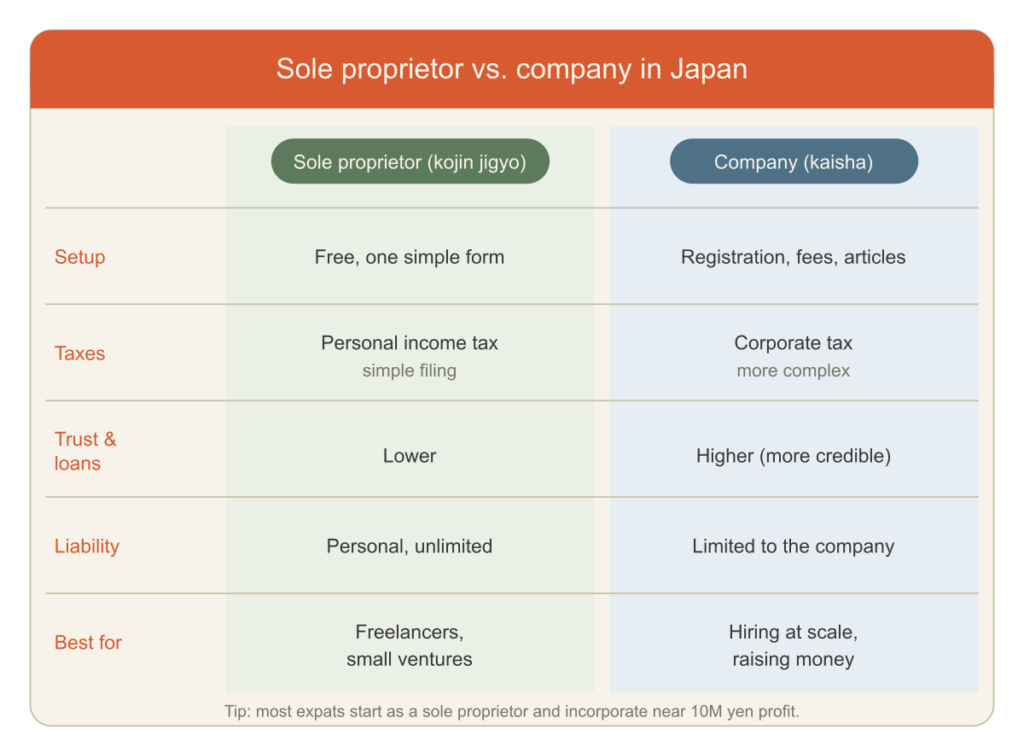
A company makes the business its own legal entity, with you as an executive drawing a salary; it reads as more credible but comes with heavier obligations — employees’ social insurance, more involved tax filing, and stricter financial rules. A sole proprietorship is just you: simple to start, simple to file, but with all liability on your shoulders and a bit less standing when you go for a loan. A common rule of thumb is to start as a sole proprietor and incorporate once profits approach ¥10 million, where the tax math starts favoring a company. If you’ll be hiring, our guide to labor law in Japan is worth a read first.
Okay then, I want to know how to kick off a sole prop.


Let’s do it. Setting up a company is more involved, so we’ll cover that in a separate article.
3. Filing the Paperwork
Notify the Tax Office (kaigyō todoke)
Submit the Notification of Business Commencement (kaigyō todoke) to your local tax office within a month of starting. Keep a copy — you may need it later for grant applications or opening a business bank account. If you file online, save the receipt. The form covers your name and date of birth, tax domicile, My Number, occupation, start date, business name and description, whether you’ll use the blue return system, your consumption-tax status, and any salaried employees.
File the blue return (aoiro shinkoku) application at the same time — it’s the single best tax move a new sole proprietor can make. In exchange for keeping proper double-entry books, you get a special deduction of up to ¥650,000 off your taxable income when you file via e-Tax or keep qualifying electronic books (it’s ¥550,000 on paper, or ¥100,000 for simplified bookkeeping). From the 2027 tax year, the top deduction rises to ¥750,000. Accounting software makes the bookkeeping painless and runs about ¥10,000–30,000 a year; I use Yayoi, whose app lets you log deposits, withdrawals, and receipts from your phone. See the National Tax Agency’s blue return page for the official rules.
Understand the Invoice System (a 2023 change you can’t ignore)
Japan launched its qualified invoice system (invoice seido) on October 1, 2023, and it reshaped life for small businesses. The old logic still technically holds — if your taxable sales two years ago were under ¥10 million, you can remain a tax-exempt business and not charge or remit consumption tax. But there’s a catch: a tax-exempt business cannot issue a qualified invoice, which means your business clients can’t deduct the consumption tax on what they pay you. In practice, many corporate clients now prefer suppliers who are registered taxable businesses, so freelancers face real pressure to register even when they’re under the threshold.
It’s a genuine trade-off — register and you take on consumption-tax filing; stay exempt and you may lose work. A transitional “20% special” measure eases the burden for newly taxable businesses through September 30, 2026. This is exactly the kind of decision worth running past a tax accountant.
Notify Your Local Government and Social Insurance Offices
Your municipality levies its own business taxes, so you’ll notify the local government too (the form and name vary by city). If you plan to hire, there are more steps: employing even one person means enrolling in labor insurance, with paperwork going to the Labor Standards Inspection Office and Hello Work. Once you have five or more full-time staff, enrolling them in health insurance and pension becomes mandatory, handled through the Pension Office. For anything labor-related, a labor and social security attorney (sharōshi) is the specialist to call; our guide to social insurance in Japan explains the systems.
4. Bookkeeping and Taxes
The tax year runs January 1 to December 31. After it closes, you file your final return between February 16 and March 15 (the deadline shifts to the next business day when the 15th falls on a weekend — the 2025 return, for instance, is due March 16, 2026). As a sole proprietor you’ll deal with up to four taxes:
- Income tax — due by the filing deadline (mid-March).
- Consumption tax — by March 31, and only if you’re a taxable business (broadly, sales over ¥10 million two years prior, or a voluntary invoice registrant).
- Resident tax — billed after you file, paid in four installments (June, August, October, January).
- Personal business tax — paid in August and November; you owe nothing if your taxable business income is under ¥2.9 million.
Keep clean records as you go, with receipts for every expense, and retain them for at least seven years. Learn the legitimate deductions early — if part of your home is your office, for example, you can claim a proportional share of rent and utilities as a business expense. Software like Yayoi automates most of this.
One point that often confuses newcomers: for income-tax purposes you may be a “non-permanent resident” (a non-Japanese who has been domiciled here five years or less out of the past ten). Non-permanent residents generally aren’t taxed on foreign-source income — unless it’s paid in or remitted to Japan, which is a common trap. The terms are tax classifications and don’t map onto your visa. The National Tax Agency has the details, and a tax accountant can tell you how it applies to you.
Going solo means handling your own taxes, so get familiar with income tax, residence tax, and the 確定申告 filing process before your first year ends.
What to Prepare Before You Start
- Accounting software — set it up from day one, not at tax time.
- A business bank account — keep business and personal money separate; an account in your business name also reads as more credible to clients. Our guide to opening a bank account in Japan covers the basics.
- Business cards — still expected here, and cheap to order online.
- A website — even a single page gives you legitimacy.
- Your own social insurance — leaving a job means moving off employer coverage onto National Health Insurance and the National Pension, which usually costs more. You can instead keep your former employer’s health insurance for up to two years (nin-i keizoku), which is sometimes cheaper — compare before you decide.
For the bigger picture on working and earning in Japan, see our overview of work in Japan.
FAQs
Which visa do I need to start a business in Japan?
If you hold permanent residence, long-term residence, or a spouse visa, you can start a business freely. On a regular work visa you generally can’t run your own company without changing status. Otherwise, the route is the Business Manager visa.
What changed about the Business Manager visa in 2025?
From October 16, 2025, the capital requirement rose from ¥5 million to ¥30 million, and applicants must now hire at least one qualifying full-time employee, meet a Japanese-language standard (around JLPT N2), have three years of management experience or a business master’s, and use a real office rather than a home address.
Should I start as a sole proprietor or a company?
For most people, start as a sole proprietor — it’s free, fast, and simple to file. Incorporate later when profits approach ¥10 million, when you need to hire at scale, or when clients require dealing with a company.
Do I need to register for the invoice system?
Not legally if your sales are under ¥10 million, but many business clients now prefer suppliers who can issue qualified invoices. If most of your customers are companies, registering may protect your contracts; if you sell mainly to consumers, staying exempt can make sense. Ask a tax accountant.
What taxes does a sole proprietor pay?
Income tax, resident tax, and (above certain thresholds) consumption tax and personal business tax. You file one final return between February 16 and March 15 each year; the blue return can cut your taxable income by up to ¥650,000.
Final Word
Going independent in Japan is absolutely achievable, but the ground keeps shifting — the visa overhaul and the invoice system are both recent, and more tweaks will come. Get the structure and paperwork right early, keep tidy books from day one, and lean on the specialists: a gyōsei shoshi for visa questions, a zeirishi for tax, and a sharōshi if you hire. Get those foundations solid and you can spend your energy on the part that actually matters — the business itself.



One thought on “How to Start a Business in Japan as a Foreigner: 2026 Guide”