Getting caught up in a criminal case in Japan is frightening on its own. When you’re a foreign resident, there’s a second fear stacked on top: will this cost me my right to live here? The honest answer is “sometimes, but far less often than people assume.” A criminal case and your residence status are handled by completely different authorities, and an arrest alone does not strip you of your status. This guide explains exactly when a criminal matter does reach into your immigration status, when it doesn’t, and what you can do about it. If you want the step-by-step of the criminal process itself—arrest, detention, and what a suspended sentence means—read What to Do If You’re Arrested in Japan alongside this one.

This article is general information, not legal advice. Immigration and criminal law are fact-specific and the rules changed significantly in 2024—if you or someone you know is actually facing a case, talk to a criminal lawyer and an immigration specialist (弁護士 or 行政書士) about your situation.
Two Separate Systems: The Criminal Case vs. Your Residence Status
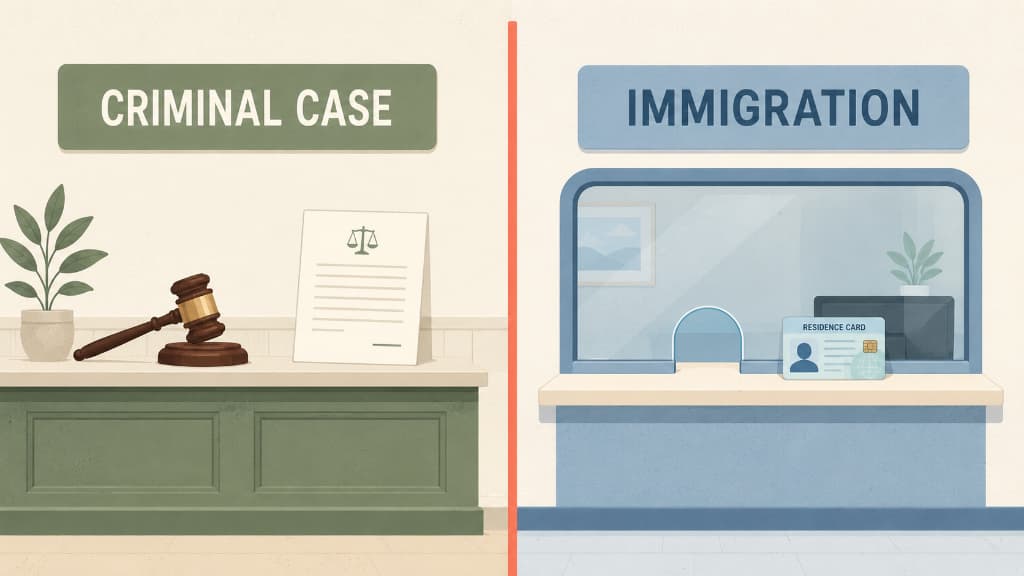
The single most useful thing to understand is that these are two different tracks run by two different sets of authorities.
- The criminal case decides whether you committed a crime. It involves the police, the prosecutors, the courts, and your defense lawyer. None of them has any power over your visa.
- Your residence status is decided by the Immigration Services Agency (出入国在留管理庁). Immigration does not decide your criminal guilt—but it does watch the outcome of your criminal case and can act on it.
One quick point on wording, because it trips people up. In everyday English we say “visa,” but in Japan the thing that actually lets you live here is your status of residence (在留資格, zairyū shikaku) and its attached period of stay (在留期間)—what’s printed on your residence card. The “visa” is really just the entry sticker in your passport. Throughout this article “visa” means your status of residence, but knowing the distinction helps when you read official documents.
The Good News: Most Cases Never Touch Your Status
Start here, because it’s the part that gets lost in the panic. Being arrested or detained does not, by itself, cancel your status of residence. Immigration consequences are tied to the result of the case, not the arrest.
If your case ends in non-prosecution (不起訴, fukiso)—including a “suspension of prosecution” (起訴猶予), where the prosecutor decides you committed the act but chooses not to charge you—then there is no conviction. With no conviction, the grounds for deportation that depend on a sentence simply don’t apply, and you generally keep your status. The same is true if you’re charged but found not guilty.
Two honest caveats. First, “no deportation” isn’t the same as “no consequences”: a criminal episode—even one that ends in non-prosecution—can make your next renewal or permanent-residency application a tougher review (more on that below). Second, a criminal investigation sometimes surfaces a separate immigration problem—an expired status, working outside your permitted activities—and immigration can act on that independently of the crime. So non-prosecution is a very good outcome, just not an automatic all-clear.
When a Criminal Case Does Reach Your Status: Three Situations
There are essentially three ways a criminal matter spills over into your right to stay.
1. Your period of stay expires while you’re detained
Detention can be long. After arrest, you can be held for up to 23 days before the prosecutor decides whether to charge you, and far longer if you are then prosecuted. If your period of stay happens to expire during that window, your stay becomes unlawful the moment it lapses—regardless of the criminal case—and overstaying is itself a ground for deportation.
This is a real trap for people on short-duration statuses (a “Temporary Visitor” stay, for example). A renewal normally has to be filed in person before the expiry date, which is obviously hard from a detention cell, so this is exactly where a lawyer or an immigration specialist (行政書士) acting on your behalf matters. Even if your status has already lapsed, don’t assume it’s hopeless—there are routes to regularize a stay, and an expert can tell you whether one is open to you.
2. A conviction triggers deportation
This is the big one. Certain convictions are listed in the Immigration Act (入管法 Article 24) as grounds for deportation. If your case ends in one of them, you’ll be handed from the criminal system to immigration at the end of the process. The key distinction is between an actual prison sentence and a suspended sentence (執行猶予, shikkō yūyo)—and it works differently depending on the crime.
- General crimes: deportation generally applies when you’re sentenced to imprisonment exceeding one year (or an indefinite term) that you actually serve. A suspended sentence for an ordinary crime is usually not, on its own, a deportation ground—an important correction to a myth that floats around expat forums.
- Drug crimes are the harsh exception. For violations of the drug-control laws (cannabis, stimulants, narcotics), any guilty verdict is a deportation ground—even a fully suspended sentence with no time served. Japan treats drug offenses by foreign nationals extremely seriously. Do not assume a suspended sentence keeps you safe here; it does not.
If you do receive an actual prison sentence, you serve it first and are then transferred to immigration for deportation proceedings. (Not sure what “suspended sentence” or “imprisonment” mean in the Japanese system? The arrest and criminal-process guide walks through them.)
3. You had no valid status when you were arrested
If you were already overstaying or otherwise without valid status when arrested, then regardless of how the criminal case turns out, immigration will take over for deportation once the criminal side is finished. Here the crime is almost beside the point—the immigration violation is the trigger.
Which Offenses Tend to Matter Most in Practice
The law is written in terms of sentences, not crime labels, so the practical question is “what kind of case ends in the kind of sentence that triggers immigration action?” A few patterns come up again and again for foreign residents:
- Drug offenses – the highest-risk category by far. Possession or use of cannabis or stimulants can mean deportation even with a suspended sentence and a near-permanent re-entry ban. Treat this as a different tier of risk from everything else on this list.
- Drunk driving (飲酒運転) – taken far more seriously in Japan than many newcomers expect, with heavy penalties. A serious case can reach the sentence range that affects status, so this is not a “minor traffic thing.”
- Theft, shoplifting, and assault – often resolved through non-prosecution or a fine, especially for a first, minor incident, in which case your status usually survives. A serious or repeat case that draws actual imprisonment is the one to worry about.
- Immigration and document offenses – overstaying, working outside your permitted activities, or false statements sit on the immigration track directly and can lead to deportation regardless of the criminal outcome.
None of this is a formula—outcomes turn on the specific facts and the sentence—but it explains why two people “arrested for the same thing” can end up in very different places.
Deportation and the Re-Entry Ban (上陸拒否期間)

Deportation isn’t only about leaving—it’s about how long you’re locked out afterward. Being deported, or being convicted of certain crimes, creates a landing-denial period (上陸拒否期間) during which you cannot re-enter Japan. The length depends on what happened:
| Situation | Period you cannot re-enter Japan |
|---|---|
| Left under a departure order (出国命令)—i.e. came forward and left promptly | 1 year |
| Deported from Japan (first time) | 5 years |
| Deported two or more times | 10 years |
| Convicted and sentenced to imprisonment of more than one year (non-drug) | Indefinite—but special landing permission may be possible after about 5 years or on humanitarian grounds |
| Deported for the most serious grounds, including drug-control offenses | Effectively permanent (no fixed expiry) |
It’s worth being precise here, because a popular claim that “any one-year sentence means a lifetime ban” isn’t quite right. A sentence of more than a year is an indefinite landing-denial ground, but it isn’t automatically forever—special landing permission (上陸特別許可) can be sought later. The genuinely permanent category is reserved for the most serious deportation grounds, with drug offenses the one most expats need to worry about.
What About Permanent Residents and Long-Term Residents?
A common assumption is that permanent residency (永住者) makes you untouchable. It doesn’t. Permanent and long-term residents can still be deported for serious crimes—the deportation grounds above apply to them too. What changes is that they often have stronger ties to Japan (family, length of residence), which can matter a great deal when arguing to stay (see the next section).
One thing genuinely did change recently. The 2024 reform to the Immigration Act expanded the grounds on which permanent residency can be revoked, including for certain failures tied to taxes and social-insurance obligations or other serious breaches. The headline takeaway for PR holders: your status is more secure than a work visa, but it is not beyond reach, and a serious criminal conviction is exactly the kind of thing that can put it at risk.
Even Without Deportation: The Quieter Consequences
Deportation is the dramatic outcome, but it’s not the only way a criminal case can hurt you. Japanese immigration weighs an applicant’s conduct (素行, sokō) when deciding renewals and, especially, permanent-residency and naturalization applications. A conviction—or even a non-prosecution that immigration knows about—can:
- Make your next status renewal a stricter review, sometimes with a shorter period of stay granted.
- Delay or sink a permanent-residency application, which expects a clean conduct record over a period of years.
- Complicate a naturalization application, which also assesses good conduct.
In other words, you can keep your status today and still feel the effects years later when you try to upgrade it. This is one more reason that minimizing the criminal outcome—aiming for non-prosecution where possible—matters beyond just avoiding jail.
Fighting Deportation: Special Permission to Stay (在留特別許可)
If you’re facing deportation but have strong reasons to remain, the main route is a request for Special Permission to Stay (在留特別許可, zairyū tokubetsu kyoka). This is a discretionary grant by the Minister of Justice, separate from the criminal case—so it falls outside your criminal defense lawyer’s job and usually needs an immigration specialist.
The 2024 reform actually improved this process: there is now a formal application procedure with statutory factors the authorities must weigh—things like family ties in Japan, having a spouse or children who are settled here, the nature and gravity of the offense, and your overall circumstances. It’s a meaningful change from the older, murkier system. That said, be realistic: approval is far from guaranteed, and the odds drop sharply after a serious conviction. Factors that help include:
- Genuine, close family ties in Japan—particularly a Japanese spouse or dependent children.
- Long, stable residence and a life clearly rooted here.
- Good conduct, genuine remorse, and a minor or one-off offense rather than a serious or repeat one.
Two related points worth knowing. The same 2024 reform introduced “supervisory measures” (監理措置), which allow some people to wait out proceedings in the community under a supervisor rather than in immigration detention. And if deportation is genuinely unavoidable, leaving early under a departure order rather than being formally deported can cut the re-entry ban to a single year—a meaningful difference if you ever hope to return. These are decisions to make with a specialist, not alone.
If You or Someone You Know Is Arrested
A short, practical checklist for the moment it actually happens:
- Get a lawyer early. You can request the free first visit of a duty defense lawyer (当番弁護士) even before charges. Fast, capable defense aimed at non-prosecution is the best protection for your status, too.
- Watch the period-of-stay expiry date. If it falls during detention, flag it immediately—this is the avoidable mistake that turns a survivable case into an overstay.
- Bring in an immigration specialist (弁護士 or 行政書士) for the status side. The criminal lawyer handles the case; the immigration side often needs its own expert, especially for Special Permission to Stay.
- Contact your embassy or consulate. They can’t run your defense, but many can help with interpreters, lawyer referrals, and family contact.
- Understand the process before you sign anything. See What to Do If You’re Arrested in Japan for your rights during questioning and detention.
The Bottom Line
An arrest in Japan is not the end of your life here. The criminal case and your residence status run on separate tracks, and most cases—especially those that end without a conviction—leave your status intact. The situations that genuinely threaten it are narrow but serious: an expired status during long detention, a real prison sentence for a major crime, a drug conviction (even suspended), or an underlying immigration violation. Drug offenses deserve a line of their own, because they’re the one area where a suspended sentence still means deportation and an effectively permanent ban. If any of this is more than hypothetical for you, the move is the same every time: get a criminal lawyer and an immigration specialist involved as early as possible, and don’t let a fixable problem—like a lapsing visa—become an unfixable one.
For the official rules, the Immigration Services Agency of Japan publishes guidance in English, including on deportation and re-entry procedures.
FAQ
Q1. I was arrested but not charged. Will I lose my visa?
A. Usually not. An arrest alone doesn’t cancel your status, and non-prosecution (不起訴) means no conviction, so the conviction-based deportation grounds don’t apply. Watch two things: your period of stay can still expire during detention, and a future renewal or permanent-residency application may face stricter review.
Q2. Does a suspended sentence still lead to deportation?
A. It depends on the crime. For ordinary crimes, a suspended sentence (執行猶予) is generally not by itself a deportation ground. Drug offenses are the major exception: any guilty verdict, even a fully suspended one, is a ground for deportation.
Q3. Can a permanent resident be deported?
A. Yes. Permanent residents (永住者) are better protected and their strong ties to Japan can help them argue to stay, but the deportation grounds still apply to them, and a 2024 law change expanded the grounds for revoking permanent residency.
Q4. How long am I banned from re-entering Japan after deportation?
A. One year if you left under a departure order, five years if deported once, and ten years if deported two or more times. A sentence of over a year creates an indefinite bar (special permission may be possible later), and the most serious grounds—including drug offenses—are effectively permanent.
Q5. What happens if my period of stay expires while I’m detained?
A. Your stay becomes unlawful the moment it lapses, regardless of the criminal case, and overstaying is itself a deportation ground. Flag the expiry date immediately so a lawyer or immigration specialist can act before it passes—this is a common and avoidable mistake.
Q6. Can I reduce the re-entry ban by leaving voluntarily?
A. Often yes. Leaving promptly under a departure order (出国命令), rather than being formally deported, generally cuts the re-entry ban to one year instead of five. It’s a decision to make with an immigration specialist, as eligibility has conditions.



2 thoughts on “How Criminal Proceedings Affect Visas in Japan”