If you live in Japan and pay taxes here, there’s a system you’re probably leaving on the table: Furusato Nozei (ふるさと納税), usually translated as “hometown tax.” I do it every single year, and the honest pitch is this—you redirect part of the tax you were going to pay anyway, and in return local towns send you food and other gifts. You’re out a flat 2,000 yen for the whole year, and that’s it.

Most Japanese taxpayers are all over this. Foreign residents, far less so—and it’s not because they wouldn’t benefit. It’s because almost every guide and every donation site is in Japanese, the paperwork looks scarier than it is, and the rules changed in late 2025, so a lot of older English write-ups are now flat-out wrong. This guide fixes that. I’ll walk through who actually qualifies, the one deadline that trips people up, and how to file without a Japanese tax accountant.
What Furusato Nozei Actually Is
Despite the word “nozei” (tax payment), this isn’t really a donation in the charity sense and it isn’t an extra tax. It’s a redirection. Normally your residence tax goes entirely to the city you live in. Furusato Nozei lets you send a chunk of it to a different municipality of your choosing—a rural town, somewhere you used to live, a place you just like—and that municipality says thank you with a local gift (a 返礼品, henreihin).
Here’s the part that confuses people: you are not paying more tax. Whatever you “donate,” almost all of it comes back to you as a reduction in your income tax and next year’s residence tax. The only cost is a fixed 2,000 yen self-payment for the year, no matter how many towns you give to. So if you donate 50,000 yen across five towns, roughly 48,000 yen comes back through tax reductions, you eat 2,000 yen, and you keep whatever gifts arrived. That’s why people bother.
By law the gifts are capped at 30% of your donation, so a 10,000-yen donation gets you something worth up to about 3,000 yen. Modest per item, but it adds up fast across a full year’s allowance, and you were paying that tax regardless. You can read the official rules on the Ministry of Internal Affairs and Communications (Sōmushō) portal.
Can Foreign Residents Use Furusato Nozei? (Read This First)

Yes—your nationality doesn’t matter. What matters is whether you’re a taxpayer in Japan. But there are a few expat-specific catches that the Japanese guides never mention, and these are exactly where people lose money. Check yourself against these before you donate.
- You need taxable income in Japan. The benefit works by reducing your Japanese income and residence tax, so you have to actually owe those taxes. If you arrived partway through the year with little Japanese income so far, your deductible limit will be small—sometimes not worth it that first year.
- You need a My Number (個人番号). Filing—either route—requires your My Number plus a copy of ID. If you haven’t set up your My Number Card yet, sort that out first.
- Planning to leave Japan? Time it carefully. The residence-tax portion of your refund is applied to next year’s residence tax, billed from June. If you move out of Japan before then, you can lose that part of the benefit. The income-tax portion is fine, but the timing matters—don’t donate a big amount in December and fly home in March.
- Use the name and address on your residence record (住民票). Your filing name has to match your jūminhyō, not your passport spelling if they differ. Mismatched names are the single most common reason a foreigner’s One-Stop application gets rejected.
- Gifts ship to your registered address. Some are bulky or perishable. If you’re about to move or travel for weeks, check the delivery timing before you order frozen seafood you won’t be home to receive.
How Furusato Nozei Works, Step by Step
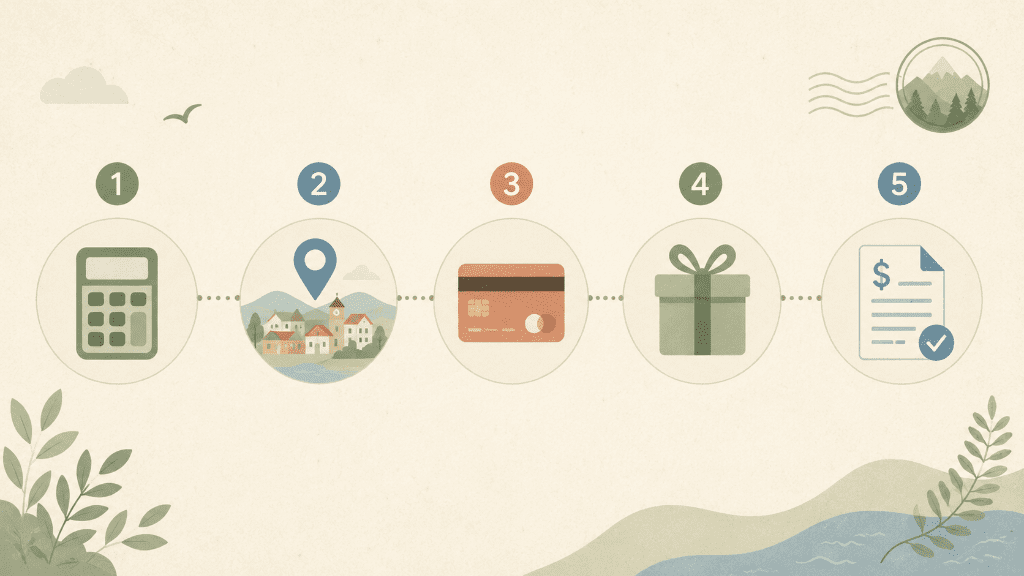
Step 1: Find your donation limit
This is the one number you must not get wrong. Your limit depends on your annual income and household situation (single, married, dependents). Donate within it and you only pay the 2,000 yen. Donate over it and the excess is a real out-of-pocket loss—it doesn’t come back. Every major donation site has a free calculator: enter last year’s income and your family details and it spits out a safe ceiling. When in doubt, aim a little under.
Step 2: Pick a town and a gift
Browse by category—beef, rice, fruit, seafood, household goods, travel vouchers—or by region if there’s somewhere you feel connected to. Most sites let you sort by popularity and read reviews, which honestly is how I pick most of mine.
Step 3: Donate
Pay by credit card (or other methods) through a donation portal, exactly like normal online shopping. You’ll get a donation receipt (寄附金受領証明書) for each town—keep these, you may need them at tax time.
Step 4: Receive your gifts
Gifts arrive over the following weeks or months depending on the item and season. Fresh fruit comes when it’s ripe; some items ship in scheduled batches (more on that below, because it’s my favorite trick).
Step 5: Claim your deduction
This is the step people forget—and if you skip it, you just gave money away for nothing. There are two ways to claim, covered next. Furusato nozei works by redirecting part of your residence tax, so it helps to understand how income and residence tax actually work in Japan first.
Two Ways to Claim Your Deduction
Option 1: One-Stop Exemption (the easy route)
If you’re a regular salaried employee who doesn’t otherwise file a tax return, and you donated to five or fewer municipalities in the year, you can use the One-Stop Exemption System (ワンストップ特例) and skip filing a tax return entirely.
- For each town you donate to, submit a One-Stop application form, along with a copy of your My Number and ID.
- The hard deadline is January 10 of the following year—the form must arrive at the municipality by then, not just be postmarked. Miss it and you’ll have to file a regular tax return instead. Some portals now offer online One-Stop application via the My Number Card app, which is much less of a hassle than mailing paper—check whether your portal supports it.
- The full deduction then comes off your residence tax for the next year automatically. Nothing else to do.
Option 2: Standard tax return (確定申告)
You must file a regular tax return if you’re self-employed, have other income that requires filing, or donated to more than five municipalities. Report all your Furusato Nozei donations on your tax return, filed in February–March for the previous year. The deduction is then split between an income-tax refund and a residence-tax reduction. If you’re already filing a return for any other reason, use this route—and note that One-Stop forms you sent are voided the moment you file a return, so include every donation on the return.
Either way, the math lands in the same place: your donations minus the flat 2,000 yen come back to you through reduced income and residence tax.
Important: The 2025 Rule Change on Points
If you read an older guide that raves about stacking site “points” on top of your gifts, ignore that part—it’s out of date. As of October 2025, the Ministry of Internal Affairs and Communications banned donation portals from awarding their own loyalty points on Furusato Nozei. The era of choosing a site purely for its 20%-points campaign is over.
What this means for you in practice:
- Portal-issued points (the site’s own reward points) are gone. Don’t pick a platform expecting them.
- Credit-card reward points still apply—those come from your card issuer, not the donation site, so paying by card still earns your normal card points.
- Choose your platform on what actually matters now: the gift selection, ease of use, and language.
What Gifts Can You Get? (And How I Choose Mine)

The gift catalog is genuinely the fun part. Broadly you’ll find:
Food and drink — rice, premium Wagyu beef, fruit (melons, grapes, mikan), seafood like crab and scallops, sake and whisky. This is where most people spend.
Household and craft goods — pottery, knives, towels, furniture from regions famous for them.
Travel and experiences — vouchers for hotels, hot-spring inns, and local activities in the town you supported.
My own strategy after years of doing this: I almost always put a big share of my allowance into rice, set to arrive in installments. A lot of towns offer a plan where they ship, say, four times across the year—once every three months. A fresh batch turns up right about when the last one runs out, so we basically never buy rice at the supermarket. It’s the most practical “gift” I’ve found. After that I splurge on good beef, which feels like a small luxury for tax I owed anyway.
If you want something more giftable—or you’re shopping for a whisky lover—there are now specialist portals too. alyawmu is a Furusato Nozei site built around premium Japanese and imported whisky as the thank-you gift, which is a nice way to turn part of your tax bill into a bottle you’d never casually buy for yourself.
Which Donation Platform Should You Use?
There’s no single “official” site—the government runs the system, but you donate through private portals, all of which are legitimate. The main ones are in Japanese, but they’re navigable with a browser translator, and your foreign card works fine. A few worth knowing:
- Furusato Choice (ふるさとチョイス) — the largest, with the widest range of municipalities.
- Rakuten Furusato Nozei — convenient if you already have a Rakuten account and shop there.
- Amazon Furusato Nozei — launched in December 2024. If you already shop on Amazon Japan, you can donate with your existing account and saved payment details, and your receipts sit in your order history. Note: it currently requires the One-Stop form to be submitted by mail, not online.
- alyawmu — a niche option specializing in premium whisky gifts.
Honestly, pick whichever has the gifts you want and an interface you can stand. They all feed into the same system, and your filing process is the same regardless.
Common Questions About Furusato Nozei
How much can I donate?
It depends on your income and household. Use a donation-limit calculator on any portal before you give, and stay under the number it shows—anything over your limit isn’t refunded.
Are the gifts taxable?
For nearly everyone, no. Gifts are treated as temporary income, which has a 500,000-yen annual tax-free allowance. You’d have to receive a very large value of gifts in one year before any of it became taxable.
Can I donate to more than five towns?
Yes, donate to as many as you like. Just remember that going over five means you can’t use One-Stop—you’ll file a tax return instead.
What’s the deadline?
Donations count toward the calendar year in which you pay—December 31 is the cutoff. If you’re using One-Stop, the application forms must reach each municipality by January 10 of the next year.
Do I still get points like the old guides say?
No—portal points were banned in October 2025. Your credit card’s own points still apply, but the donation sites no longer hand out their own.
Key Takeaways
- Furusato Nozei lets you redirect part of the tax you already owe to towns of your choice, paying a flat 2,000 yen for the year and keeping the gifts they send.
- Foreign residents qualify if they pay Japanese income and residence tax—but watch your donation limit, your My Number, your residence-record name, and your timing if you’re leaving Japan.
- Claim your deduction through One-Stop (5 towns or fewer, salaried, forms in by January 10) or a standard tax return—skip this step and you’ve simply given money away.
- Portal points ended in October 2025; choose a platform on gifts and usability, not points.
- Installment rice and good beef are the practical crowd-pleasers; whisky and travel vouchers are there if you want a treat.
If you’ve been paying Japanese taxes and skipping this, you’re leaving real value on the table every year. Start small—one town, one bag of rice—get a feel for the filing, and scale up next year once you see how painless it is.