Starting a new job is exciting, confusing, and—if it’s in a country whose rules you don’t know—a little nerve-wracking. Most of us never learn much about labor law until something goes wrong. I’m a lawyer, so I’ve pulled together the parts of Japan’s system that actually matter day to day, in plain English, to make your working life here easier to navigate. One reassuring thing up front: these protections apply to every worker for hire, regardless of nationality or visa status, and not just to full-time staff—part-timers are covered too.

This is general information about Japanese labor law as of 2026, not legal advice for your specific situation. For a particular problem, talk to the Labor Standards Inspection Office or a qualified professional (contacts at the end).
Why labor law exists (the short version)
Normally, people are free to agree to whatever contract they like. Labor law is a deliberate exception to that freedom, and for good reason: a worker negotiating with an employer is usually in the weaker position, and might feel they have no choice but to accept bad terms. So the law steps in and sets a floor—minimum wages, maximum hours, guaranteed holidays—that no contract can take away from you, even if you signed something that says otherwise. The main statutes are the Labor Standards Act (労働基準法, LSA), the Labor Contract Act, the Minimum Wage Act, and the Industrial Safety and Health Act. You don’t need to memorize them, but knowing the floor exists is what lets you spot when something’s wrong.
Your core rights as an employee
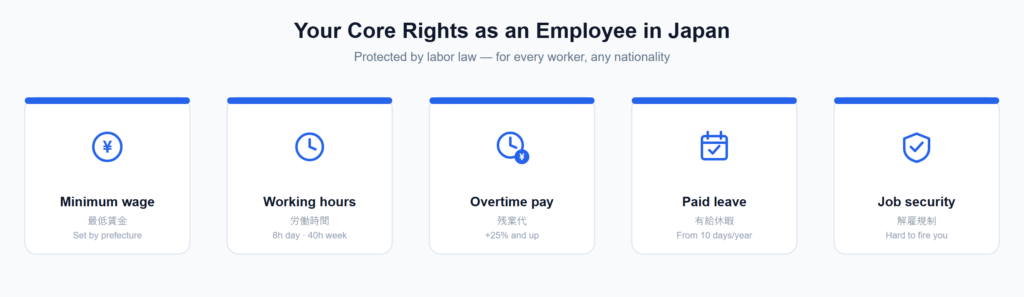
Minimum wage
Employers must pay at least the minimum wage, and it’s set by prefecture (with some industry-specific rates on top). If your contract sets a lower wage, that term is simply void and the legal minimum applies; the employer also owes you the difference, plus penalties. As of fiscal 2025 the national weighted average is about ¥1,121/hour, with Tokyo the highest at ¥1,226. Rates are revised every October, so check the current figure for your prefecture on the official MHLW list. This applies to everyone, part-timers and foreign workers included.
Working hours and breaks
The legal ceiling is 8 hours a day and 40 hours a week (LSA Section 32). Some workplaces use a “modified working schedule” (変形労働時間) that averages hours out over a period, allowing more flexibility, but the baseline is 8/40. You’re also guaranteed breaks (Section 34):
- At least 45 minutes if you work more than 6 hours, and
- At least 60 minutes if you work more than 8 hours.
Overtime: limits and premium pay
Overtime is everywhere in Japan, but legally it’s the exception, not the norm. It’s only permitted when the employer and the labor union (or an employee representative) sign what’s known as a “Article 36 agreement” (サブロク協定). Even then there are hard caps:
- Ordinarily up to 45 hours a month and 360 hours a year.
- With a special clause for busy periods, an absolute ceiling of 720 hours a year, under 100 hours in any single month (including holiday work), and an average of under 80 hours across any 2–6 month span.
- You can exceed 45 hours in a month only up to 6 months a year.
Push past these limits and the employer faces penalties. Overtime also has to be paid at a premium on top of your normal hourly rate:
- +25% for overtime
- +35% for work on a statutory holiday
- +25% for night work (10 p.m.–5 a.m.)
- +50% for overtime beyond 60 hours in a month (this now applies to small and mid-sized companies too, since April 2023)
These stack. Work past 10 p.m. in a month where you’ve already topped 60 hours of overtime, and that night pays 175% of your normal rate (100 + 25 night + 50 over-60h). You may hear the term “service overtime” (サービス残業)—unpaid overtime. It’s flatly illegal. If your employer won’t pay, you can report them to the Labor Standards Inspection Office, and you can recover the unpaid amount with interest. Note that the time limit for claiming unpaid wages was extended to 3 years (from two) for wages earned since April 2020—so don’t sit on it, but you have a window.
Paid leave (and the 5 days you must take)
Once you’ve worked at the same company for 6 months and shown up for at least 80% of your scheduled days, you get 10 days of paid leave a year, rising the longer you stay—up to 20 days:
| Continuous service | 6 mo | 1.5 yr | 2.5 yr | 3.5 yr | 4.5 yr | 5.5 yr | 6.5 yr+ |
|---|---|---|---|---|---|---|---|
| Paid leave days/year | 10 | 11 | 12 | 14 | 16 | 18 | 20 |
Part-timers on fewer days get a proportionally smaller amount. A few things worth knowing:
- You don’t owe anyone a reason. You can take paid leave whenever you like. If your boss asks why, that’s just curiosity—you’re not required to answer. The one limit: the employer can ask you to move the date if your absence would genuinely disrupt operations (a right called 時季変更権), but they can’t refuse it outright.
- Since 2019, taking leave is partly mandatory. If you’re entitled to 10+ days, your employer is legally obliged to make sure you actually take at least 5 of them each year—a rule aimed squarely at Japan’s culture of leaving leave unused.
- Unused days roll over once. Leave carries to the next year, but expires after 2 years. Watch the dates so you don’t lose them.
The right to know your contract terms
To check whether your rights are being respected, you first need to know what you actually agreed to—especially your standard work hours, without which you can’t tell what counts as “overtime.” Japanese law backs you up here. Under LSA Section 15, the employer must give you a written statement of working conditions (労働条件) covering at least:
- The contract term, and renewal conditions if it’s fixed-term
- Your workplace and job duties
- Work hours, breaks, holidays, and whether overtime is expected
- How your salary is calculated and paid (including the cutoff and payday)
- Rules on resignation and dismissal
This applies to everyone, part-timers included. If the actual conditions differ from what you were promised, you can demand they honor the stated terms—or quit on the spot (normally resignation involves notice). Keep your contract and any working-conditions document somewhere safe.
Companies with 10 or more employees must also have Rules of Employment (就業規則)—the shared workplace rules on hours, pay, holidays, and quitting—and make them accessible to staff (LSA Sections 89 and 106). Here’s a question that comes up a lot: can your employer cut your pay by quietly rewriting these rules? Generally no. Pay is part of your working conditions, and an employer can’t change them to your disadvantage without your genuine consent (Labor Contract Act Sections 9–10). There’s a narrow exception if the change is “reasonable” and properly communicated to everyone—but courts read “reasonable” strictly, and have held that simply not objecting doesn’t count as real consent.
Can your employer fire you easily? (Probably not)

This surprises people from “at-will” countries like the US, where an employer can often let you go for almost any reason. Japan is close to the opposite. Under Labor Contract Act Article 16, a dismissal is invalid unless it has objective, reasonable grounds and is considered socially acceptable. In practice that’s a high bar—poor performance or “we’re restructuring” usually isn’t enough on its own, and courts frequently side with the employee. It’s one reason Japanese companies lean on transfers, encouragement to resign, or non-renewal of fixed-term contracts rather than outright firing.
The flip side: if you want to leave, you can. On an open-ended contract you can generally resign with about two weeks’ notice, whatever your company’s internal rules say. If you’re ever pressured to “voluntarily” resign when you don’t want to, that pressure itself can cross legal lines—don’t sign anything under duress, and get advice first.
What to do if your employer breaks the law
Unpaid overtime, refused holidays, a dismissal that smells wrong—you have real options, and you don’t have to navigate them in Japanese.
- Start with the free multilingual hotline. The government runs a labor consultation service for foreign workers in several languages. It’s run by the authority that protects workers’ rights, so you can ask freely.
- The Labor Standards Inspection Office (労基署). This is the enforcement body. It can investigate, supervise, and penalize employers that break the law—your go-to for things like unpaid wages or illegal hours.
- Dispute resolution services. The Prefectural Labor Bureau offers labor arbitration and conciliation to settle disputes without going straight to court.
Whatever the issue, document things as you go—keep your contract, pay slips, and a record of your hours. Evidence is what turns “I think I’m owed overtime” into a claim that gets paid.
FAQ
Do labor laws protect foreigners and part-timers?
Yes. Labor law protects everyone who works for hire in Japan, regardless of nationality or visa status, and covers part-time and contract workers, not just full-time regular employees. The minimum wage, hours, and paid-leave rules all apply.
Do I have to give a reason to take paid leave?
No. You can take it whenever you want without explaining why. Your employer can only ask you to shift the date if your absence would seriously disrupt business—they can’t deny the leave itself. And since 2019, employers must ensure you actually take at least 5 days a year.
Is unpaid “service overtime” legal?
No. All overtime must be paid at a premium (at least +25%). Unpaid overtime is illegal, and you can report it to the Labor Standards Inspection Office and recover what you’re owed, with interest. Claims for unpaid wages can be made for up to 3 years.
Can my boss cut my salary by changing the workplace rules?
Generally not without your genuine consent. Pay is part of your working conditions, and disadvantageous changes need your agreement (Labor Contract Act). There’s a narrow “reasonable change” exception, but courts interpret it strictly and don’t treat silence as consent.
Can I be fired without a good reason?
It’s hard for an employer to do legally. A dismissal must have objective, reasonable grounds and be socially acceptable (Labor Contract Act Article 16), which is a high bar. If you’re fired or pressured to resign and it feels unjustified, consult the hotline or the Labor Standards Inspection Office before signing anything.
Key terms
- Working conditions (労働条件): The contents of your labor contract—term, workplace, hours, wages, and so on.
- Rules of Employment (就業規則): The shared workplace rules on conditions, discipline, and procedures. Required for companies with 10+ employees (LSA Section 89).
- Overtime / overtime pay (残業 / 割増賃金): Work beyond legal hours, and the premium wages owed for it.
- Statutory holidays: At least one day off per week, or four per four weeks (LSA Section 35).
- Paid leave (有給): Days off on which you still receive wages, separate from statutory holidays.
- Maternity leave (産休) / childcare leave (育休): Leave around childbirth and for raising a child. Income is partly replaced (commonly around 50–67%) through the social insurance system rather than by the employer.
- Labor Standards Act (労働基準法, LSA): The core statute setting minimum employment standards.
- Labor Standards Inspection Office (労基署): The government body that enforces labor law.
- Regular employee (正社員): An employee on an open-ended contract; different rules can apply to part-timers.
See also
- Social Insurance in Japan — employment insurance, pension, and the benefits behind maternity and childcare leave.
- Navigating Japan’s Healthcare System — how health coverage works alongside your job.
- Starting Your Own Business in Japan — if you’re moving from employment to working for yourself.


3 thoughts on “Labor Law in Japan: Know Your Rights as an Employee (2026)”