If you’re living in Japan on anything other than a Japanese passport, one document quietly controls most of your life here: your status of residence. It decides whether you can work, what kind of work, how long you can stay before dealing with immigration again, and eventually whether you can put down roots permanently. Most expats only learn how the system actually works the hard way — scrambling to renew a week before a deadline, or getting a form bounced back because they filled in the wrong box.
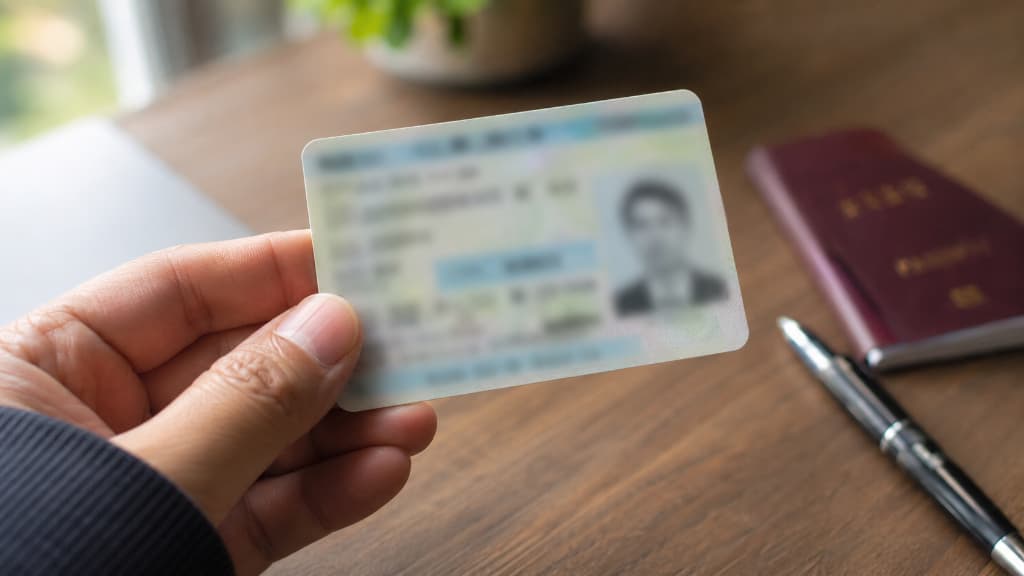
This guide lays out the system end to end: the types of status, what’s actually printed on your residence card, how renewals and changes work under Japan’s newly overhauled online system, the path to permanent residency, and the policy changes headed your way in 2026 and 2027. Immigration rules shift often — this is a starting map, not a substitute for checking with the Immigration Services Agency (ISA) or a licensed immigration specialist (行政書士) about your specific situation.
One vocabulary note before we start, because it trips people up constantly. In everyday English we say “visa,” but the thing that actually lets you live in Japan is your status of residence (在留資格, zairyū shikaku) and its attached period of stay (在留期間) — both printed on your residence card. The “visa” is technically just the sticker in your passport that let you enter. This article uses “visa” loosely, the way everyone does, but the distinction matters when you’re reading official notices — and it matters a lot if you ever end up dealing with immigration over a legal issue, which we cover separately in how criminal cases affect your status.
What’s Changing in 2026–2027
Japan’s immigration system is moving faster than usual right now. Three changes are worth knowing about before you plan around outdated information.
- Application fees are going up. Today, renewing or changing your status costs ¥6,000 at a counter (¥5,500 if filed online), and permanent residency applications are ¥8,000. In March 2026, the government submitted a bill raising the legal ceiling for these fees — to ¥100,000 for renewals and status changes, and ¥300,000 for permanent residency. The bill cleared the Lower House on April 28, 2026. The actual new amounts still need to be set by cabinet order, with implementation due by March 31, 2027 — so current fees remain in effect for now, but budget for a substantial increase before your next renewal cycle.
- Permanent residency now generally requires a 5-year period of stay (up from 3), following a guideline revision that took effect February 24, 2026. There’s a transition: applicants who already held 3-year status can still apply under the old rule through March 31, 2027. After that, only people who held 3-year status as of that date get one further grace application.
- Naturalization (帰化) — becoming a Japanese citizen, a separate process from permanent residency — got noticeably stricter in practice from April 1, 2026. The legal minimum residence requirement hasn’t changed, but the Ministry of Justice’s discretionary screening now generally expects around 10 years of residence, 5 years of tax records, and 2 years of social insurance records, following a policy review ordered by the Prime Minister’s office in late 2025.
None of this cancels an existing status of residence. But if you’re timing a permanent residency or naturalization application around the old thresholds, these changes matter — check the current requirements before you file, not after.
The Main Types of Status of Residence
Japan has around thirty formal categories of status, which sounds intimidating until you realize most expats only ever deal with one of four practical groups.
| Category | Who it’s for | Work rights | Typical period |
|---|---|---|---|
| Status-based (身分・地位) | Permanent Resident, Spouse/Child of a Japanese National, Long-Term Resident | Unrestricted — any job | Indefinite (PR) or 6 months–5 years |
| Work-based (就労) | Employees on gijinkoku, Specified Skilled Worker, Highly Skilled Professional, Business Manager, etc. | Only the approved category of work | 3 months–5 years |
| Student / Dependent | Students and the family members who accompany them | None by default (students can add up to 28 hrs/week with a permit) | Tied to the course or the sponsor’s status |
| Short-term / niche | Digital nomads, job-hunting graduates (J-Find), tourists | Usually none | Weeks to 6 months, often non-renewable |
The status-based group is the one everyone’s aiming for eventually: hold one of these and your visa stops being tied to a specific employer or program. Everyone else is on a status that only permits a defined kind of activity — take a job outside it, even one a company offers you in good faith, and you’re working illegally.
For a full breakdown of the work-based routes — the gijinkoku work visa, the Specified Skilled Worker visa’s 16 sectors, the Highly Skilled Professional points system, switching employers — see our overview of working in Japan. This article focuses on what applies no matter which status you hold: the card itself, renewals, changes, and the long road to permanent residency.
Understanding Your Residence Card (在留カード)
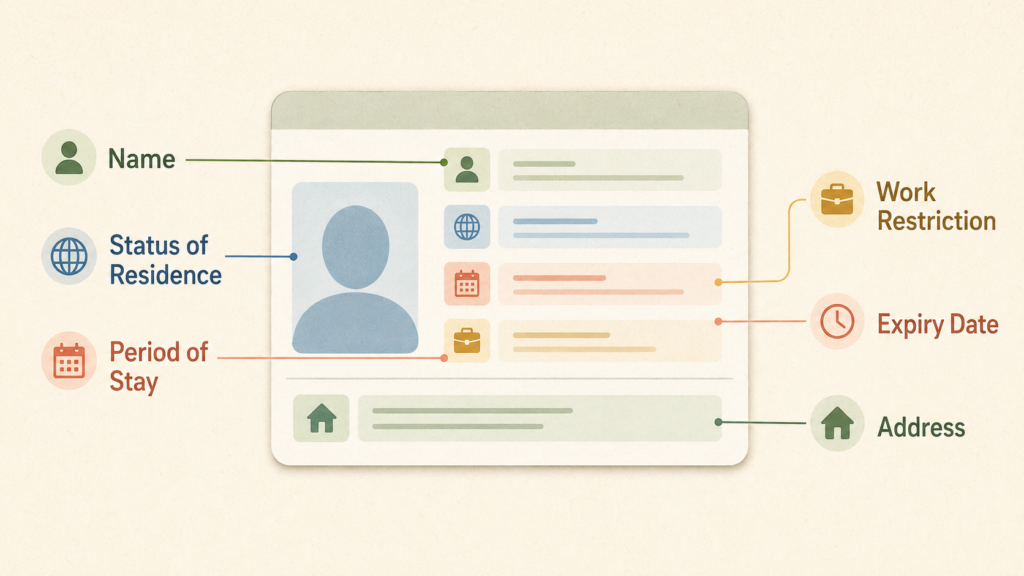
Your residence card (在留カード, zairyū kādo) is issued at airport immigration or your city hall when you arrive, and it’s the ID that actually matters day to day — more than your passport. It shows your name, date of birth, nationality, address, your specific status of residence, your period of stay and its expiry date, and whether you’re permitted to work.
You’re legally required to carry it at all times and show it on request to an immigration officer or police officer. Skip the carrying requirement and you risk a fine of up to ¥200,000; refuse to show it when asked and the penalty jumps to up to one year’s imprisonment or the same fine. (Anyone under 16 is exempt, and Special Permanent Residents — a separate historical category, mostly ethnic Koreans and Taiwanese born in Japan — don’t carry one at all.) In practice, nobody gets stopped often, but it’s not a card you want to leave at home the one time it matters.
You’ll need this card constantly — to open a bank account, sign a phone contract, and rent an apartment. Keep it in good condition; if it’s lost, stolen, or damaged, you must report it and apply for a reissue within 14 days.
Renewing Your Status of Residence

You can apply to renew (在留期間更新許可申請) starting roughly three months before your period of stay expires, as long as you have at least 6 months of status remaining to renew into. In hardship cases — hospitalization, an extended business trip — the local immigration office may accept an earlier application; call ahead and ask. The fee is ¥6,000 paid by revenue stamp at a counter, or ¥5,500 if you file online.
The Online Renewal System in 2026 (RASENS)
Immigration’s online application portal got a genuine overhaul in January 2026, and it’s worth knowing the difference if you tried it before and gave up. The old version required a Windows PC, a physical IC card reader, a separate piece of Japanese-only software, and — for many people — an evening spent compiling every document into one correctly-sized PDF. Plenty of long-time residents simply stopped trying and drove to the immigration office instead.
The rebuilt system removes most of that friction. You no longer need a card reader or any special software — you scan your My Number card directly with your phone. The system now also saves your progress partway through a form, which fixes one of the most common old complaints (get logged out or time out, and you lost everything). You can still apply for a family member — a spouse renewing on a dependent visa, for instance — as long as you have their My Number card and both of their passwords.
One catch that surprises people: applying online doesn’t mean you keep your physical card the whole time. Once your application is approved, you’re instructed to mail your current residence card to a processing office (in Tokyo, regardless of where you live), along with a revenue stamp and any supporting documents. Until your new card arrives, you carry a color copy of your old card — annotated with your application date and number — plus your passport. Sending it by tracked mail (a レターパック, for example) lets you monitor both legs of the trip; a full round trip typically takes under two weeks once your card is in the mail.
| Milestone | What happens |
|---|---|
| Day 0 | Documents submitted through the online portal |
| Day 1 | Application enters review (審査) |
| ~Day 6 | Approval email arrives; applicant mails old card + revenue stamp |
| ~Day 18 | New residence card is issued |
| ~Day 20 | Card arrives by post |
Note: this is one real applicant’s timeline, not a guarantee. Other renewals filed the same way have taken anywhere from three weeks to several months, depending on the office and the season — March and April, when many statuses expire together, are consistently the slowest.
A few practical things worth knowing before you start:
- Permanent residents currently can’t use this system for their own card procedures — it’s built around fixed-term status renewals and changes.
- Work visas usually need employer sign-off first. If your company is applying on your behalf for a category like gijinkoku, they generally need to register separately to use the online system before your case can go through it.
- The online status page tells you very little. It typically just shows “submitted” until a decision is made — don’t expect a progress bar. If your case is stuck close to your expiry date, call the office directly rather than waiting on the portal.
- Be careful with third-party tools when preparing documents. Some applicants use online PDF compressors or AI tools to merge scans — fine for convenience, but you’re uploading passport and residence-card images, so stick to tools that don’t ship your data to an unknown server.
If Your Application Is Still Pending When Your Card Expires
File before your expiry date and you’re automatically covered by a grace period (特例期間) that keeps your current status valid — legally, not just informally — until a decision is made, capped at two months past your original expiry. This is exactly why applying as soon as the three-month window opens is worth the mild hassle of doing it early: a renewal that’s still “under review” a week before your card expires is stressful even though you’re technically fine, and if the office needs additional documents, you want time to provide them.
Changing Your Status of Residence
If your circumstances change — you finish your degree and get a job offer, or you marry a Japanese national — you’ll need to file a change-of-status application (在留資格変更許可申請) rather than a simple renewal. Common paths include student to work visa, work visa to spouse visa, and dependent to work visa (after a divorce, for instance). The process and fee are similar to a renewal, but the review is more involved, since immigration is evaluating a new category from scratch rather than extending one you already qualified for. Approval for a straightforward change typically takes a few weeks to a couple of months; start the process well before you need the new status, especially if a job offer is time-sensitive.
The Path to Permanent Residency (永住者)
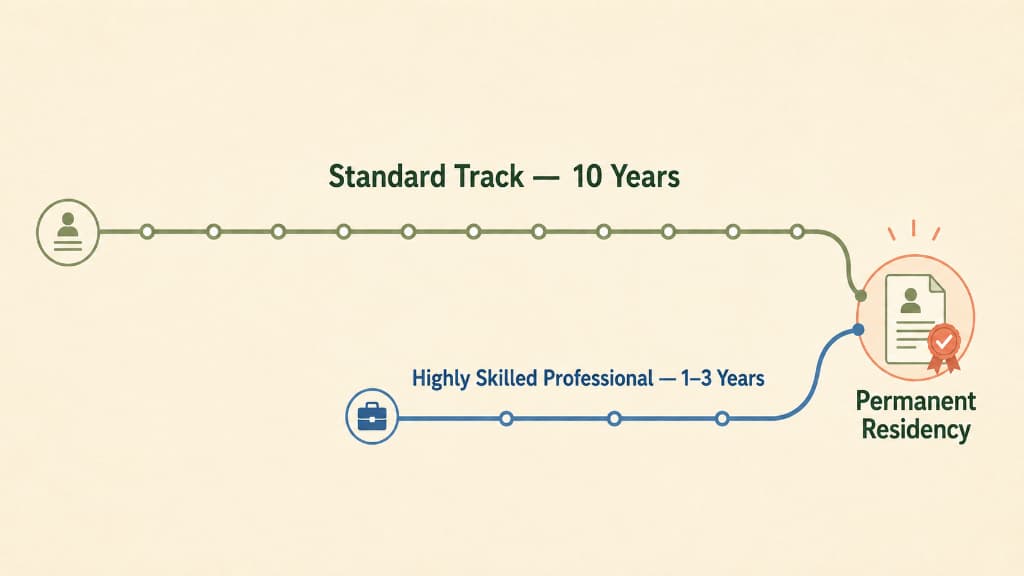
Permanent residency removes the work restrictions and the renewal cycle entirely — no more employer ties, no more expiry date. It is not the same as citizenship; more on that distinction below.
The official PR guideline sets out the core requirements:
- 10 years of continuous residence in Japan, including at least 5 years under a work-based or status-based visa (time on a Technical Intern or Specified Skilled Worker (i) status doesn’t count toward that).
- A 5-year period of stay at the time you apply (raised from 3 years in February 2026 — see the changes section above for the transition rule).
- Good conduct and financial self-sufficiency — no significant criminal record, and enough assets or income to support yourself.
- A clean record on taxes, pension, and health insurance. This is where applications most often stall — immigration checks that you’ve paid on time, and a history of late payments can count against you significantly, even after everything is settled. The catch is that these bills — 納付書 for pension, resident tax, health insurance — usually arrive in Japanese only, with no English version and no reminder email. It’s genuinely easy to miss one simply because you couldn’t read it, but that doesn’t matter to your application: a late payment is a late payment. The safest fix is to set up automatic bank withdrawal (口座振替) for all three the moment you’re eligible, so nothing depends on you correctly reading a notice in a language you may not be fluent in. If you’ve ever had a gap in your pension or health insurance contributions, sort it out well before you apply.
What the guideline doesn’t tell you is how long the review itself takes once you’ve filed. My husband’s PR application ran about a year and a half from submission to approval, and more than a year of that was simply waiting — the file sat untouched before anyone at immigration even looked at it. Partway through, they wrote back asking him to resend several documents, because the originals had expired while the case sat in the queue. Gathering the paperwork in the first place — tax certificates, employment records, proof of income going back years — took real time too. The review timeline is completely out of your hands, but how early you start collecting documents isn’t, so don’t wait until you technically qualify to begin.
If you’re married to, or the child of, a Japanese national, permanent resident, or Special Permanent Resident, the good-conduct and self-sufficiency requirements are waived — though the underlying 10-year and 5-year rules generally still apply unless you qualify for one of the fast tracks below.
The Highly Skilled Professional Fast Track
If you qualify for the Highly Skilled Professional points system — scored on education, income, age, research achievements, and Japanese ability — the 10-year wait shrinks dramatically. Score 70 points or more and you can apply for PR after 3 years in Japan; score 80 or more and it drops to just 1 year. You don’t need to currently hold the Highly Skilled Professional status itself to use this — many applicants are on a regular work visa like gijinkoku and simply demonstrate they’d score highly enough if assessed.
Permanent Residency vs. Naturalization (帰化)
People often conflate the two, but they’re different in an important way. Permanent residency keeps your original nationality — you remain, say, American or Indian, with the right to live and work in Japan indefinitely, but you can’t vote and you’re not immune from deportation in extreme cases (see below). Naturalization means giving up your original citizenship and becoming Japanese, with full civic rights and no residency conditions at all. Naturalization also has its own, separate practical requirements, which — as noted above — got noticeably stricter from April 2026. If citizenship is your goal, our full guide to naturalization in Japan walks through the requirements, the 2026 changes, the interview, and the process end to end.
Unlike the U.S., there’s no realistic path to acquiring status through donations or investment alone — both PR and naturalization are earned through years of residence and a clean record, not a lump sum.
Can Permanent Residency Be Revoked?
Yes, though it’s rare and it isn’t automatic. A 2024 immigration law amendment expanded the grounds for revocation to include intentional non-payment of taxes or social insurance premiums, and certain serious criminal convictions — that provision is expected to take effect by 2027. We cover the criminal side of this in detail, including exactly which convictions carry deportation risk, in how criminal cases affect your visa status.
Family and Spouse Visas
Marrying a Japanese national or a fellow resident, or bringing a spouse and children to Japan, opens a different set of statuses. A “Spouse or Child of a Japanese National” visa carries no work restrictions at all, while a “Dependent” visa (for the family of a work-visa holder) generally doesn’t permit work unless you separately apply for permission — capped, like the student visa, at 28 hours a week. Spouse visas also come with a shortcut to permanent residency: generally 1 year of marriage plus 3 years of residence in Japan, or 3 years of marriage if you live abroad together first. We’re preparing a dedicated guide to the marriage and spouse-visa process — check back, or explore our guides on daily life once you’ve settled in.
Re-Entry Permits: Traveling Abroad Without Losing Your Status
You don’t need to apply for anything special before a normal trip home. Under the deemed re-entry permit (みなし再入国許可) system, any resident with a valid passport and residence card can leave and return within 1 year (2 years for Special Permanent Residents) without a separate re-entry permit — as long as you check the “re-entry” box on the departure card at the airport. If your period of stay expires before that window closes, your actual expiry date governs, not the full year.
The exceptions: if you’re planning to be outside Japan for longer than a year, or your remaining status is very short (3 months or less), you’ll need to apply for a full re-entry permit before you leave. Skip this when you need it, and returning to Japan can mean your original status is treated as abandoned — a much bigger headache than the paperwork you were trying to avoid.
Frequently Asked Questions: Status of Residence in Japan
What’s the difference between a visa, a status of residence, and a period of stay?
Strictly speaking, your “visa” is the sticker in your passport that let you enter Japan — it’s used once, at the border. Once you’re in the country, what actually governs your life is your status of residence (the category, like gijinkoku or Permanent Resident) and your period of stay (how long that status is valid for), both printed on your residence card. Everyday English collapses all three into “visa,” and this article does too, but immigration paperwork uses the precise terms.
When should I apply to renew my status of residence?
You can file starting about three months before your current period of stay expires, and you should. Applying at the earliest possible moment gives you the most runway if the office asks for additional documents, and it means you’re not anxiously watching your expiry date while your case sits in review.
Can I renew my visa online in Japan?
Yes, for most fixed-term statuses, through the RASENS online system, significantly simplified in a January 2026 update. You’ll need your My Number card and a smartphone that can scan it. Permanent residents and some work-visa categories (which need employer registration first) have limitations — check the system’s coverage before you rely on it.
If I apply online, do I have to mail in my original residence card?
Yes. Once your online application is approved, you’re asked to mail your current residence card, along with a revenue stamp and any final documents, to a central processing address. In the meantime, you carry a color copy of your old card with your application number written on it, plus your passport, until the new card arrives by post.
What are the requirements for permanent residency in Japan right now?
As of the February 2026 guideline revision, the general path requires 10 years of continuous residence (at least 5 of them on a work or status-based visa), a 5-year period of stay at the time of application, good conduct, financial self-sufficiency, and a clean record on tax, pension, and health insurance payments. Highly Skilled Professionals can qualify in 1–3 years depending on their points score, and spouses of Japanese nationals have a shorter path as well.
Is permanent residency the same as becoming a Japanese citizen?
No. Permanent residency lets you live and work in Japan indefinitely while keeping your original nationality — you still can’t vote, and your status carries a (rare) risk of revocation. Naturalization (帰化) means giving up your original citizenship to become Japanese, with full civic rights. The two have separate application processes and separate requirements, and naturalization’s practical bar got noticeably higher in April 2026.
Do I need a re-entry permit every time I travel outside Japan?
No, not for a normal trip. As long as you return within a year (two years for Special Permanent Residents) and check the re-entry box on your departure card, you’re automatically covered under the deemed re-entry permit system. You only need to apply for a formal re-entry permit in advance if you’ll be away longer than a year or your remaining period of stay is very short.
Key Takeaways
- Your status of residence — not your passport — determines what you can legally do in Japan; check it before you take on a new job or activity.
- Apply to renew or change status as soon as the 3-month window opens, not the week before it closes.
- The 2026 online renewal system is genuinely easier than before, but it still requires mailing in your original card — plan around that gap.
- Permanent residency now generally needs a 5-year period of stay, not 3 — check where you stand under the transition rule before you apply.
- Application fees are set to rise substantially sometime before March 2027 — there’s no cost advantage to waiting.
- Keep your taxes, pension, and health insurance payments current from day one — this is the single most common reason PR and naturalization applications stall.
For the work-visa specifics — which category fits your job, salary expectations, and how to find English-friendly openings — see our guide to working in Japan. And if you’re ever dealing with immigration consequences from a legal issue, read how criminal cases affect your status for the full picture.



2 thoughts on “Status of Residence in Japan: The Complete Visa Guide for Expats (2026)”