You had a genuinely bad experience at a restaurant, so you left an honest one-star review on Google Maps. A few days later, your phone rings—and it’s the police. Or the business replies to your review threatening to sue you for defamation. Suddenly you’re wondering: did I just commit a crime by telling the truth?

In Japan, the short answer is: a negative review can cross into criminal or civil defamation, but an honest, fact-based review that serves the public is protected by law. The problem is that most people don’t know where the line sits—and in Japan, businesses sometimes lean on that uncertainty to get reviews taken down. This guide explains exactly when a review becomes a legal problem, how the law protects fair feedback, and what to do if a business or the police contacts you. This is general information, not legal advice—for a specific situation, consult a licensed lawyer.
Table of Contents
- The short answer: yes, but honest reviews are protected
- Three laws that can turn a review into a crime
- Civil defamation and damages
- The Defense of Truth: your main protection
- "But I posted anonymously" — why that is no longer a shield
- How to write a negative review safely
- What to do if a business or the police contacts you
- Frequently Asked Questions
- Conclusion
The short answer: yes, but honest reviews are protected
Japan takes reputation (名誉, meiyo) seriously, and unlike in some countries, defamation here can be a criminal matter, not only a civil one. That surprises a lot of newcomers. A review can technically run into three different criminal laws and a separate civil claim for damages.
But the law isn’t designed to silence honest customers. If your review is true (or something you reasonably believed to be true), about a matter of public interest, and written to inform others rather than to attack, it’s protected—even if it stings the business. The trick is knowing the difference between a protected review and a punishable one, which is what the rest of this guide is about.
Why this comes up more in Japan than you’d expect
Two things make Japan different. First, defamation is criminalized, so a business can threaten not just a lawsuit but a police complaint—a heavier-sounding stick than many newcomers are used to. Second, reputation carries real commercial weight here, and a small business owner may take a single critical review far more personally than a large chain would. Add a growing “reputation management” industry that contacts reviewers on businesses’ behalf, and you get a situation where honest customers occasionally receive intimidating messages over perfectly legal feedback. Knowing the actual rules is what lets you tell a genuine legal risk from empty pressure.
Three laws that can turn a review into a crime
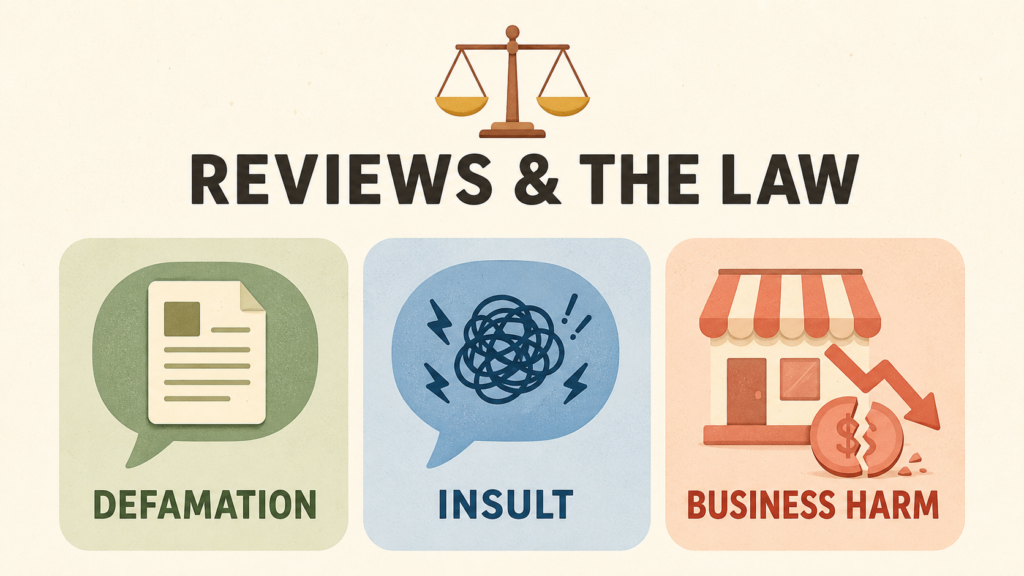
Most articles only mention one law. There are actually three you should know, because which one applies depends on what you wrote. Each is explained below, and the table at the end of this section shows them side by side.
1. Criminal defamation (名誉毀損罪, Article 230) — stating facts
This is the big one. Under Article 230 of the Penal Code, criminal defamation occurs when you publicly state a specific fact that lowers someone’s social reputation. Three elements must line up:
- Public – The statement is accessible to many people. A public Google or Tabelog review easily qualifies.
- A specific fact – You assert something concrete, such as “the kitchen reused food that fell on the floor.” Notably, this applies whether the fact is true or false—truth is handled separately as a defense (see below). A vague opinion like “the food wasn’t great” is not a “fact” and isn’t covered here.
- Lowers reputation – Judged by ordinary common sense, the statement damages how society views the person or business.
The penalty can reach up to 3 years’ imprisonment (now called 拘禁刑) or a fine of up to ¥500,000. That sounds alarming, but read the next two sections before you panic: the Defense of Truth exists precisely to protect honest reviews, and this is a “complaint offense” (親告罪)—prosecutors can’t act unless the victim files a formal criminal complaint, and they have to do so within six months of learning who posted it.
2. Insult (侮辱罪, Article 231) — opinions and abuse, and the 2022 crackdown
Here’s the part older guides miss. If criminal defamation covers facts, the insult offense covers opinions and abuse with no specific fact attached—calling a place “filthy garbage run by idiots,” for example. People often assume “it’s just my opinion, so it’s safe.” In Japan, an opinion can still be a crime under Article 231.
And the stakes went up. After a wave of online abuse cases, Japan toughened the insult law on July 7, 2022. The penalty jumped from a token “detention or a minor fine” to up to 1 year’s imprisonment (拘禁刑) or a fine of up to ¥300,000, and the statute of limitations was extended from one year to three (Ministry of Justice Q&A). The lesson for reviewers: venting pure abuse is now genuinely riskier than it used to be. Stick to facts and measured language.
3. Hurting a business’s credit or operations (信用毀損・業務妨害罪, Article 233)
A third law applies specifically to businesses. Under Article 233, spreading a false rumor or using deception to damage a business’s credit or obstruct its operations is a crime, punishable by up to 3 years’ imprisonment or a fine of up to ¥500,000. Think of a fake review inventing food poisoning at a restaurant you never visited.
One important difference: unlike defamation and insult, this is not a complaint offense, so police can investigate without the business filing a formal complaint. The saving grace for honest reviewers is the word false—a truthful account of your own real experience is not a “false rumor.”
Quick comparison
Here’s how the three laws compare at a glance:
| Law | What it targets | Typical review example | Maximum penalty |
|---|---|---|---|
| Criminal defamation 名誉毀損罪 (Art. 230) | Stating a specific fact (true or false) that harms reputation | “They reuse dropped food in the kitchen.” | 3 yrs’ imprisonment / ¥500,000 fine |
| Insult 侮辱罪 (Art. 231) | Opinion or abuse with no specific fact | “Trash restaurant run by idiots.” | 1 yr’s imprisonment / ¥300,000 fine (since 2022) |
| Credit/business obstruction 信用毀損・業務妨害罪 (Art. 233) | A false rumor that damages a business | Inventing food poisoning you never had | 3 yrs’ imprisonment / ¥500,000 fine |
Civil defamation and damages
Even when no crime is charged, a business can sue you in civil court for monetary damages. The bar for civil defamation can be lower than for the criminal version, which is why most real-world disputes over reviews are civil, not criminal.
That said, Japanese courts have grown more protective of online reviews. Under the Counter-Speech Doctrine (対抗言論の法理)—articulated in a Tokyo District Court ruling on August 27, 2001—statements made online can sometimes be answered publicly by the other side, which reduces the lasting reputational harm and weighs in the reviewer’s favor. The same Defense of Truth that applies in criminal cases also protects you here. What courts won’t excuse is genuinely extreme content, such as discriminatory slurs.
The Defense of Truth: your main protection
This is the shield that keeps honest reviewing legal. Even if a review technically meets the definition of defamation, you are not punished when all three of these hold (Article 230-2, 真実性の抗弁). The most important of the three is the first—truth is the foundation—but all three need to line up:
- Truth – The fact is true, or you had reasonable grounds to believe it was true when you posted.
- Public interest – The review concerns a matter the public has a legitimate reason to know (e.g., hygiene, safety, dishonest charging).
- Public benefit – Your main purpose is to inform other customers, not to take personal revenge.
Two practical points. First, the truth element is forgiving: if you genuinely and reasonably believed what you wrote—say, based on what staff told you—you can be protected even if it later turns out you misunderstood. Second, courts generally presume a public-interest review was posted for public benefit unless the business proves you were just out for revenge. So a calm, factual review written to warn other customers sits on solid ground.
“But I posted anonymously” — why that is no longer a shield
A lot of older advice says anonymity protects you, because tracking down an anonymous poster used to be slow and expensive—two separate court cases, often many months and significant legal fees. For a single review, businesses rarely bothered.
That changed on October 1, 2022. A reform to the Provider Liability Limitation Act created a new sender-information disclosure order (発信者情報開示命令) that lets a claimant unmask an anonymous poster in a single, streamlined court procedure instead of two (Ministry of Internal Affairs and Communications overview, PDF). Identifying who you are is now faster and cheaper than before.
The takeaway isn’t “you’ll definitely be found.” Most ordinary reviews never trigger any of this. But don’t treat an anonymous handle as a license to write things you couldn’t stand behind. Write as if your name were attached—because increasingly, it can be.
How to write a negative review safely
You’re allowed to be critical. The goal is simply to stay on the protected side of the line:
- Stick to verifiable facts. “I waited 50 minutes after my reservation time” is far safer than “the worst service on earth.” Describe what actually happened to you.
- Frame it as help for other customers. That supports both the public-interest and public-benefit elements of the Defense of Truth.
- Avoid personal attacks and exaggeration. Insulting a specific employee’s character, or inflating a real issue into something it wasn’t, is where reviews get into trouble.
- Don’t state things you can’t back up. If you only suspect something, say so (“it seemed like…”) rather than asserting it as fact.
- Keep your evidence. Photos, receipts, reservation confirmations, and dates make it far easier to show your review was truthful if it’s ever questioned.
To make the line concrete, here’s the same complaint written two ways:
| Risky version | Protected version |
|---|---|
| “This clinic is a scam run by a clueless quack who clearly hates patients.” | “I was charged ¥3,000 for a service that wasn’t explained beforehand, and when I asked, the receptionist refused to itemize it.” |
| Pure abuse and an unprovable accusation (“scam,” “quack”)—exposure to both insult and defamation. | A specific, verifiable account aimed at warning other patients—squarely inside the Defense of Truth. |
The second review is arguably more damaging to a bad business, because it’s credible. Specificity is both safer and more persuasive—a rare case where the cautious choice is also the better one.
What to do if a business or the police contacts you

This is the situation the intro described, and it’s more common than you’d think—sometimes used simply to pressure reviewers into deleting honest feedback.
If the business sends a complaint or “cease and desist”
- Don’t panic, and don’t reflexively delete. A threatening message is not a court order. If your review is truthful and fair, you are likely within the Defense of Truth.
- Re-read your own review honestly. Is every factual claim something you can support? If part of it was exaggerated or unverifiable, editing that part is reasonable.
- Keep records. Save the message and your evidence rather than getting into a public back-and-forth in the replies.
If the police call
- Stay calm and polite. Because defamation and insult are complaint offenses, police often act after a business complains—and they frequently just suggest taking the review down to ease tensions, even when no clear crime occurred.
- You are not obligated to admit wrongdoing. You can say you’ll respond after seeking advice. If the matter looks serious, talk to a lawyer before agreeing to anything.
Extra considerations for foreign residents
A few things make this situation harder for foreign residents than for Japanese citizens, and it’s worth being prepared.
- Almost everything will be in Japanese. Cease-and-desist letters, police phone calls, and any formal documents are written and conducted in Japanese, with no obligation to provide a translation. Don’t ignore a letter you can’t read—the timing of any response can matter legally. Get it translated quickly, either through a friend, a paid service, or the multilingual helpline below.
- You can request an interpreter for police questioning. If police ask you to come in for voluntary questioning (任意同行) or call you in connection with a complaint, you have the right to ask for an interpreter, and they generally must arrange one. Don’t try to manage a serious legal conversation in broken Japanese—misstatements there can be costly.
- Visa impact is mostly a question of conviction, not investigation. Being contacted by police, or even being investigated, does not by itself affect your residence status. What can matter is an actual criminal conviction with a meaningful sentence—and for defamation or insult cases involving a single review, that outcome is rare. Still, this is the part most foreign residents worry about most, so see our guides on what happens if you are arrested in Japan and how criminal proceedings affect your visa for the full picture.
- Your embassy or consulate can help in serious cases. If you are formally questioned, detained, or charged, your country’s embassy or consulate in Japan can usually provide a list of English-speaking lawyers, notify family members, and (in detention cases) visit you. They will not act as your lawyer or intervene in the case itself, but the practical support is genuinely useful—don’t be shy about calling.
- Use Houterasu’s multilingual line first if you’re unsure. The Japan Legal Support Center (Houterasu / 法テラス) runs a free phone service in English, Chinese, Korean, Portuguese, Vietnamese, and several other languages. They won’t represent you, but they will explain the system in your language and point you to the right consultation window—often the right first step before you spend money on a lawyer.
Frequently Asked Questions
Can a one-star rating with no comment be defamation?
On its own, a bare star rating contains no specific factual statement, so it’s very unlikely to count as criminal defamation. Problems arise from the words you add, not the number of stars.
If my review is completely true, can I write anything?
Truth is a powerful defense, but not unlimited. A true statement can still be an insult if it’s pure abuse, and even truthful information must relate to public interest to be fully protected. Stay factual, relevant, and measured.
Do I have to delete my review if a business asks?
No. A request—or even a threat—doesn’t legally compel you to remove an honest review. Only a court can order removal. That said, if part of your review was inaccurate, correcting it is sensible.
Can the business find out who I am if I posted anonymously?
Potentially, yes. Since the October 2022 reform, a single court procedure can compel platforms and providers to disclose a poster’s identity. It still takes effort, so it’s uncommon for a single ordinary review—but anonymity is no longer a guarantee.
Is leaving a negative review worth the risk at all?
For the vast majority of honest customers, yes. Fair, factual reviews are legal and genuinely useful to others. The risk attaches to abuse, exaggeration, and false claims—not to telling the truth about your own experience.
Conclusion
So, can a negative review really be a crime in Japan? Yes—but only when it crosses specific lines: stating damaging facts you can’t support, hurling pure abuse (now punished more harshly since 2022), or spreading false claims about a business. Honest, fact-based reviews written to help other customers are protected by the Defense of Truth, in both criminal and civil cases.
Write about what actually happened to you, keep your tone measured, hold on to any evidence, and you can share real feedback with confidence. And if a business or the police ever does reach out, remember that a threat is not a verdict—stay calm, check your facts, and get proper advice before agreeing to anything.
Reminder: this article is general information, not legal advice. For a specific situation, consult a licensed lawyer or the Japan Legal Support Center (法テラス).