Japan is one of the easier countries in the world to own property as a foreigner—there’s no citizenship or visa requirement to hold real estate, and you buy on the same legal footing as a Japanese national. The harder part is financing it. A mortgage (住宅ローン, jūtaku rōn) is where banks start asking questions, and the answers depend a lot on your residency status. The good news is that it’s very doable, including without permanent residency, once you know which banks to approach and what they want to see. This guide walks through who qualifies, the banks that lend to foreigners, current interest rates, the tax break, and the actual step-by-step of applying.
Figures below are accurate as of June 2026. Interest rates in particular are moving right now—treat the numbers as a current snapshot, and confirm with the bank before you commit.
Can foreigners get a home loan in Japan?
Yes. Foreign residents can and do get mortgages here. The catch is that banks worry about one thing above all: the risk that you leave the country with the loan unpaid, since chasing a debt across borders is difficult for them. That single concern explains almost every requirement you’ll run into.
It splits into two situations:
- With permanent residency (永住権) or a Japanese spouse — Most major banks, including the megabanks, will treat you essentially like a Japanese applicant. This is the smoothest path, with the best rates and the lowest down payments.
- Without permanent residency — Fewer banks, usually a larger down payment, and sometimes a slightly higher rate—but it’s far from impossible. A handful of banks specialize in exactly this, and we’ll name them below.
In both cases the property must be for you or your family to live in. Standard mortgages are for primary residences; financing a place to rent out is an investment loan, which is a different product with stricter terms. You’ll also need to be a registered resident, which means you’ve been living in Japan and have a residence record (住民票) on file.
Does permanent residency really make that much difference?
It does, mostly because it answers the bank’s core worry—someone with PR is presumed to be staying. If PR is on your horizon, it’s worth knowing the basics: you generally need around ten years of residence with taxes and pension paid and a clean record, but holders of a Highly Skilled Professional visa can apply after as little as one year. If you’re close, waiting for PR can widen your choice of banks and improve your terms. If you’re not, don’t let that stop you—read on.
Who qualifies: the general requirements
These apply broadly to Japanese citizens and foreign nationals alike. Individual banks vary, but this is the shape of what they look for.
About you
- Age: Typically 20 to around 65–70 at application, and able to finish repaying by about 80.
- Job stability: Often 1 to 3 years in your current job. A permanent (正社員) contract is viewed more favorably than contract or freelance work, and changing jobs right before you apply tends to hurt.
- Income: A stable annual income, commonly from ¥3 million up. Some foreigner-friendly banks set their own floors—as low as ¥3 million, others ¥5 million.
- Clean credit: No record of missed payments. Phone-installment defaults catch people out here more often than you’d think.
About the property and the amount
- The property must be a legally compliant building under the Building Standards Act, and you must hold ownership rights to it (not merely leasehold).
- Banks lend against the lower of the purchase price and their own assessed value. With strong credentials you may borrow most of the price, but expect to put real money down—and without PR, a deposit of 20% to 50% is common.
- Your total annual loan repayments (this mortgage plus any other debt) generally shouldn’t exceed roughly 30–35% of your annual income. This ratio, not just the headline income, is what decides how much you can borrow.
Banks that lend to foreigners without permanent residency

This is the question most readers actually arrive with, so let’s be concrete. The megabanks (MUFG, Mizuho, Resona) generally want PR or a Japanese spouse. But several banks have built products specifically for foreign residents, some with English support:
| Bank | PR required? | Typical conditions | English support |
|---|---|---|---|
| Tokyo Star Bank (Star Housing Loan) | No — built for non-PR foreigners | ~1 year continuous employment; annual income ¥3M+ | Yes |
| SMBC Trust Bank (PRESTIA) | No | Resident in Japan; annual income ¥5M+ | Yes |
| SBI Shinsei Bank | Usually PR or a Japanese spouse + guarantor | Annual income ¥3M+ | Limited |
| Aeon Bank | No, with unrestricted work status | Stable residency status; annual income ¥1M+ | Limited |
| Megabanks (MUFG, Mizuho, Resona) | Generally yes | Best rates, lowest deposits once you qualify | Varies |
If you don’t have PR, Tokyo Star Bank and SMBC Trust PRESTIA are the two names that come up most, partly because they’ll deal with you in English. Conditions and rates change, so use this as a shortlist to start conversations, not a final answer.
One more option worth knowing: Flat 35, a long-term fixed-rate loan backed by the government-affiliated Japan Housing Finance Agency and offered through many banks. It’s available to foreign residents and is popular with anyone who wants the certainty of a rate that never moves for up to 35 years—useful now that rates are rising.
Interest rates in 2026: variable, fixed, or Flat 35?
For years the standard advice was “take the variable rate, it’s basically free money.” That era is ending. The Bank of Japan has been raising its policy rate—around 0.75% in mid-2026 and expected to approach 1.0% by year-end—and mortgage rates have followed, with fixed rates seeing some of their biggest jumps in years. Here’s roughly where things sit as of June 2026:
- Variable rate: Best offers from major lenders around 0.9%–1.1%. The lowest number on the page, but it can rise during your loan, so leave yourself headroom.
- 10-year fixed: Roughly 2.9%–3.2%. You pay more now for protection against future hikes.
- Flat 35 (full-term fixed): Around 3.2%, locked for the life of the loan.
The variable-versus-fixed choice is genuinely harder than it was five years ago. Variable still wins on today’s monthly payment; fixed buys you a known number for the next few decades while rates are climbing. There’s no universally right answer—it depends on how much a rate rise would stretch your budget. This is exactly the kind of decision worth running past a financial advisor before you sign.
The two big perks: tax deduction and dan-shin
Even buyers who could pay cash often take a loan, because financing here comes with two real advantages.
The Home Loan Tax Deduction (住宅ローン控除, jūtaku rōn kōjo). This is the big one, and it’s where old guides will steer you wrong. Since the 2022 reform, the deduction is 0.7% of your year-end loan balance (not the old 1%), credited against your income tax for up to 13 years on a qualifying new build (10 years for existing homes). The maximum balance the deduction applies to depends on the home’s energy performance and your household—certified low-carbon or long-term-quality new builds qualify for higher caps (up to ¥45 million, or ¥50 million for child-rearing and younger households), while a standard home is lower. The floor-area threshold has been eased to 40㎡, and the program currently runs through 2030. The practical takeaway: a more energy-efficient home is rewarded with a bigger break, so it’s worth checking a property’s certification before you buy.
Group Credit Life Insurance (団体信用生命保険, danshin). Bundled into most Japanese mortgages, this pays off your remaining balance if you die or, in many plans, become severely disabled during the loan term. Your family keeps the home with no debt attached. Approval depends on your health—you complete a medical declaration—so a pre-existing condition can complicate it, but for most people it’s a genuine safety net and one of the quiet reasons borrowing here makes sense.
How to apply, step by step
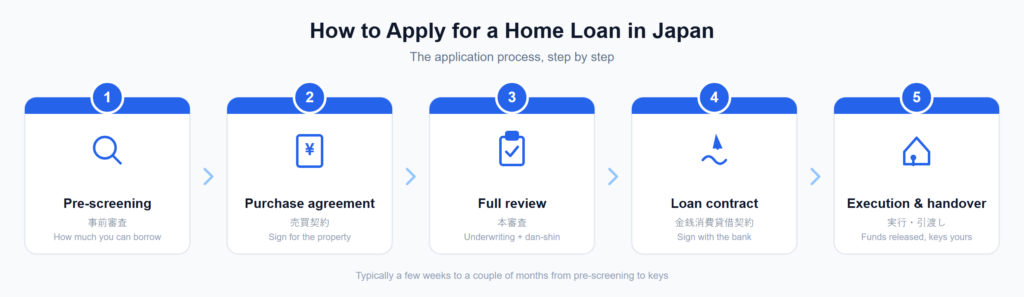
The process has a clear shape once you’ve seen it. Start it early—ideally before you’ve fallen in love with a specific property—because the pre-screening tells you what you can actually afford.
- Pre-screening (事前審査 / 仮審査, jizen shinsa). A quick, light review—often online in a few business days—that estimates how much the bank will lend you. Sellers and agents usually expect you to have this before they take an offer seriously.
- Sign the purchase agreement. Once a property is chosen, you sign the sales contract, typically with a clause that lets you withdraw if your loan is ultimately rejected.
- Full review (本審査, hon-shinsa). The detailed underwriting, including the dan-shin medical declaration and a check of all your documents. This usually takes one to a few weeks.
- Loan contract (金銭消費貸借契約). With approval in hand, you sign the actual loan agreement with the bank and fix your rate type and term.
- Execution and handover. On the closing date the bank releases the funds, the balance goes to the seller, ownership is registered in your name, and you get the keys.
From pre-screening to keys, a smooth case runs a few weeks to a couple of months. Where it slows down for foreign applicants is documentation, so get that ready early.
Documents you’ll typically need
- Residence card (在留カード) and passport
- Residence certificate (住民票) and personal seal (印鑑) with its registration certificate (印鑑証明書)
- Proof of income — withholding slips (源泉徴収票) or tax returns for the last 1–3 years, plus recent pay slips
- Tax payment certificates (納税証明書) showing you’re up to date
- Property documents — the sales agreement, floor plans, and registry information (your agent provides these)
If your Japanese isn’t strong, this is the stage to lean on an English-capable bank or your real estate agent—the forms are detailed and almost entirely in Japanese. For the wider buying process around the loan, see our beginner’s guide to purchasing real estate in Japan.
Don’t forget the upfront costs
The loan covers the property, but buying a home carries one-off costs on top—commonly in the region of 6–9% of the price. These include the agent’s brokerage fee, registration and license tax, judicial scrivener fees, stamp duty, and loan arrangement fees. Budget for these in cash; lumping them into expectations and then being surprised at closing is a classic first-time mistake. The purchasing guide above breaks these down in detail.
Why foreign applicants get turned down—and how to avoid it
Rejections usually come down to a handful of recurring issues, and most are avoidable with a little planning:
- Short time in the current job. Changing employers just before applying resets the clock banks care about. If a move is coming, either apply before it or wait until you’ve built a year or two at the new place.
- Residency status too short or near expiry. A visa with little time left makes banks nervous. A longer-validity status, or progress toward PR, helps your case.
- Unpaid taxes or pension. Banks check, and a gap here is a fast no. Clear any arrears and have your tax payment certificates clean before you apply.
- Hidden small debts. Phone installments, consumer-finance balances, and even unused-but-open card limits all count toward your repayment ratio. Pay down what you can and close cards you don’t use.
- Health flags for dan-shin. Because the group credit life insurance is usually mandatory, a medical condition that fails the screening can sink the loan. If that’s a risk, ask early about banks with relaxed dan-shin (緩和型) or Flat 35, which doesn’t require it.
If one bank says no, it’s not the end of the road—criteria differ, and a borrower rejected by a megabank is often approved by a foreigner-focused lender. Don’t fire off applications everywhere at once, though; space them out, because a cluster of recent inquiries can itself look like a red flag.
FAQ
Can I get a mortgage without permanent residency?
Yes, from a narrower set of banks. Tokyo Star Bank and SMBC Trust PRESTIA both lend to foreign residents without PR and offer English support; Aeon Bank is another option with an unrestricted work status. Expect a larger down payment—often 20% or more—and confirm each bank’s current income and employment conditions.
How much deposit do I need?
With PR or a Japanese spouse, you may finance most of the price with a modest deposit. Without PR, banks typically want 20% to 50% down. On top of the deposit, set aside cash for the buying costs—roughly 6–9% of the price.
Are mortgage rates really rising in Japan?
Yes. After years near zero, the Bank of Japan has been lifting its policy rate, and mortgage rates have moved up—fixed rates especially. As of June 2026, best variable rates sit around 0.9–1.1% and Flat 35 around 3.2%. If a future rate rise would strain your budget, a fixed rate is worth serious thought.
How long does approval take?
Pre-screening is often a few business days. The full review usually takes one to a few weeks, and the whole journey from pre-screening to receiving keys typically runs a few weeks to a couple of months. Document delays are the usual bottleneck for foreign applicants, so prepare yours early.
How much is the home loan tax deduction worth?
It’s 0.7% of your year-end loan balance, credited against income tax for up to 13 years on a qualifying new build (10 years for existing homes). The maximum balance it applies to depends on the home’s energy rating and your household, with more efficient homes earning higher caps. The scheme currently runs through 2030.
See also
- A Beginner’s Guide to Purchasing Real Estate in Japan — the full buying process, from finding a property to closing.
- How to Open a Bank Account in Japan as a Foreigner — you’ll need one to handle the loan and payments.
- How to Rent an Apartment in Japan — weighing buying against renting.